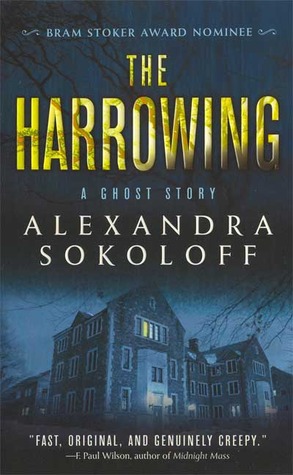
 The Halloween Countdown continues as Randy M. looks at Alexandra Sokoloff’s The Harrowing.
Join us in the Countdown to Halloween discussion thread
THE HARROWING by Alexandra Sokoloff (St. Martin’s Press, 2006; St. Martin’s Paperbacks, 2007)
It had been raining since possibly the beginning of time.
In the top tier of the cavernous psychology hall, Robin Stone had long since given up on the lecture. She sat hunched in her seat, staring out arched windows at the downpour, feeling dreamily disconnected from the elemental violence outside, despite the fact that every few minutes the wind shook the building hard enough to rattle the glass of the windowpanes.
Thanksgiving holiday and Robin faces a long weekend alone in Mendenhall, formerly a frat house, before that a mansion, with a broad stairway and trappings from paintings to door knobs hinting at the glamour of an earlier era. As other students abandon the dorm for home and family, Robin steeps in her own discomfort, feeling out of place and friendless. Only at Baird College for two months, she has yet to find a niche and struggles under a sense of unworthiness exacerbated by phone calls from her mother screaming demands to know why Robin hasn’t come home for the holiday, why Robin has deserted her, why Robin is ungrateful, a litany similar to the litanies Robin has heard before.
For a day and a half Robin haunts corridors long and dark, uneasy in her solitude, locking herself in her room at night rather than face the weight of silence and desertion in the mansion. She finally unearths her roommate’s hidden stash of Valium and Jack Daniel’s and descends to the lounge, only to find four other strays already there. Pills and purpose tucked away, bottle and a joint shared, Robin and the others start to feel each other out, and then one of them finds an Ouija board and with it the five students contact Zachary.
One blurb on the paperback proclaims the novel combines The Breakfast Club and Poltergeist, an inside blurb suggests a cross of The Breakfast Club with The Shining. As far as story elements are concerned, these comparisons aren’t far astray: five disparate personality types sequestered together; Mendenhall’s history includes the deaths of five students in a fire; odd, inexplicable things begin to happen; Robin and her companions feel a presence and under the pressure of surviving find reasons to live and to form bonds and alliances. If you’re allergic to young adult angst, The Harrowing might not be for you, but Sokoloff for the most part doesn’t dwell on it, sketching in enough for us to understand motivation and attitude as the behavior of these not-quite-children, border-line adults stems from their inadequacies, real or perceived. She mixes this with a bit of obscure (to me at least) Jewish folklore and proceeds from there with a story that kept me reading.
A screenwriter turned novelist, Sokoloff writes camera-ready prose – concise, direct, visual – so that the novel proceeds somewhat like a movie, in well-realized scenes giving a sense of a camera following Robin and the others. That feel put me off a bit at first, but Sokoloff’s empathy for her characters won me over. Not as emotionally involving or thematically rich asThe Haunting of Hill House and not as graphic and relentless as Hell House, still I found this novel diverting. Sokoloff drew me in, interested me sufficiently in her characters and provided a satisfactory resolution, albeit not one that surpasses the earlier build up with its moments of dread.
Dubious Dwellings:
The Shining by Stephen King
Deadfall Hotel by Steve Rasnic Tem
The Red Tree by Caitlin Kiernan
More distressed youth:
“The Body” & “Apt Pupil” by Stephen King (both in Different Seasons)
Sharp Objects by Gillian Flynn
The Snowman’s Children by Glen Hirshberg