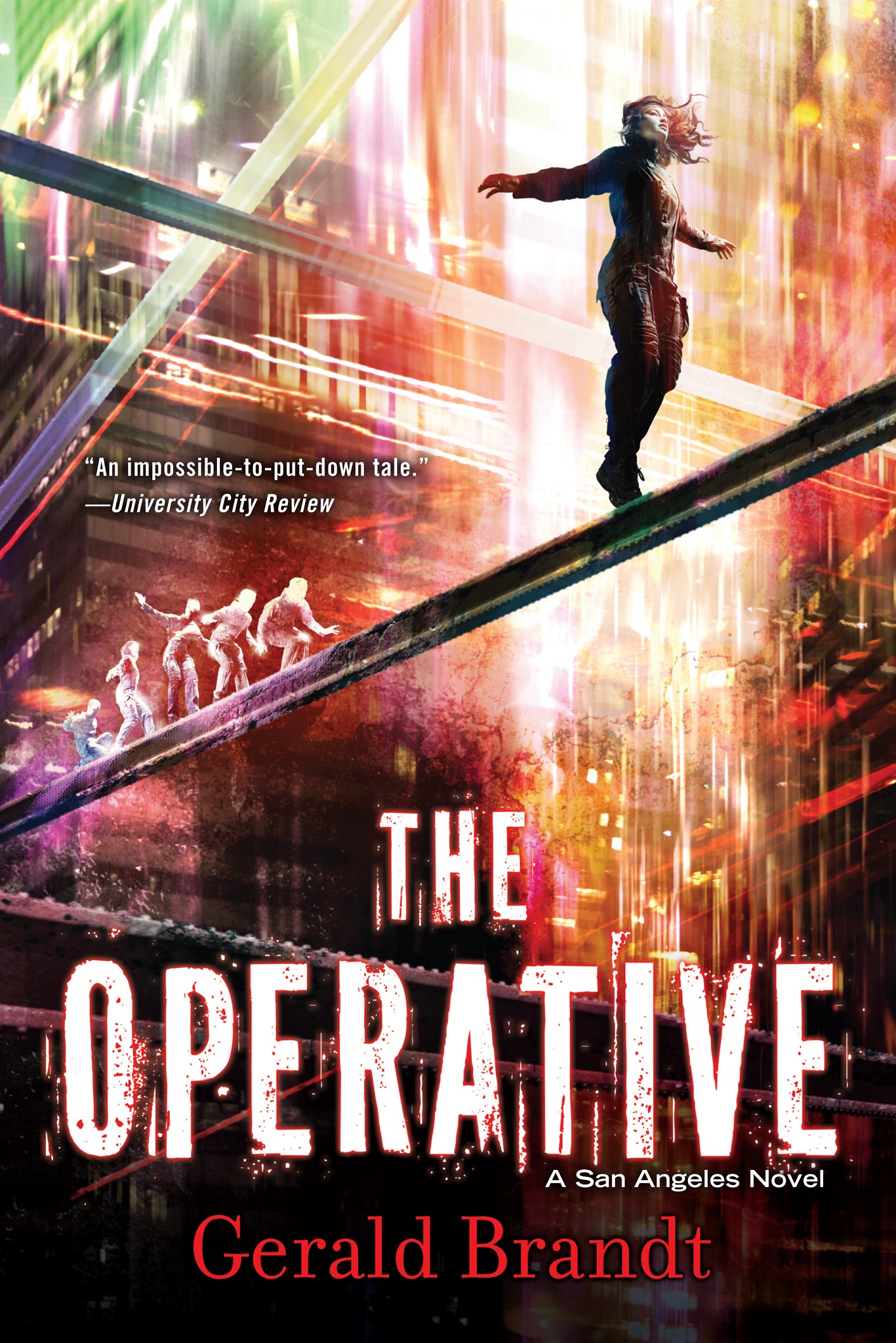
We’re very pleased to give you an exclusive excerpt as well as being able to reveal the cover for Gerald Brandt’s The Operative. The Operative is being released by DAW on November 1st and is the sequel to The Courier which was released earlier this year.
The Courier was the first novel in the San Angeles series and a cinematic sci-fi thriller set in a far future California that has been turned into a multilevel city where corporations rule. It followed Kris Ballard a motorcycle courier who witnesses a murder and must go into hiding with an underground resistance group. The Operative picks up right where The Courier left off, and is sure to be a hit with fans of cyberpunk and sci-fi action/adventure. (Excerpt below the cover)
Chapter 1
ACE Boot Camp, Kananaskis—Sunday, June 11, 2141 5:20 A.M.
The nightmares are the worst.
They are always the same: I wake up in total darkness, crammed into a wooden box too small to hold me. Every nook and cranny is filled with shards of glass and metal. My skin weeps blood from a million tiny cuts. When I lift my head, my forehead scrapes against the rough-hewn wood of the lid.
Outside the box I can sense someone moving. I try to shout, to let them know I’m trapped in here. To let me out. But I can’t. My breath freezes in my lungs, solidifying into a mass of fear so intense it threatens to explode from my body.
That’s when the first shaft of light pierces the box. I feel the bullet enter my chest, splitting my skin, pushing through my ribs, before coming to rest against my spine.
Another shaft of light. Another bullet. More drill through the box’s wooden top, until the fear melts into warm blood filling my lungs, drowning me in my dark coffin. I am dying. Can you die in a dream?
The lid opens slowly on well-oiled hinges, and all I can do is blink in the sudden brightness. My mouth opens and closes like a fish pulled from water. I can feel the hot blood running past my lips and down my cheeks, filling my ears. I gag, spitting more of the coppery, viscous fluid onto my face. Above me is a mirror, placed so I can see what’s left of my body as my life seeps away.
But the reflection I see isn’t mine. Instead it’s Quincy. The man I killed.
I told myself—keep telling myself—that it was in self-defense. That I’d had no other choice. It doesn’t make any difference.
Quincy lies in the small box, his skin sliced in a thousand places. His chest is a morass of blood and bone and flesh where the bullets—bullets that only moments ago I had felt—plowed into him.
And then the nightmare gets worse.
Quincy stares back at me, stares into my soul, and he begins to change. His black, beady eyes soften into hazel. His narrow face widens. His thin lips fill, curving into a persistent smile. It’s not Quincy in the box anymore. It’s Ian Miller, the man I love. The fine lace pattern of old scars on the left side of his face make him more beautiful rather than less. His hazel eyes—eyes I’d lost myself in so many times—slowly lose their light, until they are as dull as the Level 1 ceiling.
I used to wake up screaming. Thrashing in sheets wrapped so tight around me that it took two people to unwind them. My heart pounding so hard I thought it would burst through my chest. They moved me out of the bunkhouse until I learned to control myself better.
It took almost six months, half the time I’d been at the ACE training compound.
While the other ACE trainees bonded over bunkhouse chats and shared spaces, I learned how to squeeze more into the dark corner of my mind where I kept the other memories. Memories of being told I’d never see my parents again, of my uncle and aunt. Of Quincy’s handiwork.
I was moved to a small room off the cookhouse. I’d lock myself in early at the end of the day, avoiding the others, avoiding everyone. Sometimes I’d hear the other students come in for a late night snack, chatting and happy; smell the fresh coffee and biscuits the cook, Pat, made for them. All I had to look forward to was another agonizing night. After they left, I’d hear a soft knock on my door and footsteps walking away. Pat would always leave a little snack for me.
We’d all been here almost a year, and I was bunking with the others now. The beds, hard, lumpy, and smelly, reminded me of the halfway house I was placed in after my parents were killed, adding more fuel to the nightmares that still came almost every night. Only the screaming had stopped.
At the compound, I learned it helped to be outside, to feel the sun beating on my skin, the sky open above me. In winter, I walked from the bunkhouse to the cookhouse in just a t-shirt and shorts, wanting . . . needing to feel the wind and sun on my bare skin, no matter what the temperature.
There were no ceilings here, no putrid water dripping from the Ambients and girders, no recycled air. I’d grown to love the huge open expanse, no longer scared by a sky that stretched on forever. There was nothing to break the silent splendor of the mountains. Even transports were forbidden from flying overhead by the Canadian government, to keep the wilderness as pristine as possible.