
 As part of our Countdown to Hallowe’en 2016 and as part of his Blog Tour, SFFWorld is very pleased to welcome writer Mark Morris. Here Mark tackles that question often-asked of Horror writers: GORE! IS HORROR FICTION SIMPLY ABOUT BLOOD AND GUTS?
The horror genre has been a massive part of my life for as long as I can remember. I feel instinctively drawn to horror, and always have – by which I mean the monstrous, the weird, the supernatural. As a kid I loved monsters, because they were something different and startling, something ‘other’; they existed beyond the humdrum reality of this solid, dependable world of ours. I would eagerly devour stories about ghosts and aliens, because they hinted at dimensions beyond our own. They opened up possibilities; they made everything, our entire realm of existence, seem far more exciting and unknown than it actually was, or seemed to be. And yes, monsters and ghosts were scary, but mixed in with the fear and the disquiet was something deliciously thrilling, even awe-inspiring, that always drew me back to them.
 The uninitiated – people I meet at social gatherings who have no interest in, or knowledge of, the genre – regard me as though I’m something strange and dangerous when I tell them what I do. Say ‘horror’ to them, and they immediately think of teenagers being bloodily dismembered by a masked, chainsaw-wielding bogeyman, or vampires being staked through the heart amid lashings of Kensington Gore, or ravening monsters tearing people apart and eating their brains.
They think, in fact, of lowest common denominator horror. They think of the terrible violence that is often, if not always, associated with extreme evil. But gore is not the be-all and end-all of horror. Horror stories are often about good, or at least ordinary, people being pitted against the kind of intense evil we would hope never to encounter in our own lives, whether that be of human or supernatural origin. And, of course, a consequence of extreme evil is often extreme violence. It is, therefore undeniable that the threat of extreme violence, plus the sheer unpleasantness of witnessing it, or the results of it, frequently cause us to experience the emotions we associate with watching or reading horror – tension, apprehension, dread. But whilst violence and gore undeniably have a part to play in horror fiction, just as they have a part to play in crime fiction (there would be no sense of peril without it), a general reader coming to the horror genre for the first time, and perhaps expecting to step into the fictional equivalent of an abattoir, would, I think, find themselves surprised not only by the range of fiction on offer, but by how bloodless much of it is.
I’m not denying that there are gory novels and stories – in certain subgenres, like zombie fiction and serial killer fiction (which is actually more often regarded as crime rather than horror fiction), there is simply no getting away from it. But whereas extreme violence seemed almost a pre-requisite in much 1970s horror fiction, and in the ‘splatterpunk’ movement of the early 90s, modern horror fiction far more often than not associates itself with psychological dread – with fears that suggest, and hint, and prey on the mind. As Stephen King once said, the suggestion of what is behind the door at the top of the stairs is far more terrifying than the reality. Open the door and your monster has limits, parameters, potential weaknesses. But keep the monster out of sight and your imagination (and thus your sense of fear and dread) has no boundaries to contain it, and thus goes into overdrive.
So yes, whilst fear of pain, of disfigurement, of mutilation, of death, is awful, what we can’t see, and don’t know, is often even worse. At least death is an end to pain, a cessation of emotion, and therefore a release. But what if there was something worse? A suggestion that death will never come, and that the pain and terror will therefore never end? The most effective kind of horror fiction recognizes this, and strives to get to the heart of it.
So although the axe-wielding psycho is undeniably terrifying… sometimes there are even worse things waiting.
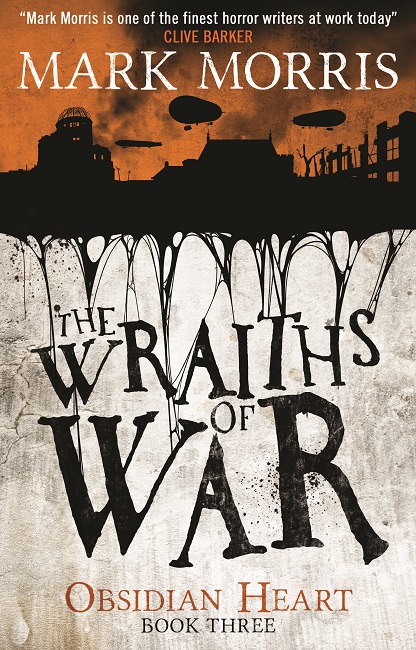
Mark’s latest book, The Wraiths of War, is now available online and in all good bookshops. Thanks to Philippa at Titan for helping sort this one.



Nicely said. Much of the horror fiction we regard as great is at its most effective when exciting anticipation rather than depicting deeds.
I normally do not like horror, but maybe…I’ll give Mark Morris’ story a try…maybe!
Have a look at my review of the first in the series, Nila, to see if its your sort of thing. It is different, though.