
 Joyland by Stephen King
Part of the Hard Case Crime series, Book 112.
Published by Titan Books, June 2013. (Review copy received)
ISBN: 978 178 1162 644
288 pages
Review by Mark Yon
Stephen King’s latest seems to have caused a bit of a stir. First of all, it’s currently a print-only novel (at least initially), something which has annoyed a few people now used to reading on their generic e-reader device. And secondly, it’s a noir-like crime novel, which is not what many general King fans will expect (although he has written there in the past.)
It must also be said that part of the publicity for the novel has been that there is… well, little or no publicity. I’ve had the relatively unusual experience of having to sign a non-disclosure form for this one, and it is very noticeable how little has been said about the book before its publication.
But then, to my mind, that’s not a bad thing. Joyland is a book that is meant to be read with no preconceptions, no baggage attached. It’s meant to be the sort of a story that a reader picks up at random, perhaps from one of those newspaper bookstands whilst about to embark on a long journey and looking for something to just pass the time.
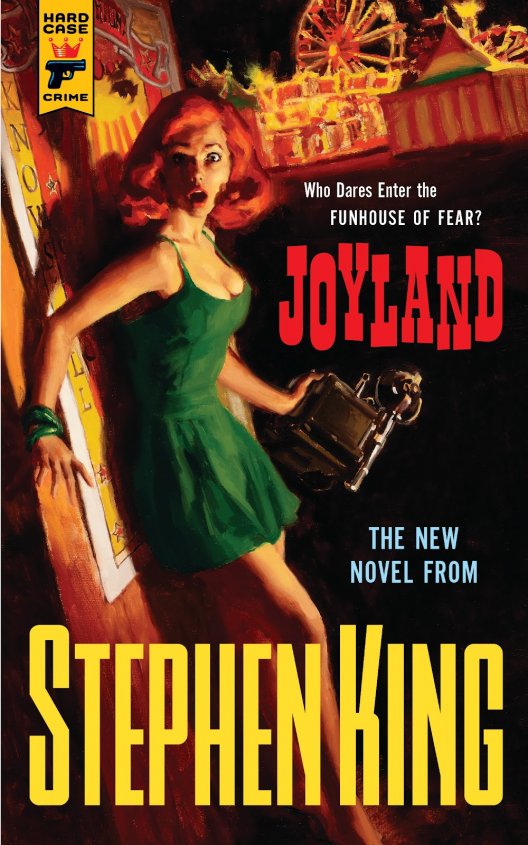
The deliberately lurid cover further emphasises this, drawn by famous noir-style artist, Glen Orbik. Once upon a time, had perhaps the lure of SK not been so enormous, I could see this being published as if by Richard Bachman or another pseudonym in order to avoid the preconceptions that just the author’s name may create.
By using evocative language and vivid imagery on the cover (shocked red-headed girl in a green outfit), Stephen’s made sure that readers are aware that it’s a pastiche. It’s meant to have the tone and physical properties of a cheap pulp novel from the 1950’s, although as it’s from Stephen, the style and intelligence of the plot elevate it a little from those potboilers of yesteryear.
With such elements in mind, the plot’s pretty simple. It’s a coming of age tale, a story of a young man (Devin Jones), with a broken heart, who takes on a summer vacation job in Heaven’s Bay at a rather seedy and run-down amusement park called Joyland. There’s an old tale of murder (for what old Amusement Park doesn’t have a tale of murder in its shadows?), and Devin has to deal with some hard and deep life-truths along the way. There’s also a touch of psychic prediction – “There’s a shadow over you”, the fortune teller Madame Fortuna tells Devin – which is reminiscent of other King tales, although much of the beginning of the book is Devin working through the summer, learning the carny ‘Talk’, nursing his destroyed ego and making new friends before deciding that he likes the carny life. He decides to stop on instead of going to college, which means that he stays at Joyland after the main summer season, as the park begins to wind down to season closure and refurbishment.
And then, like many of Stephen’s other ‘coming of age’ tales, what Devin discovers is something life-changing. The summer/autumn of ’73 is one that Devin never forgets, for many reasons.
And this too is a story that resonates with remembrance, and even loss. This is a King tale mainly set in the past, like 11.22.63, Blockade Billy, or The Colorado Kid, where the author manages to do that trick of his of recapturing that idealistic sense of a past, but then imbibes it with something dark. It’s another summer novel*, something that King does so well, like IT or Hearts in Atlantis or The Body. There’s also a definite Ray Bradbury vibe here, in that as we approach autumn there is that combination of romanticism with the hyper-reality of amusement arcades, alternatively brash light and deep blackness. It’s Dark Carnival, seen with a contemporary 2013 perspective. As Ray was both a fan of horror and crime novels, and Stephen a fan of Ray, it’s perhaps not surprising that the film-noir tone becomes prevalent here. And it works. It scores emotionally, romantically and stylistically.
In summary, Joyland is clearly written with love and respect, and won me over as a result. Admittedly, it’s not Stephen’s most original tale, but that isn’t really its point. As homage, I found it to be one of the more enjoyable stories I’ve read from Stephen in recent years. Whilst reading I imagined it as being in a seaside resort rather like Amity (in Jaws), with creepy IT coulrophobic** overtones, with a dash of the TV seriesCarnivale and a touch of Something Wicked This Way Comes via The Twilight Zone.***
It’s going to be a great seaside holiday read, and I can see it being read whilst sitting on the beaches of Summer 2013. There’s enough humour, romance, suspense and chills to move and amuse a fan.
Mark Yon, May 2013.
*I can’t be the only person who sees the reading of a King novel as a sign of summer? I used to begin my summer vacation with one, regularly.
**Go on: look it up… *grin*
*** And even, pop-pickers, Bobby Goldsboro’s Summer – The First Time.




Hmmmmm … I see Joyland in my future, maybe not long after I leave Christmasland.
I wonder if King and his son, Joe Hill, worked out something about these names?
Anyway, intriguing review. I had wondered if there would be a Bradbury vibe to a story about an amusement park, and hearing there is makes the book that much more intriguing.
Thanks, Mark.
Randy M.
Thank you, Randy. Pleased you’re piqued.
It’s not particularly complex, but it is told well. And some people have found Joyland quite emotional. But definitely tighter than, say, Under the Dome, more straightforward than 11.22.63.
I have read some comments that say it might be suitable for Young Adults. Not sure myself.
M.
I’ve finished it now. It’s actually very good.
Pingback: LATER by Stephen King – SFFWorld