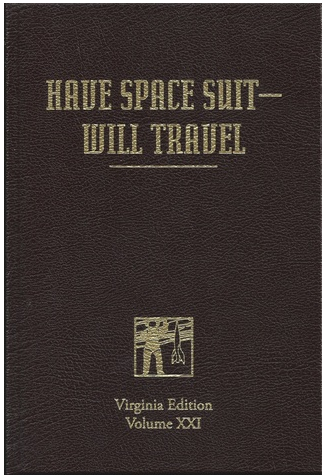
 “You see, I had this spacesuit.” Mark continues his intermittent re-read of Robert Heinlein’s novels through the Virginia Edition series.
It is with shock that I now realise that we have reached the last of what are regarded as Heinlein’s so-called juvenile novels (although there is some debate over whether Starship Troopers and Podkayne of Mars, a much later novel, count as well.)
It is not an easy read for me. In my last re-read (Citizen of the Galaxy) I felt that the skill and the sheer entertainment of the novel encapsulated the author’s work, and that despite a feeling that we’d seen much like it before, Citizen may be seen as one of his best.
By comparison, my memories of reading Have Spacesuit… are not as positive, for reasons I will explain later. This is one I haven’t re-read much since first reading it, though I have read many other Heinlein more than once.
This may be a surprise, as all of the now-traditional aspects seem to be there. According to one of RAH’s biographers, William H. Patterson, Have Spacesuit…. is summarised as a story “that framed all his (Heinlein’s) concerns about intellectually-soggy American youth in a story about a space-struck boy accidentally prepared to take advantage of the slings and arrows fate threw at him amid the game shows and jingle contests that made up American television in the 1950s – and let the boy stand up as a proud representative of humanity in a kangaroo court of aliens.”
It is for those elements that Have Spacesuit… is often regarded by many professional writers as Heinlein’s best – or at least one of them near the top. Dr. Robert James, often co-writer of the Introductions in these Virginia Editions, has said:
“Have Spacesuit, Will Travel is widely regarded as one of the finest books Robert Heinlein ever wrote (which is to say, one of the finest works of science fiction, and one of the finest books ever written for young adults, particularly teenage boys).
Repeatedly, I have been told by students and fans that this was their favorite of all the Heinlein juveniles (the series of novels Heinlein wrote for what was then called the juvenile market, published by Scribners between and ended by their rejection of Starship Troopers). In terms of sheer readability, this is more than likely the best entry point for a reader who has never encountered Robert Heinlein; for readers who may not have the vocabulary and reading level required for many of his other juveniles, this is the easiest of the juveniles to read. Have Spacesuit, Will Travel is as close to a perfect book for all ages as any writer has ever reached.”
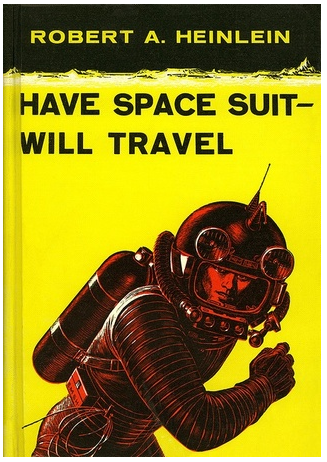
This is praise indeed. However, on rereading I must say that I’m not quite as glowing about the book as those comments. I had issues with it, which I will discuss here, and my hopes that it would improve on a re-reading don’t seem to have materialised.
But let’s start with a positive. The very first sentence shows how good Heinlein could be at engaging the reader:
“You see, I had this space suit.”
Deceptively simple, instantly attention-grabbing, in seven words this shows that impressive knack that Heinlein had of making the reader want to read more. It makes you think, “Where from? Why? How?”
I must admit, as I re-read the first couple of chapters, there was a lot I liked. I was impressed that despite what I expected to happen, the plot develops in unusual ways. Whilst the prize is earned by creativity and hard work, Heinlein is clear to point out that it is definitely not an automatic consequence of our hero Kip Russell’s actions. It is noticeable that despite all of Kip’s hard work he got his spacesuit as one of the runners-up in a television contest, by sending in thousands of soap wrappers to the TV station with a catchy slogan for each one. This is not the pioneering brave new world exemplified by Space Cadets of earlier novels, but one where the power of television holds sway over the masses – sound familiar, anyone?
Heinlein doesn’t miss a chance to have a dig at the visual medium – this may be based on his personal experiences on the Tom Corbett Space Cadet series (see also Space Family Stone.) Indeed, I noticed almost straightaway, perhaps more explicitly than before, RAH’s railing at the state of things.This is shown in the first chapter when Kip endures a lecture from his father about the poor quality of the education he’s receiving:
“It’s my fault, not yours. I should have looked into this years ago — but I had assumed, simply because you liked to read and were quick at figures and clever with your hands, that you were getting an education.”
“You think I’m not?”
“I know you are not. Son, Centerville High is a delightful place, well equipped, smoothly administered, beautifully kept. Not a ‘blackboard jungle,’ oh, no! — I think you kids love the place. You should. But this — ” Dad slapped the curriculum chart angrily. “Twaddle! Beetle tracking! Occupational therapy for morons!”
This is Heinlein unleashed, in his lecturing rant mode that we see more of in his later work. We seem to have turned a corner here, and so it is not much of a leap from this to, say, Starship Troopers or the later adult books. It is perhaps where we begin to see more explicitly that Heinlein may be less concerned with telling an entertaining tale and more about communicating a message. This will be discussed again later.
Perhaps more worryingly, it is when things get further underway, after Kip’s retrieval and repair of the well-used spacesuit, that I found myself beginning to become unhappy, particularly with the plot. To illustrate this, here I’ll refer to the back of the US Ballantine/Del Rey edition for a summary:
One minute Kip Russell is walking around his own backyard, testing out an old space suit and dreaming about going to the moon–the next he is the captive of a space pirate and on his way to the very place he had been dreaming of. At first, the events are so unreal he thinks he might be having a nightmare . . . but when he discovers other prisoners aboard the spaceship he knows the ordeal is all too real. Kip and his fellow abductees, the daughter of a world-renowned scientist and a beautiful creature from an alien planet, have been skyjacked by a monstrous extraterrestrial who is flying them to the moon–on a journey toward a fate worse than death. . . .
Whilst there are definitely parts that should sound familiar to anyone who has read other Heinlein novels, this is not the usual RAH plot, written with care and attention to detail. Indeed, in places, even to my young teenager-self it begins to read as a Space Opera plot of the simplest kind, of the ‘one bound and he/she was free’ variety. First of all, there is the gi-normous plot coincidence that out of all the places in the entire planet and at that particular time, Kip playing in his repaired spacesuit is conveniently heard and then mistaken for a real radio transmission, with the consequence that he is taken captive and abducted from Earth by an alien, something that even when not summarised as such stretches disbelief.
And then to compound issues there is the arrival of ‘Peewee’, the eleven-year old girl-genius. Clearly both intelligent and supremely irritating at the same time (even the nickname grates!), this character deeply annoyed me on my first read and, sadly, nearly as much this time around. And the plot contrivances begin to accumulate – not only does this young girl manage to kidnap a spaceship, she is able to fly it to where Kip is and land it (admittedly not well).
Later Kip and Peewee are left alone as hostages on a spaceship on the Moon, which they unsurprisingly attempt to escape from. Why would you leave two wanted and valuable hostages on their own other than to create a plot point?
Whilst I appreciate Heinlein once more giving girls a central role in a male-dominated readership, Peewee still reads as a slightly jarring portrayal. More than any other representation of a young girl I’ve read in RAH’s juveniles, Peewee seems forced and unrealistic, nearly destroying my sense of self-belief that Heinlein is usually so good at developing. What I was hoping was that my remembrance of her being irritating was due to my teenage experiences to that point. But no, she is almost as bad thirty-plus years later, this time around.
The only difference now though is that by reading the books in roughly chronological order, and knowing what has gone before in earlier novels, I can see that the character is an understandable development. (It also makes me think that Peewee is an early variant of Podkayne, though admittedly Podkayne is a much more realistic character, in my opinion.) Rather troublingly, biographer Patterson says that Peewee is written partly in tribute to Ginny and that this novel is one that Ginny was more involved in, checking mathematical calculations and creating the musical speech for the alien Mother Thing.
Most worrying by this point I am starting to feel that Heinlein’s going through the motions a little. This is the first novel, with the possible exception of his first, Rocketship Galileo, where I have felt that Heinlein was writing down to his audience, and that more than any other book in his juvenile series, felt more like a book deliberately written for younger readers. At times, it seems almost condescending, something I’ve never really noticed with the other re-reads.
Such a reaction leads me to beg the question: Was Heinlein tired of writing such novels? It may be unlikely, as things were beginning to look up for the Heinleins at this stage of their lives. According to Volume 2 of William Patterson’s biography, by mid-1957 Heinlein’s health was improving and Ginny, after a number of surgical operations, was doing so as well. Both were looking forward to foreign travel to the Far East and India towards the end of the year. Though he did “his usual careful research and presentation”, once he had the initial idea it seems to have been one that made fairly easy writing.
Unfortunately to me this ease of writing also makes me feel that we’re on familiar ground here. It may be that with the pressure on, Heinlein was determined to get the book finished before their travels. The court scene at the end is like that of the trial in The Space Beast, for example. Even the alien ‘Mother Thing’, a form of life determined to save Peewee and Kip as well as the human race from an ignominious end, seems to echo Lummox of The Space Beast or even the Martians of Red Planet, with a nod in the direction of EE ‘Doc’ Smith’s shapeless, formless Arisians.
My problem seems to be that Have Spacesuit… at this point seems to be more about recycling old ideas, though admittedly still with style, than producing a credible set of characters and plot. The bad-guy aliens, known here as ‘wormface’, are appropriately but perhaps simplistically evil. Having clear designs on planet Earth for conquest, and possibly as a food supply, Heinlein leaves us in no doubt that some alien species out there are bad and Kip and Peewee are fighting not only for their own lives but also for the future of the planet. We seem to have almost gone back to the writing of Rocketship Galileo, but fighting aliens instead of Nazis. Had this been the first Heinlein I read as a teenager, I’m not sure I would have read more.
Luckily for me, things seem to improve slightly by the end of the novel and we seem to be on firmer ground towards the book’s climax. The last part of the book shows Heinlein on more recognisable concepts.
If there is a ‘message’ at the end of the tale it is a positive one – that Mankind’s future is in space and that we deserve to be there. I suspect that for a forward-thinking teenager of the 1950’s, it is a call to arms that is appropriately uplifting and one that could be seen as stridently, even provocatively American in outlook. If ever there was a rallying call for the future of space exploration then this could be it. The novel’s message is clear, it’s ending positive, and for that reason I can perhaps see why it was nominated for a Hugo Award in 1959.
In the introduction to this Virginia Edition, William Patterson states that he thinks that the reasons for this need to explicitly proclaim a message in Heinlein’s writing was due to both a noticeable decline in US education (mentioned earlier) and the launch of Sputnik by the Russians as Heinlein was finishing writing this book.
In an impassioned letter to his long-suffering editor, Alice Dalgleish, at this time Heinlein made his feelings clear – that America, both physically and ideologically, was critically at risk.
It is no coincidence, as noted by Patterson, that the friend who Heinlein dedicated the book to, G. Harry Stine, had been fired from the Martin Company (later Lockheed-Martin) for commenting about the superiority that Sputnik, launched in October 1957 and ahead of the Americans, gave the Russians in space.
It seems that whilst Heinlein was defending the need for quality young adult fiction, he had also begun to believe that his future writing career was writing for adults where such values could be given relatively undiluted.
Clearly the world, and Heinlein’s own attitude towards it, had changed and this would be reflected in Heinlein’s future work, starting with Starship Troopers in 1959.
So, with all this in mind, how to sum up? In short, Have Spacesuit… shows many of the author’s strengths and in particular to write uniquely stylish, entertaining and engaging science fiction. As I have said above, it is not one of my personal favourites, but whilst I may not be quite as glowing as Dr. James at the beginning of this review, I would grudgingly agree that it still better than most work of a similar nature at the time, showing sheer readability and a narrative that drags you in. Despite some evidence of dating, its success is that it engages with universal concerns that may be as relevant today as they were in 1958. Personally, I would start somewhere else, but there are others (see Dr James, above) who would suggest the opposite.
———————————–
With the summary of this novel I can now draw these reviews to a close (though I know I have a Podkayne review around somewhere…) Overall, over the last eight years or so I have enjoyed these rereads. They have shown me how a writer evolves and hones his skills with effort and perseverance and that reader’s perceptions can differ and change through time.
Despite the relatively minor weaknesses I have noticed, it has, on the whole, been a lot of fun. I suspect that I will keep rereading these, though with less of a 30+ year gap than before.
And now… to the more challenging, so-called ‘adult’ reads…
Mark Yon, August 2016 – February 2017.
Have Spaceship Will Travel by Robert Heinlein
Originally serialised in The Magazine of Fantasy & Science Fiction (August, September, October 1958)
First published August 1958 by Scribner’s
ISBN: 9781897350263
Volume XXI (21) of the Virginia Edition
192 pages