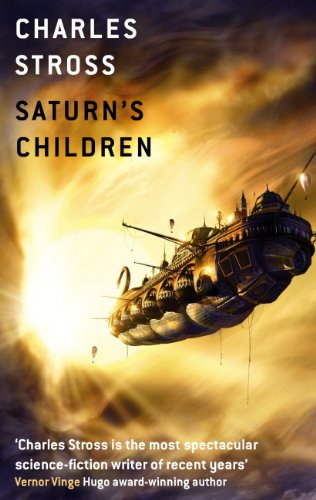
Saturn’s Children
In a future Sol system where humankind is long extinct and only robots remain, society consists of slavers and enslaved; a society the robots have inherited from their Creators, who modelled robots on themselves and programmed them to serve. Elite robots have stepped into the gap left by their human masters, and Asimov’s
Three Laws of Robotics are nullified (these are stated at the beginning of the book and presumably apply in this world).
Despite the lack of human characters, there is still a high degree of individuality and human character in the robots. For example, at the start of the book the main protagonist, Freya, a sexbot originally designed to pleasure humans but now, she feels, with little purpose in life, is contemplating suicide by jumping from the balcony of a pleasure palace floating above Venus. In this respect, she can exercise free will, but her choices are limited by her programming and in other situations her programming takes over and are beyond her control. Even so, her thinking is still very human.
To me, the post-human setting was an interesting one. It was surreal, at times, yet was tempered by the realities of travelling around the solar system without the usual SF tropes of wormholes or superfast drives and was always governed by the exigencies of physically available space, cost and flight duration. On one of her journeys between planets Freya remarks 'Space travel is s**t.' and in this book it certainly seems so. The story itself is mostly entertaining and enjoyable, though it does become less so as it progresses and could have done with a more exciting ending. For myself, I enjoyed the journey around the solar system most of all.

. Then I went looking for The Kaiju Preservation Society and discovered that it isn't out yet.