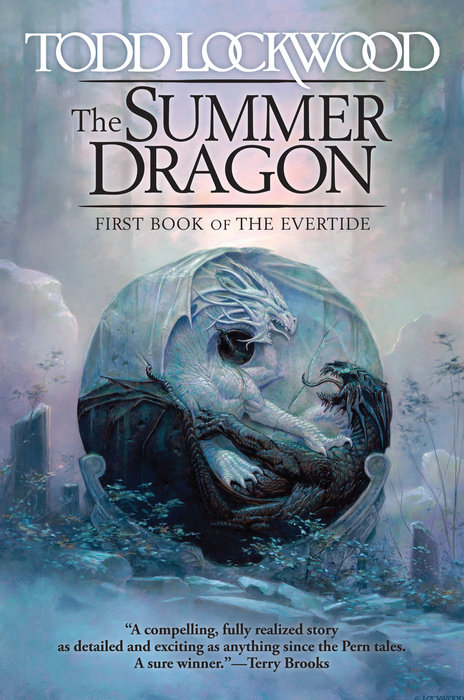
Todd Lockwood, painter, artist, and creator of many draconic images for book covers has just released his first book in the Evertide series, The Summer Dragon. Recently also reviewed here at SFFWorld by Rob Bedford.
Welcome to SFFWorld Todd, many thanks for giving us some time here.
You have written some short stories earlier, but this is your debut novel. Is this something you’ve always wanted to do?
It is. I grew up writing and drawing. You might say that I learned to write by drawing, and to draw by writing. I made my own comic books to entertain myself.
I started a novel in my twenties, called Ring of Moons. It’s still kicking around here somewhere. I wrote entirely in longhand, and when my illustration career started to pay the bills, transcribing it in an age before computers or even reliable word-processors made it daunting to finish. I probably never will—its time has passed, though I liked the ultimate story. I need to talk about other things now, though, and the series of The Evertide will let me say what I want to say.
Tell us about The Summer Dragon, what inspired the story?
The Summer Dragon was inspired by my desire to pillory some bad trends in the world, but in a creative way. Once I knew who my victims were, I needed a vehicle. I planned honestly as an art book, a big volume with lots of illustrations in it, strung together with a simple narrative. I figured that since I like dragons and was already known for my dragon art, I’d tell the story of a Dragon War (that was the working title in genesis), and since I’d be painting the protagonist a lot, I wanted a young woman. But when I started writing the backstory, my long-slumbering writer’s muse was awakened, and she was hungry.
Maia, your main protagonist, is a headstrong girl who acts on her emotions like any character her age, but she also has a good head on her shoulders. What was important for you when you created this character?
I really needed for Maia to be real and relatable. If dragons are the vehicle, then she’s the driver. And I needed a character who could navigate this dragon war from beginning to end and teach the reader about her world by learning about it herself. I truly got excited about her when I decided that I’d begin with a beginning—her acquisition of a qit, or baby dragon, and came up with the dragon-breeding aerie that is her home. From there, having worked out a world and a conflict in nascent terms, her story practically told itself.
How was it to design the cover for your own book?
It was great fun, though I have to admit that I struggled with deciding what this image should be for the longest time. Normally, I know by a third of the way through a manuscript what the cover for a book should be. Not so for my own book. A friend who’d read early drafts had to tell me that it was the statue in the ruins. As soon as he said it, I knew he was dead right.
When did your fascination with dragons start?
One of my earliest childhood memories is of Maleficent turning into the dragon, in Disney’s Sleeping Beauty, as seen through the windshield of the family car. We were at a drive-in. I was probably three. It was like she was right outside the car! Very exciting. Any movie with monsters in it intrigued me, and of course I was a dinosaur geek. Dragons are a fantasy extension of that fascination with creatures larger and more dangerous than anything living today. When I went to work for the folks who make Dungeons & Dragons (TSR and then Wizards of the Coast), I got to work with dragons in a much more intimate way, to consider the ecology of something so impossible and how it could be made believable.
You also have some wonderful pencil drawings inserted throughout the narrative. Was it important for you to add this element to your book?
As I mentioned before, in the beginning this book was meant to be mostly art. When the story became so much more important to me, I discovered that too many illustrations actually slowed the narrative down, so I devoted myself entirely to the writing first. Then, while the book was in edits, I revisited the imagery, polishing up the map and plotting a series of interior illustrations. I knew that fans of my art wouldn’t forgive me for a book without illustrations, but I saw it as a boon to readers who might never have heard of me too. More than that, I grew up with my dad’s copies of classics like Robin Hood and Treasure island, which had color plates tipped in, with art by the likes of NC Wyeth and others. I wish all books—especially fantastic literature—had illustrations in them more often. New editions of some classics are making a reappearance, perhaps in part to justify a paper product, not just a digital file. But art and words go together in my mind. Good illustrations make a good story even more immersive.
Looking back, what has been your favorite and least favorite part of the writing process?
Writing and illustrating The Summer Dragon was like being a kid again. Invention and exploration. Make-believe was my happy place throughout childhood. Having complete control over the arc and look and content of the story is liberating. I played to my oldest audience—me.
There were some struggles. Another publisher early on got wind of my project and wanted to have a crack at it. But they also wanted to dictate what I did and how I did it. They wanted to change Maia into a boy, for starters (“Boys won’t read girls, but girls will read boys,” they said), and they wanted me to rewrite in third person, which I didn’t want to do—I had very specific reasons for choosing first-person. I spent several months writing up an alternate story in the universe, a sort of prequel, that would let me preserve Maia’s tale, then waited a year for their offer. They wanted a specific word-count and an illustration on every page and a cover that they wouldn’t commission separate from the advance, and the advance was less than they normally paid me for a cover alone. I had no choice but to turn them down. It left me depressed and angry about writing and publishers and I didn’t look at The Summer Dragon again for another year. It was instructive, though. It taught me that if I was going to succeed as a writer, I had to do it on my own creative terms. Otherwise, it wouldn’t be sincere, and if it wasn’t sincere, it wouldn’t be fun.
What books and authors have influenced your writing and what authors do you enjoy now?
My favorite book of all time is To Kill a Mockingbird, by Harper Lee. Perfection. There was a book in my elementary school library that I read multiple times (it was illustrated, too, now that I think about it) that told the tale of a young lion who grows to maturity, contending with other lions and fires and drought and Masai warriors. I couldn’t tell you the title or author now. I devoured science books, especially astronomy and paleontology. I fell in love with science fiction books and movies early on. Alfred Bester, Isaac Asimov, Robert L. Forward, Poul Anderson, and others. The Mote in God’s Eye, by Larry Niven and Jerry Pournelle ranks high on my list of favorites, as does Childhood’s End, by Arthur C. Clarke. The movie Planet of the Apes and its first sequel Beneath the Planet of the Apes awakened my awareness of politics and world conflict. Anything that left me thoughtful about humanity or inhumanity, truth, and man’s place in the world or even in the universe would suck me in.
Later I discovered Tolkien, Robert E. Howard, H.P. Lovecraft, and Edgar Allen Poe, who dissected those same questions with a different edge to their blades. Ursula K. LeGuinn, Andre Norton. Ray Bradbury above them all combined science-fiction, fantasy, and horror with a truly deft hand.
I devoured a lot of Stephen King, more for the way he wrote people than for his story lines, though the Walking Man in The Stand is one of the most terrifying characters in all of fiction.
I ate up the works of Joseph Campbell as well. Transformations of Myth Through Time remains in the top spot for its influence on my life and thinking. Very nearby is Zen adn the Art of Motorcycle Maintenance, by Robert M. Pirsig.
I find fiction difficult to read these days, oddly, though I powered through The Water Knife, by Paulo Bacigalupi, and A Walk in the Woods, by Bill Bryson—two very different books and writers. Laura Hiilendrand’s Seabiscuit is absolutely enchanting. Near-to-hand as I write this are Iranian Rappers and Persian Porn, by Jamie Maslin, and The Ultra Thin Man, by Patrick Swenson. I guess you could say my reader’s diet is pretty varied.
When can we expect the next book in the Evertide series? Do you have the whole series planned out already, anything you can reveal?
I hope to have the manuscript finished in the next year. The outline is fairly solid, ready for me to tackle—I just have to pay some bills first. The series will be three books, as currently planned, each with two parts that are more or less complete narratives in their own right, much like The Summer Dragon. That came about because I’d originally plotted out six shorter books, thinking that I could keep up a delivery pace better and that people are busy and might do better with shorter installments. My editor, Betsy Wollheim, convinced me to combine every two books and make it a three book arc instead. She was right to do so; they pair up well, and it made The Summer Dragon a much better book in the end.
Once again, thank you very much for your time.
It was my pleasure! Thank you!
*****
Interview by Dag Rambraut – SFFWorld.com © 2016