

 The Gollancz Black Leather library editions continue with this welcome hefty tome. Robert Ervin Howard is, of course, perhaps best known for the character of Conan and his world of Hyperborea, which have already been released in such an edition.
However, less well known are the other characters created by Howard in his sadly short writing career, whose stories were often published after the author’s death. (Howard took his own life at the age of thirty, in 1936.) Here we meet a diverse range of the other characters, from the Puritan Solomon Kane to Kull the King of Atlantis and Brak Man Morn, the rebel.
As befits the other books in this series, this is a lovely edition. Yet, lovely as it is, it is not the accouterments that make the book, but the writing within that makes this book a treat. Though the names here are less well known, there are tales, ideas and characters here that are, dare I say it, at times better than the Conan stories.
The book does show its origins however. Howard was published professionally for a mere twelve years in his lifetime, work written for the pulps at a ridiculously low rate and at astonishing speed. Consequently, names become a little interchangeable and situations become increasingly frantic after dashing from one set piece to another. This was what the pulp readers wanted, divided into chapters or kept hanging until the next instalment next month or a few months after. Howard was writing for a prescribed audience and was writing to be sold for entertainment with few pretensions.
As some of the tales are over eighty years old, the purple vocabulary is passionate but can be a tad wearing: rather like spending time with a hyperactive relation, I suspect – at first rather exhilarating, but after a day or so of intense exposure rather exhausting
When in such a huge tome as this, the hyperventilated enthusiasm can become repetitive and formulaic if read in large chunks. It may be better to read only a story or two at a time and then have a break: I found this similarly with Lovecraft and Howard’s Conan, for the same reason.
Some readers may also find issue with the reflected cultures of the 1920’s and 30’s. We have African cannibals and jungle savages in the unexplored territories. The issue of ‘the noble savage’ is not really addressed here, but rather slaughtered instead as a means of entertainment. This will not sit easily with many, though it can perhaps be seen as a reflection of some views at the time of writing. (That does mean, sadly, a lack of good female characters.)
On the more positive side, what you do find here is a much broader range of tales than you get in the Conan canon, from the historic to the action-epic, from the precursor of the sword-and-sorcery tale to the Lovecraftian supernatural tale. (Howard and Lovecraft were constant correspondents.)
Considering all of the limitations that were imposed upon them, I was surprised how varied the tales were in tone: written at such speed, I was expecting a book much more homogeneous. There’s adventure tales, horror stories and historical narratives here that suggest that there’s more to Howard than just Conan. (I’ve put a full list of the stories at the bottom of this review.) Howard’s first ever published story, Spear and Fang, from Weird Tales in 1925, is included here. Though it is a rather unremarkable caveman tale, published at the age of 19 it hints at what is later to be published. More appropriate to his skills, Solomon Kane, a 16th century Puritanical preacher seeking to destroy all sins, is a memorably sombre character as he travels the USA, England, Germany and Africa fighting ghosts, vampires and slave traders. In the seven stories and one piece of poetry about Kane given here, nearly all of the Solomon Kane stories, we see an often dis-likeable character with a righteous cause, who will stop at nothing to defend what he sees as right.
Of an older historical time, the four stories of Brak Man Morn included show a tortured character that David Gemmell would’ve been proud of, the King of the beleaguered Picts, fighting Celts, Romans and (in typical Weird Tales style) the odd Lovecraftian monster. Kull the Conqueror, the exiled Last King of Atlantis and Ruler of Valusia, is the less complex, earlier template for Conan that in three stories seems more like the movie version of Conan than the Conan novels do. Sailor and boxer Steve Costigan fights both pirates and evil monsters from the ocean depths that would eat Captain Jack Sparrow for breakfast. The novel-length planetary romance Almuric tells of Esau Cairn, a muscular character of Earth displaced to a different planet and a hero not that dissimilar from Edgar Rice Burroughs’s John Carter. Also not too far away from John Carter, James Allison is a character from 1930’s Texas* who, rather like Michael Moorcock’s later Eternal Champion, lives as a hero in many previous lives. Heroes and adventurers all, broad in range and yet similar in style, they are the epitome of pulp fiction, showing all the strengths and weaknesses of the time.
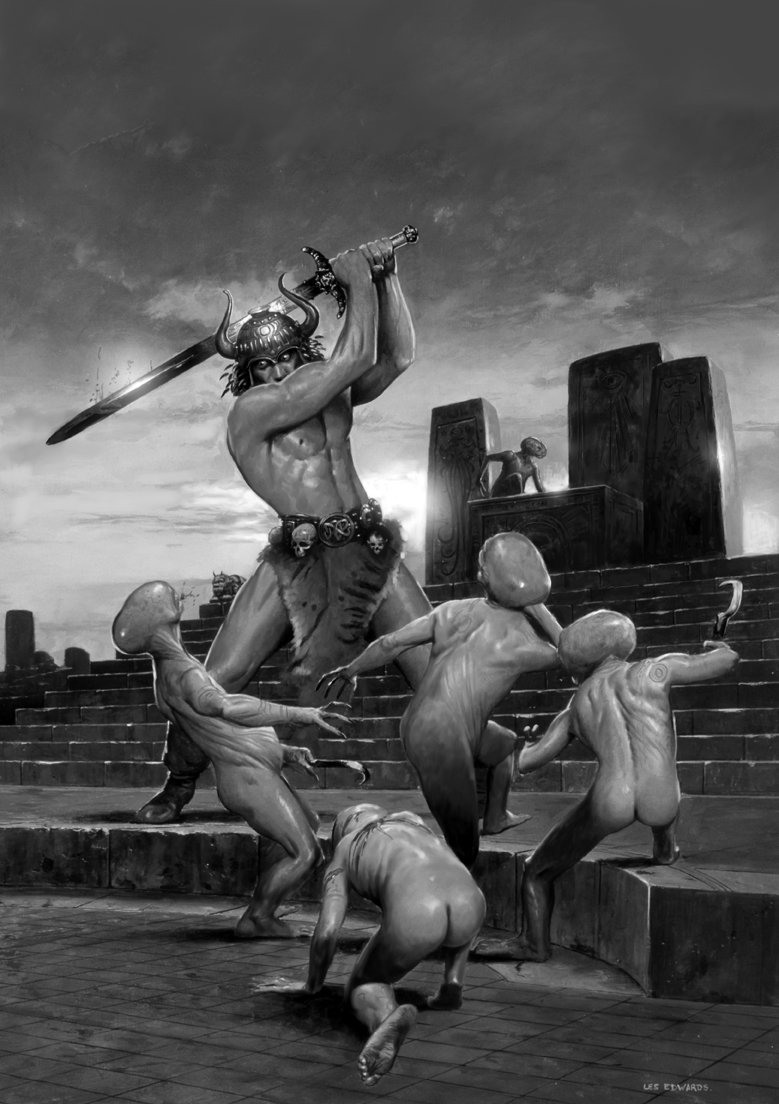
However, furthermore on the plus side, the details included as extras are worth noting. We have to start with an Introduction written by Howard to fellow writers Harold Preece and H P Lovecraft explaining the context of his characters. Howard was often interested by outsiders, by people of different races and in particular, the ‘small, dark, Mediterranean (?) aborigines of Britain.’ Here he tries to explain his interest. It is fascinating, if rather politically un-correct reading. The drawings throughout from Les Edwards are, as ever, sympathetically presented throughout and nicely done generally in black and white. (There is a Frontispiece in my edition – see picture, left.) The Afterword by horror writer Stephen Jones makes a nice counterpoint to the one written by him in the Conan edition, though as you might expect there is some repetition here for the benefit of those who have not experienced Howard before.
In summary, it must be said that Conan’s Brethren does reflect its age. It’s full of action and yet talky, enthusiastic, naïve, overblown and even at times clumsy. Nevertheless, once again by reading these tales I’m reminded by what a loss to Fantasy Howard was, and wonder what he could have achieved with a few more years of experience and work. The book is a testament to the skills of an imaginative writer whose efforts influenced many of today’s contemporary writers. If you want to see where George RR Martin, Karl Edward Wagner, Mike Moorcock, Fritz Leiber and many others got their inspiration from, it is important to read this book. And this edition does the work justice.**
Recommended.
*Perhaps based on Howard himself – living in Cross Plains, Texas, he enjoyed gym training and often took part in boxing matches.
**Later edit: Since this review was written, the book has become available on the Kindle and other e-book readers.
Full Story list:
INTRODUCTION by Robert E. Howard
Solomon Kane
SOLOMON KANE’S HOMECOMING (verse)
RED SHADOWS
SKULLS IN THE STARS
RATTLE OF BONES
THE MOON OF SKULLS
THE HILLS OF THE DEAD
THE FOOTFALLS WITHIN
WINGS IN THE NIGHT
King Kull
THE SHADOW KINGDOM
THE MIRRORS OF TUZUN THUNE
THE KING AND THE OAK (verse)
Bran Mak Morn & the Picts
THE LOST RACE
KINGS OF THE NIGHT
THE DARK MAN
WORMS OF THE EARTH
Savages, Swordsmen & Sorcerers
SPEAR AND FANG
HAWKS OF OUTREMER
THE GODS OF BAL-SAGOTH
THE SOWERS OF THE THUNDER
LORD OF SAMARCAND
THE LION OF TIBERIAS
THE SHADOW OF THE VULTURE
THE VALLEY OF THE WORM
THE FROST KING’S DAUGHTER
THE GARDEN OF FEAR
GATES OF EMPIRE
ALMURIC
THE GHOST KINGS (verse)
AFTERWORD: KINSMEN OF CONAN by Stephen Jones
Conan’s Brethren by Robert E. Howard
Published by Gollancz, January 2011 (Black Leather edition)
ISBN: 978-0575089877
722 pages
Mark Yon, February 2011/ Updated May 2016.





I’ll have to get that. Despite the obvious flaws noted above, Two Gun Bob had few peers when it came to writing great nuts-and-bolts adventure stories of any kind. His other series characters were just as good as Conan, and deserve this kind of exposure themselves.
Thanks David. I was pleasantly surprised myself when I read it.