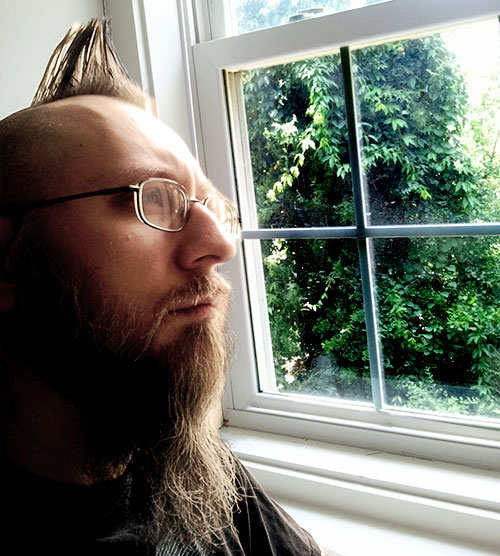
Gary Ballard is the author behind The Bridge Chronicles, a near future cyberpunk series set in Los Angeles. We’ve talked to him about the series and his future plans.
Welcome to SFFWorld, Gary. Many thanks for giving us some time here. First of all for those not familiar with your Bridge Chronicles series, can you tell us a bit about it?
The Bridge Chronicles is a near future cyberpunk series set in Los Angeles of the late 2020’s/early 2030’s. The main character is a underworld fixer named Artemis Bridge, the go-to, know-who guy whose reputation has earned him the nickname the Amoral Bridge. You need something illegal or immoral, for a small finder’s fee, he knows a guy that can get it for you. The United States has been sold off piecemeal to corporations like Chronosoft, Inc., who currently control every aspect of city and county government in Los Angeles and Southern California. Over the course of five novels and a short story compilation, Artemis Bridge gets involved with the corporate-controlled mayoral elections, discovers modern-day wizards known as the technomancers, tries to prevent ethnic cleansing on the minority gangs of LA, and rescues a runaway assassin from a centuries old Japanese death cult. In the latest novel, Reclamation, he is brought in to rescue a notorious, mythical gang of hackers trapped on a derelict oil tanker, a group with history dating back to a war zone almost two decades earlier. If you like stylish noir with near-future cyberpunk themes, you’ll love the Bridge Chronicles.
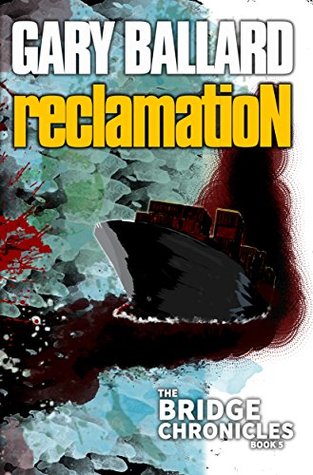
Reclamation, which is your latest Bridge Chronicles novel,has just been released. What can your fans expect?
Reclamation originally started out as a second compilation of short stories set in the universe, with Bridge being a peripheral figure. As I started adding stories, I realized that I was really writing one connected story that just happened to span almost two decades. Fans of the earlier books in the series will love some of the historical events that I cover in the book, from the first public appearance of cybernetics during the 2018 Venezuelan War to the creation of a mythical band of hackers called 4NAsia. Though he is the “main” protagonist of the series, he actually only appears in about 1/4 of the story. Fans of the series will be happy that other supporting characters get more “screen time” as it were, especially a section dedicated to fan-favorite character Aristotle as well as more on the Bottle City Boys.
What do you find fascinating about cyberpunk? Any authors and books that have been a great inspiration?
I’ve been a fan of cyberpunk for years, particularly from games like Cyberpunk 2020 and authors such as William Gibson, Bruce Sterling and Neal Stephenson. I think the part that really fascinates me is the exploration of what I call the ultimate class warfare – the tension between corporations who insinuate themselves into every aspect of civilian’s lives and how that affects the populace. A lot of the introductions for my books talk about current events that all too closely echo some of the these themes. Politically what we are seeing today is really the first steps towards a nation that is run as much by corporate fiat and economic pressure as by any system of rules and laws, and I explore what I think might be the potential consequences of relinquishing control to private, monied interests.
 You also have to tell us a bit about your The Stepping Stone Cycle which is a modern interpretation of Lovecraft’s Cthulhu mythos.
The Stepping Stone Cycle is a series of novellas, released only as eBooks for $.99 cents, as a kind of modern-day “Penny Dreadful” pulp stories. I wrote each novella with an eye towards the series being like a TV series, with each book like an episode of the series. It follows the life of Jack Carter, forensic psychologist for the FBI. As the series opens, Jack is in an institution with catatonia, but he wakes with amnesia of the last two years. Last seen with his wife on vacation, he turned up in a fugue state with no memory of the whereabouts of his wife. Suspected of her murder, Jack vows to find his wife or her killers, but along the way discovers her abduction is related to the several murders all across America, all related to the creeping influence of an entity known as Cthulhu. If you like series like The X-Files and Lovecraft’s work, you’ll love The Stepping Stone Cycle.
Let’s talk a bit about audiobooks. Why did you want to try a audiobook release? I know some authors have had great success with audiobooks, what is your experience?
I resisted audiobooks for years, mainly because I’m just not an audiobook fan. I have no problems with the format, it’s just never appealed to me. If I’m listening to something recorded for long stretches, it’s going to be music. However, one of the bloggers who reviewed my books, Joe Hempel, told me about ACX, which is the audiobook division of Amazon. He does narration for audiobooks and they have a good program that matches narrators with authors, so I had Joe record the first Bridge novel for me. Sales on the initial audiobook were really good, so I decided to get the rest of my works out there. Joe has recorded the first two Bridge novels and is working on the third now, while I found Stephen Rauch to narrate the entire Stepping Stone series. It only made sense – not having audiobooks was literally leaving money on the table. Sales have been good, and what’s even better is that it’s allowed me to get customer reviews on my older books that transfer over to Amazon.
The first book in the series, Under the Amoral Bridge was originally published as a web serial. Can you tell us about this experience, any pros and cons?
I originally wanted to do Under as a web series on a blog in order to drum up interest in another book that I was trying to get published the traditional route – a book, incidentally that is the basis for the world of the Bridge Chronicles. Once I’d finished the serial, I decided to self-publish the collected serial in a paperback, figuring it would be easier to get people to read it all at once. It wasn’t until I decided to also do an eBook version that sales really proved to me that self-publishing was going to be my best avenue for this series. I really enjoyed writing it, and in the process, I got inspiration for a sequel, The Know Circuit. I also did that one as a blog but I was finding more success with eBook sales than getting visitors to a blog. So when the idea for the third novel, if [tribe] =, came to me, I knew I had to publish it straight to eBook and paperback. One of the pros of writing in a blog format is writing on a regular schedule with a deadline can motivate the writer to be productive. However, I found with The Know Circuit, and this is something I’ve really noticed on reflection when listening to the audiobook, my writing got a bit stilted. I was writing in such discrete chunks that the narrative flow felt choppy. When I wrote tribe, I feel like I really hit my stride and I still think that is my best work to date.
On the topic of marketing. How do you go about the marketing aspect and especially related to your online presence? Anything you’ve seen work better than other things?
Marketing is so much harder than actually writing a book! My day job is creating web sites for an ad agency, and I’ve learned a few tricks of the trade there. What I’ve found with marketing is that dedication and commitment matter as much as messaging. If you stop marketing for a second, people will forget about you, especially with self-published authors because not only are there so many of us, readers often are alone with our work. Big-time authors like Stephen King have millions of readers, and those readers can talk to each other about his books. Self-published authors may have thousands of readers and there’s much less of a community built around that fandom. Social media, when it first started gaining marketing traction, was a great venue for getting your work out there. However, with everyone and their brother trying to use social media to pimp their products, the noise somewhat drowns out the message especially with so many social media outlets these days. And with social media, if you aren’t on whatever the “cool” app is, you might as well be invisible to readers, especially younger readers. What I’ve found to be the most successful marketing tactic, better than anything else is reviews. Not “critic” reviews though they can certainly help if the critic has a large following. No, I mean actual reader reviews that show up on the book’s page wherever it’s sold. Amazon reviews are absolute gold even the negative ones. The thing about self-publishing is that there is still a patina of distrust among readers, because of it’s long history as “vanity publishing.” Reviews give the readers confidence they can spend their hard-earned money on your work and you aren’t just some moonbat cranking out derivative dross from a cabin in the Flyspeck Mountains in between sending pipe bombs to Congresspeople. Marketing is giving the customer reason to believe in the product, believe that the product is “worth it” for whatever measure of worth that customer uses for comparison.
What’s next? What projects are you working on at the moment?
I just yesterday finished the first draft of my latest project – screenplays. I have adapted Under the Amoral Bridge as a movie screenplay and my work yesterday was on a pilot screenplay for a Bridge Chronicles TV series. I was approached a few years ago by a screenwriter wanting to adapt Under to a movie and seeing the kind of money that movie rights and screenplays earn, my thought was that I should at the very least explore the possibility of selling the screenplay. Plus, as a writer, I was intrigued by the differences in writing prose as opposed to screenplays. It’s such a different experience that I had to try it. I plan to refine both projects then see about selling them. What do I have to lose but time? Once those two are in sales-ready state, I’ll likely be going back to the Stepping Stone Cycle series to finish up the first “season” – episodes 4-6.
*****
Interview by Dag Rambraut – SFFWorld.com © 2016