
 In this collection of potential reading, Mark Yon suggests books that you may appreciate whilst considering your vote.
It may have escaped your attention that during this week there are elections in the US.
Whilst we do not endorse any particular candidate or party at SFFWorld (and the person mainly writing this is non-US anyway!) but on behalf of SFFWorld we thought we would compile a list of ten SF books that use politics as an important part of their world. Be warned – not all of these are future visions you may like…
- The Time Machine by HG Wells (1895)
Whilst on the surface a tale that tells of future global decline and barbarism, it has been commented by some reviewers that the relationship between the sweet yet ineffective, subservient Eloi and their masters, the barbaric, cannibalistic Morlocks, is actually a social commentary on the state of British society at the time of writing. Bearing in mind Herbert George’s interest in politics throughout his life, this should not be a surprise.
- Starship Troopers by Robert A Heinlein (1959)
As our recent and ongoing reread of Heinlein’s books have shown, RAH’s books are not known for their willingness to accept the political status quo. Of them all, Starship Troopers is often cited as one of the more controversial. A world where citizens can only vote if they have served? Where life as a soldier exercising that right is revered?
“Under our system every voter and officeholder is a man who has demonstrated through voluntary and difficult service that he places the welfare of the group ahead of personal advantage.”
The film version made in 1997 by Paul Verhoeven parodied aspects of the novel that fans read as gospel – something that was not appreciated by long-time advocates of the book. Most of Heinlein’s later books deal with politics too – from Stranger in a Strange Land to The Moon is a Harsh Mistress, and from Citizen of the Galaxy to Time Enough for Love, there’s plenty of Heinlein’s body of work that we could have chosen here.
- Stand on Zanzibar by John Brunner (1968)
Stand on Zanzibar is a book based on a future world of rising population, global advertising and politics. Though there are multiple narrative styles, the book centres on the rise to power of two New York men, Norman Niblock House and Donald Hogan. Whilst dealing with these plots in a multi-layered, unusually styled prose, inspired by John dos Passos, Brunner’s world is a dazzling combination of prose poetry, essays and plot. It’s not always an easy read and often exhibits the tendency of the New Wave to be style over substance, but it is impressive.
Set amid a future of relentless advertising and population growth, Stand on Zanzibar also highlights and satirises the globalisation of media and the influence of advertising in a future society – something seen as rather far-fetched at its time of publication in the 1960’s, but now with hindsight seems tame when compared with the reality of 2016.
- The Dispossessed by Ursula K. Le Guin (1974)
A Hugo and Nebula Award – winning novel based on two distinct societies, set on Anarres and Urras, the twin inhabited worlds of Tau Ceti. it tells the life of a physicist, Shevek, whose new Mathematics will result in the Ansible, the instantaneous-communication device necessary to communicate between different parts of the galaxy. Anarres is an anarchist society whilst Urras is primarily capitalist, although this is not as distinctly separate as such definitions would suggest. (As John Clute has said, there are seldom absolutes in Le Guin’s work). The people of Anarres consider themselves as being free and independent, having broken off from the political and social influence of the old world; but the powers of Urras consider Anarres as being essentially their mining colony. Much of the book is about how Shevek is not completely at home in either society, with deliberate echoes to the actions of the Vietnam War and other global military actions. Interestingly, the book chapters alternate between the worlds of Anarres and Urras – even-numbered chapters are set on Anarres and earlier in time, odd-numbered chapters are set on Urras and later in time. One of Ursula’s much vaunted Hainish novels.
See also:
- The Reality Dysfunction et al. by Peter F. Hamilton (1999)
In Peter’s first series of books, The Night’s Dawn, set in the Commonwealth, we first meet the Adamists and the Edenists. The Edenists have a genetic implant, the Affinity gene, which allows telepathic-like powers, and their world is filled with bio-engineered creations, huge constructed Habitats and living Voidhawk spaceships. By comparison, the Adamists have eschewed such adaptations, preferring to use mechanical and cybernetic technology instead. Much of the conflict of the series is about the social and cultural differences between these groups as they spread out across the galaxy.
- The Iron Dream by Norman Spinrad (1972)
Another book determined to shock at the time of its publication. The book has a nested narrative that tells a story within a story. According to Wikipedia, “On the surface, the novel presents an unexceptional pulp, post-apocalypse science fiction action tale entitled Lord of the Swastika. However, this is a pro-fascism narrative written by an alternate-history Adolf Hitler, who in this timeline emigrated from Germany to the United States in 1919 after the Great War, and used his modest artistic skills to become first a pulp–science fiction illustrator and later a successful science fiction writer, telling lurid, purple-prosed adventure stories under a thin science fiction-veneer.”
(Reminds me of another pulp writer who managed to turn his own ideas into a religion… *grin.*)
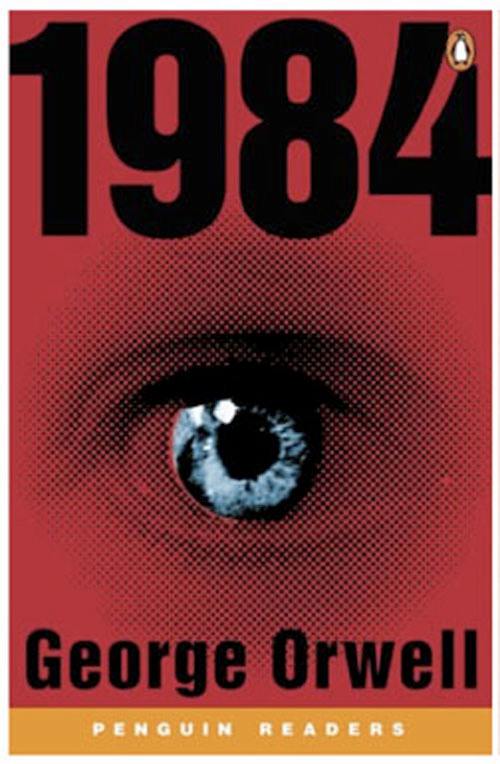
- 1984 by George Orwell (1948).
Perhaps the ultimate, and certainly one of the most memorable, depictions of a totalitarian state in fiction. The story of Winston Smith and his rebellion against the State. Filled with terms now accepted as general parlance (“newspeak“, the “Thought Police“) it introduced the world to the idea of Big Brother…. “But it was all right, everything was all right, the struggle was finished. He had won the victory over himself. He loved Big Brother.”
See also Alan Moore’s graphic novel V for Vendetta (1988 – 89), an updated version of a dystopian future Britain.
- The Man in the High Castle by Philip K Dick (1962)
One of Dick’s most famous novels (especially after the recent television series), Man in the High Castle tells of an alternative America where the USA is being run as a totalitarian state following the success of the Germans and the Japanese in World War II. The daily life is one of routine grind and general drudgery. Books are banned and items from pre-war America are in demand from the Japanese as cultural icons. The book (and the TV series) tell of possible revolution against the harsh regime.
- Brave New World by Aldous Huxley (1932).
In a future world (c. 2540) we read of a variety of characters living under a benevolent dictatorship (the World State). Real people are mixed with fictional ones – Henry Ford is seen as a god-like figure, for example. Along the way we read of sleep-induced learning, selective breeding in hatcheries and drugs (soma.) Perhaps because of this, the book was banned in Ireland and some US states in the 1930’s.
See also CJ Cherryh’s Cyteen (1988) for future uses of eugenics. Literate, dense and emotionally clever.
- The Space Merchants by CM Kornbluth & Frederik Pohl (1953)
A world in the future where advertisers take the place of governments. States exist merely to ensure the survival of transnational corporations. It is advertising gone mad, and surprising to think that this was satire sixty years ago but now has aspects that in 2016 are quite recognisable. The Space Merchants follows the story of Mitchell Courtenay, an associate at advertising agency Fowler Schockenan. Again, it is a story of people climbing to power as Courtenay climbs up the corporate ranks. He is assigned to lead the agency’s next largest task: to create promotional materials encouraging people to move to and colonize Venus. Courtenay, however, faces many obstacles along the way, from jealous coworkers and anti-capitalist protesters who seek to disrupt his work.
There’s our ten suggestions: are there any others you would suggest?



The Last Centurion , by John Ringo.
http://www.baen.com/the-last-centurion.html
Frank Herbert’s Dune, especially the original novel, offers a very interesting take on Machiavellian politics.
Great post. Starship Troopers by Robert Heinlein. Personally i think it is a great cross between sci-fi and politics. Also, I found Ender’s Game as a compelling science fiction that depends heavily on the use of politics and gaining power especially in a military setting.
Many thanks for your kind words, Hanz. Afterwards, of course, I realised that Heinlein’s Double Star should have at least have been mentioned! An actor, playing the part of President? Who’da thought it? *grin*
Hey, may I modestly suggest my sf novel STATE SLAVE, available as Kindle or paperback at Amazon http://amzn.to/2gz2PsI FreeFood, FreeMed, FreeFone–what more could a state slave want?
I thought of Dune as well. I have read 7/10 of the books on Mark’s list; hasn’t helped me understand politics in 2016, though. Maybe nothing could… .
Thank you Stuart: good point!