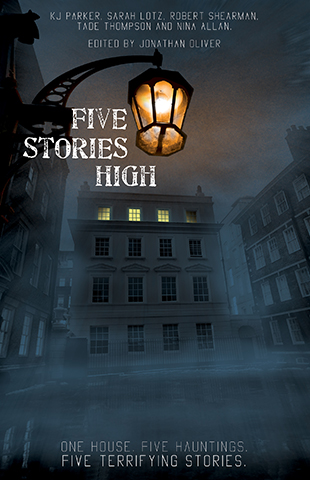
 Five Stories High features (surprise surprise) five horror stories of substantial length, arguably six—and it would be a churlish reviewer who cast the book aside due to the clearly four story building lurking on its cover. Subterranean floors don’t count, of course—but then, given the kind of terrible things that take place at this address, the basement might smell pretty high as well…
The tales here, some novella length, some less voluminous, are bookended and connected by editor Jonathan Oliver’s brief Notes on Irongrove Lodge. In these, an unnamed obsessive seeks out a fabled London property which has a notorious history of horror, yet may not even exist outside the minds of an unfortunate few. We segue from his increasingly frustrated investigations to each of the principle pieces, linked only by the occasional threatening presence of a certain Georgian townhouse in a certain upscale neighbourhood.
There’s obviously a potential stumbling block for any strongly-themed anthology: all the stories are about the same thing. The polarising prospect of sinking into one after another example of whatever-it-is can either be a fierce draw or a serious turn-off, depending on the reader’s capacity, or tolerance, for more of the same. Fortunately, there’s also a potential dodge as well: make sure all the stories are good. The critical question becomes, in this case, Are they?
The collection opens with Maggots by Nina Allan, and there’s a case to be made for this being the strongest of the set. Beginning with a colossal but necessary digression into a bizarre family tragedy which only the narrator even recognises the existence of, it reveals how his life comes to be guided, and then disturbingly derailed, by his need to find answers to the events of the past, no matter their cost. Though that may sound familiar in summary, this is not a predictable yarn by any means. It blends a contemporary take on the academic mystery with a very real atmosphere of suppressed trauma. The themes of isolation, disorientation and uncertain identity, plus an increasing air of the uncanny, are reminiscent of David Lynch’s Lost Highway, and it incorporates a kind of eldritch, cosmic horror that would have tightened H. P. Lovecraft’s trousers most uncomfortably.
It would also be easy, if more superficial, to draw a Lost Highway comparison to Priest’s Hole, by K.J. Parker. Here we meet a professional shape-shifter, capable of mimicking his subject right down to the genetic, even the intellectual level—an ability bestowed by his sinister home after a troubling part exchange. He monetises this ability via lucrative but tawdry gigs from his domineering talent agent, most of which demand he do no more than perform a mundane task in the guise of some wealthy tax-dodger; but when a suspiciously high-paying alibi job goes bloodily wrong he is left to wonder whether or not he is the real target. This would be an interesting premise for a supernatural thriller, but—as the title might suggest—Parker’s tale is much more reflective and slow-paced than such a thing, preferring to gradually peel away layers than kick open the door.
Tade Thompson’s Gnaw provides the collection with its first, and most conventional, real ghost story, but in doing so it demonstrates that a classic interpretation of the haunted house can be the most satisfying kind. Kicking off with two prospective owners confronting their supposed dream home, it’s not a spoiler to say that the process of moving in and “making the place ours” has very literally an opposite effect—as is often the case in this type of tale, there is always that question of exactly who is going to be taking possession of whom, be it the buyers or their kids… That’s not to say there’s nothing original going on here, far from it; and while the other stories here might prove tricky to translate to blockbuster form, from punchy title to visceral climax you could easily imagine Gnaw double-billing with The Amityville Horror or The Shining.
Taking a title to the other extreme, Robert Shearman delivers The Best Story I Can Manage Under The Circumstances, and that’s a signal right there towards the slippery, meta-fictional nature of what follows. What begins as a bizarro-fairytale, ripe with very adult anxieties, bleeds incomplete into another, this more typically juvenile on the surface but more genuinely real in its emotion and rising sense of threat. At times the picture painted is minimal and obscure, at others—especially in the chapter named “Wasteland”—it is strikingly vivid. But then it changes, and changes again, or maybe nothing changed, it just wasn’t what you thought it was at the beginning… Safe to say, this is the strangest of the five stories by a significant margin: fractured, stand-offish and sinister, sometimes it seems to be whispered in your ear, sometimes not, and it varies dramatically in tone throughout.
The collection rounds off with Skin Deep by Sarah Lotz, which is immediately notable for its unusual format. It takes the form of a series of monologues which recount the build-up and aftermath of a shocking crime, as recorded by a silent interviewer. There are shades of Rashômon here, as each contributor to the collective narrative adds conflicting perspectives upon either murderer or victim, or of the house, or all three. The writing is strong, and the variety of voices make for an entertaining read in the moment; however, while we’re back in more straightforward haunted house fiction again, the nature of this format is by definition somewhat distancing from the supernatural action. One reminiscence in particular has a truly creepy vibe, but the basic plot is similar to Gnaw and the final beat is very much a staple of the genre, if not plain cliché.
Maybe this is the right way to go—there’s certainly no question that this collection resides in classic territory, and Skin Deep closes the book on exactly those terms—but being the third instance in just five stories of someone moving to a new house and discovering a nasty left me feeling a little bit like we were retreading old ground just within these covers, let alone regarding the genre at large. The wrapping up of the collection with the last of the Notes on Irongrove Lodge proves, if one were being harsh, similarly hokey—but while it’s disappointing that the background story ultimately adds fairly little, we’re not really here for the editor’s framing material.
To answer my opening question: Yes, these are good stories. Five Stories High might end on a couple of easy, traditional tropes, but it also includes some inventive takes on the sub-genre and all the writing shows real quality. However, it should be acknowledged that, despite its invariably dark nature, this is more a literary collection than (to quote the cover) a “terrifying” one. The presence of the linking texts might encourage you to consume the book in one sitting, if you can, but my suggestion would be to resist that urge: giving each piece the space to stand alone will do better justice to them all. This is a case in which the individual parts may be greater than the whole—but if you come to the book in that frame of mind, that’s not necessarily a bad thing at all.
Review by Andrew Leon Hudson – SFFWorld.com © 2016