The Art of Assassin’s Creed IV: Black Flag
Published by Titan Books, November 2013.
ISBN: 9781781169032 Hardback.
Review by Mark Yon
It’s that time of year for Gamers: as we approach Christmas, the BIG games are on the way. We have Battlefield 4, Call of Duty: Ghosts and Assassin’s Creed IV, all being released now or very soon. It’s not as if it’s been a bad year for games so far, with Grand Theft Auto V gaining the records for the best-selling game on release ever* ($1 billion, and counting.) But it’s probably fair to say that, with new game consoles on the way, Christmas 2013 is going to be a bumper year for computer game sales.
The book I’m looking at covers the production artwork for Assassin’s Creed IV, due late October / early November, whose game to date has sold over 57 million copies worldwide. In Assassin’s Creed IV we are clearly tapping into a Pirates of the Caribbean type scenario. The cover shows our titular assassin, Edward Kenway, stepping out of the ocean surf, scabbard in right hand and flintlock in his left. There’s a large sailship behind and a dead body in the sand to his left.
So: we’re into the era of the pirates, with the so-called ‘Golden Era’ of piracy. The Caribbean, Blackbeard, and all that stuff. The Black Flag of the title was often proudly displayed in the 18th century as the means of noting whether a ship was a pirate ship or not.
The book itself is 192 large pages of glossy, heavy stock. The artwork therein covers the inspirations for and the characters of the game, the locations (at sea, in cities and underwater) as well as some historical background, so that presumably the game-player can get a feel for the place and the lifestyles of the 18th century.
But, as you might expect with an art book, it is the artwork we’ve come to look at. Frankly, whether you are a fan of the game or not, it is gorgeous. We have Mayan temples, mangrove swamps, ships at port and at sea, in battle and barely afloat as shipwrecks. The cities of Havana, Kingston and Nassau look fantastic, as well as places such as Port au Prince, which are included in the book, though no longer part of the game.
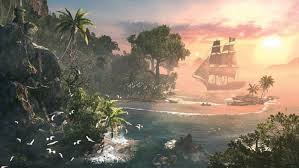
The book is full of the pictures, most pages having more than one art-piece. Pleasingly, there are few pictures that disappear down the crease of a double page spread, although many stretch across more than one page.
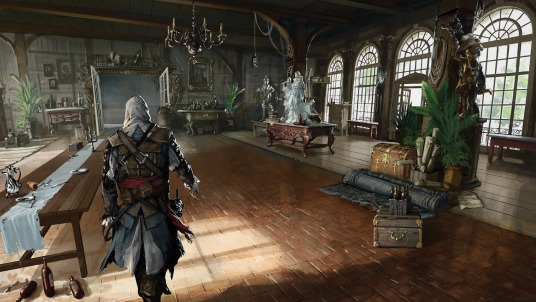
Of the text, there’s little to be concerned about. The comments from the artists are the most interesting. The author Paul Davies mainly lets the pictures and the production team do the talking. There are comments from the Art Director Raphael Lacoste and production artists Martin Deschambault, Donglu Yu, Max Qin, Yong Jin Teo, Guang Yu Tan, Maxime Desmettre and Kobe Sek and others (there are 23 in total!) throughout, explaining the pictures and their purpose. There is an introduction from Raphael Lacoste, the Brand Art Director, outlining his objective for the project – to quote, ‘diversity, epic, luminous and awe-inspiring’. I think the book manages that admirably.
In summary, it’s a lovely looking book. Whether a fan of the games, or a fan of pirates, this book highlights their lives, their locations and their challenges upon the 18th century High Seas. It would make an ideal present for a trainee pirate wanting to know more or an experienced gamer wanting to get a feel for the new game.
Mark Yon, November 2013.
*According to Wikipedia, “Grand Theft Auto V broke industry sales records by earning US $800 million in the first 24 hours of its release, and $1 billion within its first three days, making it the fastest selling entertainment product in history.”