Over the Edge of the World – Magellan’s Terrifying Circumnavigation of the Globe by Laurence Bergreen
Published by HarperCollins (April 30, 2008)
Review by N. E. White.
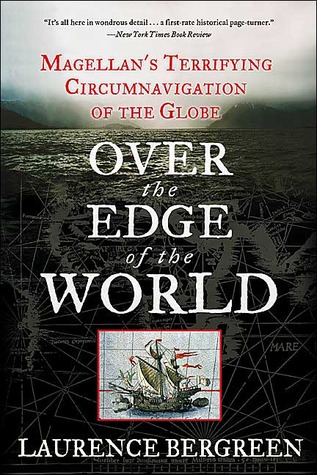 Over the Edge of the World – Magellan’s Terrifying Circumnavigation of the Globe is an illuminating read. Filled with wonders, betrayal, murder, navigational feats, culture, and more history trivia to wow your friends – this is a book worth a few weeks of your time.
Fantasy fiction has long had its roots in historical fiction, from Tolkien’s Nordic based epic (Lord of the Rings) to George R. R. Martin’s Song of Ice and Fire series loosely based, and most definitely inspired, by England’s War of the Roses. In addition, the amazing characters we grow to love in fiction usually have their genesis in real-world historic figures. I just finished reading Anne Lyle’s The Alchemist’s Soul in which she cobbled together her main character from several real-life historical figures. If you love fantasy fiction, then you probably love historical non-fiction narratives. In Over the Edge of the World, a non-fiction account of Magellan’s journey to the other sie of the world, Mr. Lawrence Bergreen describes a journey that will inspire any fantasy readers’ imaginations.
The beginning chapters, in which the preceding events leading up to Magellan’s voyage are detailed, can be a chore to get through, but once you get past the list of players and their interconnections (repeated for memorization, I think), this is an amazing historical account of a journey you will hardly recognize.
In the new world, danger and mutiny abounds on the five ships, manned by an international crew that have little love between them. So little, in fact, it is amazing Magellan got as far as he did. Though in his wake, he did leave many sailors dead and, one way or another, lost four of his ships.
However, the extraordinary Portuguese navigator did make it across the Atlantic and Pacific Oceans, a feat that no other European (that we know of) could boast at the time. In addition, he set the stage for Spanish exploration of the Philippines and the famous Spice Islands that drew merchants and explorers alike with a siren’s call. If nothing else, Magellan’s journey is an adventure worthy of exploration and Mr. Laurence Bergreen does so with depth and authority, highlighting interesting characters on the crew as well as their fearless leader.
Mr. Laurence Bergreen chronicles the day to day hardships the crew endured to survive on a ship cut off from their normal routes and supply chain. We get tantalizing glimpses into the lives of the officers and what it meant for them to be on this voyage. And more importantly, we see what drives a man like Magellan into the relatively unknown with “quixotic delusions of grandeur”.
Though the author does his best to piece together the events of the journey from surviving documents, he is hampered by the fact that Magellan did not survive the journey, nor did his journals. This story of their voyage draws heavily on the journals of those who did survive (and had reason to distort the truth) and the Venetian Antonio Pigafetta.
Pigafetta was a man keenly interested in the new world and decidedly influenced by his faith. He wasn’t a scientist nor a merchant, but rather a traveler. He joined the expedition simply because he wanted to sail around the world. And that he did. Without his journal, we would not have the insight of just how much of a culture clash the Europeans experienced when they finally landed on the island shores of the Philippines.
I particularly found Pigafetta’s descriptions of the native customs enlightening. In the modern Philippines, much of the population are Catholics. How much different would their culture be today had it not been so heavily influenced by the Spanish and Portuguese? Though the Chinese and Arab traders had long preceded the Europeans, they were not interested in conquest as the Portuguese and Spanish were. Thus, prior to their arrival, the Philippine culture had remained, more or less, intact when Magellan and his crew landed. Pigafetta’s dismay at their sexual practices and social norms clearly show a meeting that changed the course of the Philippines like nothing they had experienced before. For this one reader, Pigafetta’s account, however flawed, brought clarity to the situation and made me appreciate how terribly important ‘first contacts’ are.
At times, this tome does read a bit too much like a textbook. Despite this, Mr. Bergreen’s story of Magellan is worth the read and will change your perception of the navigator. He was both madman and commander. Stubborn and brilliant. Faithful and extremely lucky (or unlucky, depending on how you look at things). If you like reading about sailors living at the edge of their world, pushing boundaries like no one else had done before, this book will sate your need for historic, high-sea adventure.
Notes on the layout of the ebook: The book includes chapters listing principal characters, measurements and a prologue. The main part of the book is divided into three books, each containing four to six chapters. In addition, there is a section on the historic sources that highlights the controversy surrounding Magellan’s voyage. Also included is a bibliography. And though lacking a linked-index, the publisher did include a ‘Searchable Terms’ section that I found useful.
N.E. White, December 2013.
Copyright © sffworld.com. If quoted, please credit “sffworld.com, name of reviewer”.