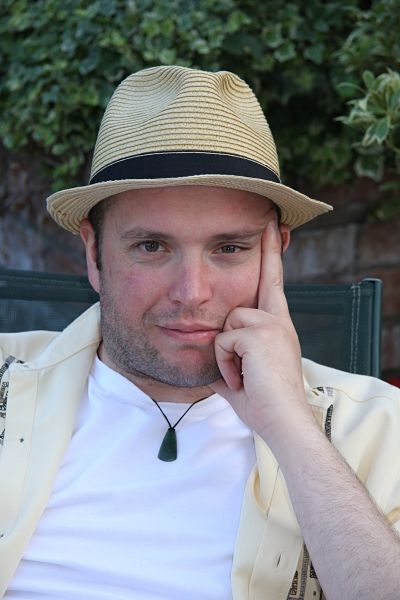
 As Gavin has his latest SF novel, The Age of Scorpio, released in paperback, he provides us with a Guest Post that looks at the ever-present argument in SF: Dystopia vs. Utopia?
So somewhat irritatingly editors expect you to pitch for publishing deals rather than just respecting your obvious (sub)genius and giving you money to go away and write stuff. A little while ago I was doing such a pitch and before I could get into the full flow (previously I had just been shouting the words ‘aliens’ and ‘spaceships’ over and over, in a busy restaurant) I was asked, with a sigh, if the project in question was going to be set in another dystopia. For some reason Age of Scorpio and the Jakob Douglas books, Veteran and War in Heaven, are considered a little dark.
When I was looking for ideas for this blog my editor, Marcus Gipps, suggested utopia vs. dystopia and asked me which one I thought we would be likely to end up in. I had never really given much thought as to why I tended to write dark futures. To a degree we’re subject to the ideas we have and I grew up reading quite dark SF. From Judge Dredd, Strontium Dog and Rogue Trooper in the pages of 2000AD, to books by William Gibson, Walter Jon Williams and Jack Womack (now there is someone who writes dark futures), to films like Blade Runner, Aliens and Terminator. I never had a great deal of time for shinier, fluffier, happy stuff. There’s a reason that the Star Wars films are set a long time ago…
Whilst there is a reasonable amount of SF where the future is quite rosy it seems to be outweighed by the darker stuff. It seems that we think there is something wrong with our future. Or do we?
SF is often thought to be predictive, and some times it gets things right (I suspect Arthur C. Clarke could actually see into the future.) and sometimes it inspires science and technology (Just how many episode of Star Trek: The Next Generation did IPad designers watch?) but if you have enough monkeys, typewriters, time and all that… I’m sure you were all as disappointed as I was, however, that there wasn’t a base 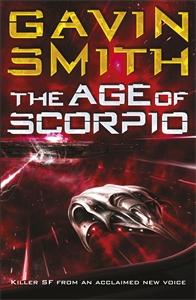 on the moon when it was knocked out of orbit in 1999, that New York isn’t a prison (Though I have suggested that the Isle of Wight could be used for this, though it doesn’t have quite the same ring.) and with only five years to go I suspect that the flying car still won’t be all that practical. (The first person who can tell me the three books/shows/films/games/comics/whatever I am referring to above I will send them a copy of Age of Scorpio. Whether they want it or not!)
Science Fiction’s job isn’t to predict, it isn’t even to critique, first and foremost the job of an author is to entertain, beyond that anything else is a bonus. Brian Aldiss once said that science fiction was not about prediction. It is a warning. There is an element of warning in both the Jakob Campbell books, and the Age of Scorpio trilogy. If the current oligarchic approach to economics that is masquerading as a predatory form of capitalism, broken free of its role as an economic tool and living like one of the bloodier Aztec gods awaiting it’s next sacrifice, persists then these stories are my guess at the kinds of society we could end up with. The Age of Scorpio in particular had its genesis in the question: what if we had access to near-Culture levels of technology but were still arseholes? And one of the great things about all fiction is we can give all the bad things in the world form, make them our monsters, and slay them.
The thing is I am an optimist. I think we have taken a few backwards steps recently but largely I tend to think things are on the up. In general, the majority of us are better off than we were a hundred years ago. There is no halcyon golden age. This doesn’t mean I think everything is perfect by a long shot, that we don’t have a long way to go as a species, that there are not many, many things that require fixing, but for the most part I think we’re moving in the right direction (allowing for the recent back steps). This isn’t a terribly popular view but frankly whilst we all talk about the inevitable end of the world as a result of an economic, social, ecological or zombie-based disaster, whilst the media tries to make us live in fear so we will buy things, children still play, lovers still fall in love, there a millions of acts of random kindness and altruism that go unreported, the secrets of the cosmos are being unlocked (As I wrote this I came across an article on a device that you can wear on your finger and it will read a book to a blind person!) and kittens gambol through the internet. (It occurred to me yesterday that the internet seems to have been invented purely to humiliate our feline overlords.) So why all the darkness?
Well maybe it’s laziness. Darker futures make it easier to write conflict, and conflict of some kind drives most fiction. This is more difficult to do in a positive upbeat future. This is one of the many reasons that Iain M. Banks was such a genius. The Culture is pretty much the only fictional universe I would be prepared to live in, the rest of them are just too dangerous. If you want to write Utopian science fiction then you had better have something very interesting to say because Mr Banks is a hard act to follow.
Or maybe we just like the darkness. (F*ck me, I sound like a paranormal romance writer!) Not exactly blinding insight I know but sometimes we’re a bit remiss in admitting it. Sometimes it’s nice to wallow in filth, to very vicariously experience evil but to ultimately see it vanquished in some way. I suspect this is probably healthy and that fiction is the best place to put dark things. And when darkness in SF becomes too much there are always the pleasant wish fulfilment stories of fantasists like Joe Abercrombie (Or the Jabbercrombie as I like to think of him), or the cheeky Ealing-style crime capers of writers like James Elroy.
So are we heading for a dystopia or a utopia? I think it’s easy to feel like we’re heading for a dystopian society but I have a lot of hope. We either have everything we need, or making moves towards everything we will need technologically speaking. Resources are an issue but we know what to do even if we seem to lack the foresight to do it at the moment. The big changes will have to come socially but again we know were the problems are, I suspect we even know how to fix them but lack the will to do so at the moment but I think that is changing. I don’t think we’ll ever live in a perfect utopia but frankly I remain optimistic for the future.
Maybe science fiction is a warning but sometimes it’s just about the spaceships and aliens.
The Age of Scorpio by Gavin Smith is now out in paperback, priced at £8.99. The next stand-alone story in the dark space opera series, Quantum Mythology, will be released in trade paperback and ebook in March 2015.