Hello, Elisabeth: many thanks for giving us some time here. Welcome to SFFWorld.
Open Road Media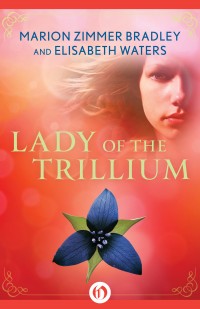 are now releasing the whole Saga of the Trillium as e-books. Do you have any expectations now that the books are released in this new medium and potentially to a wider audience?
I don’t have “expectations” as much as hopes. I hope that people will buy the books and enjoy them, and I’m very glad that they are being released as eBooks. I’m a big fan of eBooks, having run out of bookshelf space years ago.
Lady of the Trillium was a collaboration between yourself and Marion Zimmer Bradley. How did that work when writing?
First, Marion and I purposely set our sequel many centuries after Black Trillium so that what we wrote wouldn’t interfere with the sequels Julian and Andre were writing. Our original plan was that Marion would write the wise old sorceress (Haramis) and I would write the teenager (Mikayla) and we’d do alternate chapters. Unfortunately, Marion had a stroke about a week after we started writing the book, which made her major contributions reading what I had written each day and answering the question “Is this what having a stroke feels like?” (I gave Haramis Marion’s health problems.) Fortunately Marion liked what I wrote. I had a lot of fun with the book, especially combining both real magic and the ancient technology that people thought of as magic. I’m a bit of a techie (my Masters degree is in Computer Science), while Marion burned out the motherboard on her word processor every single year. Literally. I never did figure out how she managed that. Who knows, maybe it was magic.
Besides Marion Zimmer Bradley and yourself, Julian May and Andre Norton were the other contributors to this series. How much did you interact with them as part of the process?
Quite a lot, and I learned a great deal from being part of the project. I went with Marion to Florida for the conferences at Andre’s home where they made up the Bible for the world. I also did a lot of work on the next-to-last revision of Black Trillium (Marion was in the hospital with a stroke at the time). I inadvertently killed off the villain—I thought he was supposed to be dead. Julian fixed it and told me pityingly when we later met up at a convention, “You never kill off a good villain.” After Black Trillium, we all branched off in different directions so the books are more a set, rather than the sort of series where the books have to be read in a certain order.
You also write shorter fiction. How different do you find writing short stories and shorter fiction rather than novels? Do you have a preference?
I find writing shorter fiction much easier. Novels are very difficult for me. My first one, Changing Fate, started as a short story in Sword and Sorceress 3, and then I expanded it as a distraction for Madeline L’Engle, who was a friend in addition to being one of my favourite writers. I sent her a chapter each week during the summer that her husband was dying, and by the end of the year it was a book. It then sat on a shelf until the trip to Florida, when Andre’s secretary told me I should enter it for Andre’s new Gryphon Award. I did, it won, and it finally occurred to me that maybe somebody other than Madeleine would be interested in reading it, so I sent it to my agent.
Do you have a process you follow when creating short stories? Does a well-formed idea come to you and you just polish it, or do you spend a long time maturing ideas and mixing them together until you find something that works?
It depends on the story; most of them just come to me. The closest I come to a process is to follow Marion’s “What Is a Short Story?”—a hand-out from the writing workshops she used to give, which is still on her website. Lately I’ve been writing stories for Mercedes Lackey’s Valdemar anthologies by choosing a suitable phrase for a group of animals—last year it was “a wake of vultures” and this year it’s “a bellowing of bullfinches”—and writing a story with that as the title. If I get stuck, I call her and we brainstorm. I sometimes co-write something for Sword and Sorceress (I collaborate with a friend I’ve known since high school on the “Treasures of Albion” series), and those stories are generally inspired by either museum exhibits that have just gone through both our cities (the terracotta warriors was the most recent one) and/or verses from Psalms (usually from the 1668 Book of Common Prayer). Daily prayer can be inspirational in more ways than one.
Any other short story writers you admire?
Most of the writers I admire write both short stories and novels. I particularly like Mercedes Lackey, Nalini Singh, and Deborah J. Ross.
You are also the editor of the Sword and Sorceress anthologies. How has it been to pick up that legacy after Marion Zimmer Bradley?
It wasn’t really a new job for me; I started working on Sword and Sorceress with Marion around the fourth book. She died while editing Sword and Sorceress 18, right at the stage where she had enough good stories for three volumes and hadn’t returned any of them yet, so I kept them all and produced volumes 18, 19, and 20. I am currently working on Sword and Sorceress 30. They’re still selling, so Marion’s Trust keeps hiring me to edit them. I really enjoy it, except for the day after the deadline when I have to return stories I wanted to buy. There are always more good stories than will fit in the physical book.
Rumours has it that you’re working on a sequel to Changing Fate called Mending Fate. Any news you can share with us about that?
Mending Fate is set a generation after Changing Fate, and children of the characters in the first book are now trying to cope with the consequences of what their parents did. One of the problems is that the Queen of Diadem died shortly after the end of Changing Fate, and the new Queen is only seventeen and really hates being Queen.
Undoubtedly, the fantasy genre has changed a lot over the years. Do you find yourself still reading for entertainment much? Or do you tend to read away from the genre?
I’ve always been a bookworm, and I still read constantly. I read SF/fantasy—fortunately I’m not one of those poor souls who can’t read the genre they write in—but I also read romance and mystery. I love Kerry Greenwood’s Miss Fisher mysteries.
And what of newer authors? Are there any personal favourites?
I have a long list of favourite authors. Some of my current ones are: Donna Andrews; Patricia Briggs; Lois McMaster Bujold; Tera Lynn Childs; Eric Flint; Laura Ann Gilman; Andrea K. Höst; Mercedes Lackey; Sharon Lee & Steve Miller; Seanan McGuire; Tamora Pierce; Sharon Shinn; Nalini Singh; Wen Spencer; and Carrie Vaughn.
Would you care to pass on any advice to writers starting out? What was the best advice you were ever given when starting out?
Apply the seat of your pants to the seat of the chair and stay there until you have a story.
How are you finding the e-book revolution? Personally, are you happy with an e-reader these days, or do you still prefer ‘tree-books’?
I love eBooks. In addition to solving the problem of lack of shelf space, they have type size I can make larger, and I can read in bed without needing to have the lights on. I have Kindle installed on my iPod, and I carry it with me everywhere, so I always have something to read.
And, in 2015? What are your aspirations today?
I really, really, want to finish Mending Fate. (I think I’m on my seventh re-write, but I’ve rather lost track.) After that, there are some ideas I’m playing with, but nothing definite yet. I tend to work by letting things percolate in my subconscious until they come out as stories—or at least as first drafts.
Once again, thank you very much for your time, Elisabeth.
* * * * * * *
Interview by Dag Rambraut – SFFWorld.com © 2015