

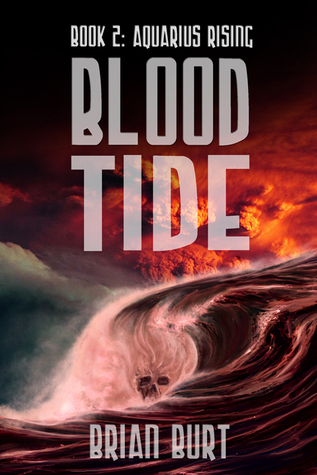
 Science fiction writers have always drawn inspiration from emerging scientific trends and topics, especially those that spark controversy. It’s not surprising, then, that quite a few writers have set recent novels in worlds turned upside down — or at least sideways — by global warming. My own first novels, In the Tears of God and Blood Tide (Books 1 and 2 of the Aquarius Rising trilogy), have climate change as a central theme. Enough books and authors have used global warming as a story driver that media sources like NPR and Wired proclaim a new literary genre called “climate fiction” or “cli-fi.” This has prompted many SF veterans to sigh, roll their eyes, and point out (validly) that this is nothing new: SF has a rich history of tackling environmental themes, and “cli-fi” is at best a loose subcategory of classic science fiction.
I see why the SF community bristles at the implication that this style of fiction represents something completely new. Great SF writers have indeed explored the territory that includes climate change, environmental disaster, and ecological imbalance for decades and have found fertile ground there. (Fertile for the writers; perhaps not so fertile for the story’s main characters, who may be left wandering through parched and barren hellscapes.) Frank Herbert’s Dune series is a perfect example. Kim Stanley Robinson has mined this rich story vein brilliantly for years. And I still remember being mesmerized by Ursula Le Guin’s “The Word for World Is Forest.”
So, for science fiction fans, this is nothing new. What’s changed, then (besides the melting polar ice, rising seas, violent weather patterns, and mean Earth temperature)? I’d say two major factors contributed to the emergence of “cli-fi” in the public eye. First, the evidence for global warming has become dramatically visible to people in their everyday lives. Extreme weather events and the nearly unanimous consensus of climate scientists have shifted popular perception of this issue. Even the deniers grudgingly admit that something is happening, although they might argue about the root causes. Second, the theme of climate change has begun appearing in the work of acclaimed “mainstream” literary fiction writers like Barbara Kingsolver (Flight Behavior) and Margaret Atwood (MaddAddam Trilogy). Although this rankles some SF folks who feel that we’re treated like “second-class literary citizens,” the reality is that mainstream fiction writers carry more weight with traditional media sources. (And Kingsolver’s and Atwood’s books are wonderful — I highly recommend them.)
New genre or just newly recognized SF sub-genre, this can be a positive development for writers of speculative fiction with a passion for environmental themes. And, for those of us who also feel impassioned about environmental causes, it’s a win-win. I believe fiction can communicate messages (like “we’re mortgaging our planet’s future for short-term economic gain”) in ways that are more visceral than nonfiction books addressing similar concerns. Facts can move the mind, but fiction can move the spirit. Fiction writing is not activism… but infusing core beliefs into a story can make that tale more vivid and thought-provoking if it’s not done in a preachy, heavy-handed way.
 Cli-fi reflects a growing movement among writers in and outside of science fiction who develop stories around a central premise of “what if global warming really does proceed unchecked?” What will the world look like if weather patterns alter drastically, the cycle of seasons becomes unrecognizable, coastal mega-cities flood, large swaths of land become arid wastelands, and masses of people are forced to migrate away from their homes in search of less hostile environments? What kind of social and political chaos will result, and how will we cope? Will we try to geo-engineer a solution on a planetary scale, and what if there are unintended consequences? Will humans be forced to tweak their own genetics to adapt to the harsh conditions that constitute Earth’s “new normal”? All of these questions fueled my own writing as I began the Aquarius Rising trilogy, and they’re still propelling my imagination as I work on the final novel, The Price of Eden. I can’t wait to see how things turn out.
Is it really cli-fi or just good old sci-fi? Ultimately, I’d argue that it doesn’t matter what label media or marketers assign as long as readers enjoy the books and consider the implications. Science fiction has a proud history of presenting cautionary tales about possible dystopian futures. Very few of the cli-fi books I’ve read so far conclude on an optimistic note. Maybe, together, we can write a happier ending!
Brian Burt writes both short and novel-length speculative fiction. His short story “The Last Indian War” won the Writers of the Future Gold Award and was anthologized in Writers of the Future Volume VIII. His debut novel, Aquarius Rising: In the Tears of God, won the 2014 EPIC eBook Award for Science Fiction, and the sequel, Aquarius Rising: Blood Tide, has just been released by Double Dragon Publishing. You can sample his writing at http://www.briantburt.com.





Fantastic essay Brian! KEY GRAF: Is it really cli-fi or just good old sci-fi? Ultimately, I’d argue that it doesn’t matter what label media or marketers assign as long as readers enjoy the books and consider the implications. Science fiction has a proud history of presenting cautionary tales about possible dystopian futures. Very few of the cli-fi books I’ve read so far conclude on an optimistic note. ***Maybe, together, we can write a happier ending!*** YES YES YES!
This piece reminded me that I read J.G. Ballard’s The Drowned World some fifty years ago, my adolescent introduction to the concept of global warming. I’m going to get an ebook from Amazon and read it again.
On an actually tangential note, Gordon Van Gelder edited Welcome to the Greenhouse for O/R Books a few years ago. It’s a collection of short stories about climate change. Not too many optimistic ones, though.
It is a bit sad to think that global warming has been a potentially catastrophic issue that science fiction writers put on the radar half a century ago… and it doesn’t feel like we’ve made that much progress as a species in the meantime. It’s tragic that climate change has become so politicized that we waste all our energy arguing about whether it exists instead of figuring out what to do about it. I do feel cautiously optimistic, though, that the tide is turning and that my sons’ generation actually “get it.” I’m praying that they’ll succeed where my generation failed.
Great article. I, too, hope we can all find a happy ending.
I totally agree with the previous commentators: great article. And there is, perhaps for the first time, a glimmer of hope that the upcoming Climate Change Conference in Paris will have positive results – if a Republican Congress doesn’t prevent the American government of carrying through the necessary prevention measures and if China actually carries through with its commitment (but it does appear to be serious about it). So, yes, we’ve moved some since the last Climate Change Conference in Denmark (2009) that was a total write-off!
Does this mean that (for the first time) hope is around the corner? I hope so! Though some adverse climate change will be inevitable even if the Conference results in a global agreement to address it. The problem is not really the diagnosis (the scientific evidence is in), the problem is Man and the inability to stick to commitments and carry through effective policies on the ground! Basically, we all know what should be done. But with Big Business lobbies muddying the waters, will it get done? It’s the human element that trumps everything…and makes for great literature!
Very important issue! The current crisis in the Middle East is fueled by climate change and it will get worse. Climate change is going to alter where food is grown and how much is reaped. There will be winners and losers, as with all change. Ultimately, it is all fueled by human overpopulation, which I suspect nature will address one day.
Writers are our only hope for moving people toward changing their ways. Yes, I also write eco-fiction.
Here is a link to my novel, KINGSLEY, on Amazon: http://www.amazon.com/Kingsley-Carolyn-ONeal-ebook/dp/B014JOVXAS/ref=asap_bc?ie=UTF8
I also have a website and blog entitled “Impact of our choices”: http://authorcarolynoneal.com/news/
Would you be interested in reviewing each others novels? I’m looking to get the word out in the Sci Fi community about KINGSLEY. Most of my readers are environmentalist so I think we could really help each other.
My email is [email protected] if you want to chat.
Thanks!