
Back in 1997, when I had more hair, less beard and shining, starry-eyes, I landed the Best Job In The World—prosthetic make-up trainee/runner—for the Creatures department of what was going to be The Best Film In The World.
That film was Star Wars: The Phantom Menace.
While history may not have registered my own personal heyday with the adulation I once anticipated, that experience remains cherished for me. I moved to Watford, just north of London, where a former airfield had become Leavesden Studios, temporary home to a galaxy far, far away. Some of that galaxy was old—on my first day, I arrived to find two highly familiar robots being unpacked from a crate marked Skywalker Ranch—but more was new: walking across palace grounds, through spacecraft hangers, ducking below the ceilings of adobe-like hovels—all of them plaster, chipboard, fibreglass, and real.
And, of course, there were the creatures. My daily grind involved constant exposure to the slow, steady creation of the fantastical (invariably within offices and workshops as mundanely IKEA-based as any less glamorous industry). Disembodied heads and hands decorated every table at every stage of completion, even a few complete body suits—including a long-faced, tan-and-orange humanoid which was called, I was told in excited whispers, Jar-Jar…
It was, of course, just a job. It’s strange to look back and not know when, or rather how my early days of awestruck wandering could segue into an almost clichéd image of the jobbing labourer: clothes stained with clay, latex, plaster and paint, perhaps a cigarette dangling from the corner of my mouth as I tossed a big pile of six-legged lizards into another crate to be shipped off to hang in a market place in Tatooine, Tunisia. Same-old, same-old.
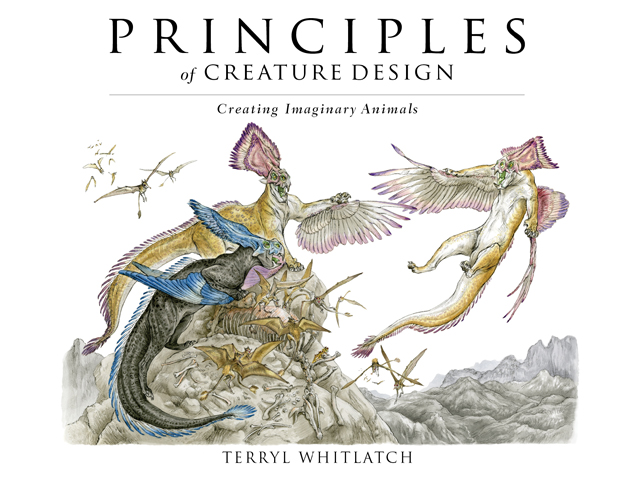
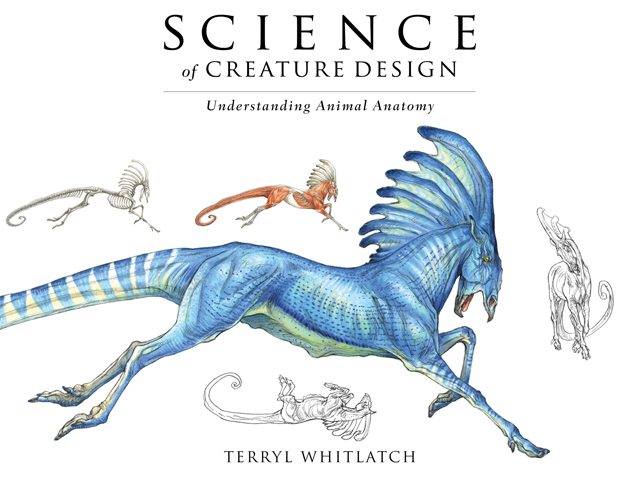 Now, almost twenty years later, as I flicked through two books from Design Studio Press—Science of Creature Design and Principles of Creature Design—I was startled to see what looked like one of those very lizards cavorting on the page, as large as hexapedal life. I shouldn’t have been: almost every beast I saw while working in the universe of George Lucas sprang from the mind of Terryl Whitlatch, a zoological illustrator who has forged a career by melding scientific rigour to the most imaginative of fine art.
Today I have a chance to speak to Episode One’s principle creature designer, and someone responsible, indirectly and in part, for making ’97 one of the best years of my life! So for myself I’ll say thank you, and for everyone else I’ll start by asking: what is it like to see a world you helped imagine becoming real?
It’s a glorious feeling, amazing really, and doesn’t quite seem real. I imagine that it is akin to sending your child to college, and seeing him graduate with a ph.D. But what is most truly awesome is all the people who worked so hard for this to come about. It’s not about oneself—it’s about the concept and the collaboration.
I witnessed first-hand the painstaking process that went into realising your work physically: sculptors working in clay; mould-makers producing masks, puppets and props; technicians building mechanical muscle-substitutes; painters giving their skin living detail. Tell us about the process that brought these beings into existence before all that took place.
The process first began with George Lucas himself—he would meet with us an average of twice a week and discuss the characters, the vehicles, architecture, story arcs—what was most pressing on his mind. Then Doug Chiang, who was art director, would immediately hold a meeting after that meeting, to review everything that was said and send us to our respective drawing boards, imaginations quivering and assignments in hand, to design what was within our realms of expertise. Sometimes there were some crossovers, but most of the time we each had our various areas—storyboarding, environments, costume—and mine was anything having to do with an animal or creature. We’d work all week creating, mostly in traditional media—pencil and markers and acrylics. Digital media was just starting to happen, as far as the concept art went. Then we’d present the results to George—typically Friday to Friday, Fridays being the official ‘George’ meetings.
When the art was officially approved (that is, the basic concept of what the creature, for example, looked like) it was then further refined. I did anatomical orthographical drawings—views of the side, front, rear, top, and often the bottom—of the skeletons, musculature and anatomical surface for all the alien wildlife and creatures, so they could be modelled, textured, rigged and animated for Industrial Light & Magic. This was done regardless of whether the animal was digital or animatronic, or a combination of the two. That’s at least 9 to 15 technical drawings/paintings for each approved creature, and there were at least 50 such creatures accepted for the film.
All of these creatures needed to appear real, from their outer colouring to their inner structure. Sometimes I even had to design the dental configurations and the tongue relationships, and at times even needed to animate the creature myself in 2D to make sure it could do certain things, or to act as a locomotion guide for ILM. Needless to say, a lot of what was done in Pre-production (by the Star Wars Art Department, located at Skywalker Ranch for security) was to make sure that Production/ILM (where things get really expensive really fast) had exactly what they needed.
Your track record includes other film projects in which fantastical creatures hold a high-profile place—Men In Black and Dragonheart spring to mind—but you also worked on The Dig, a “serious sci-fi” LucasArts point-and-click adventure game, and illustrated The Katurran Odyssey, in which real-world animals are anthropomorphic in behaviour if not form. Do these distinct mediums and themes result in very different working experiences for you?
Essentially, all these projects had to do with making the imagined seem real, in various worlds and in various times. However, Men in Black and DragonHeart take place on planet Earth, where basic culture and civilizations and modus operandi are already established and figured out—there is Earth-centric historical context. Creature design for this subgenre is like doing flourishes or… adding frosting. The settings of The Dig and Star Wars are very different in that they do not take place on Earth or in this galaxy, and one needs start from scratch. This World Building is what I enjoy most, but The Katurran Odyssey provides a middle-ground, taking place on an Earth-like planet but where the acting characters are all animals, not humans. This is where one has to imagine Animal Culture, going beyond a clinical scientific gaze or proscribed theories (which are here one day, and gone the next), and look at animals on their own terms. This is especially important in paleontological reconstruction.

At last, to your books. Science of Creature Design and Principles of Creature Design are both, frankly, gorgeous to look at—if, as they say, “a picture paints a thousand words”, these must be 100,000 apiece, maybe literally. Tell us about what your objectives are with each, and how they complement each other.
They were originally just going to be one volume, but because there was so much material it was decided to divide it into two. Science of Creature Design lays the foundation, mainly focusing on real-world examples, then Principles of Creature Design jumps off where Science concludes, applying what was introduced there to imaginary species—although there is crossover between the two as well. I’m really happy to have recently learned that one of the paleontology professors at UC Berkeley is using Science as a textbook for paleo-reconstruction.
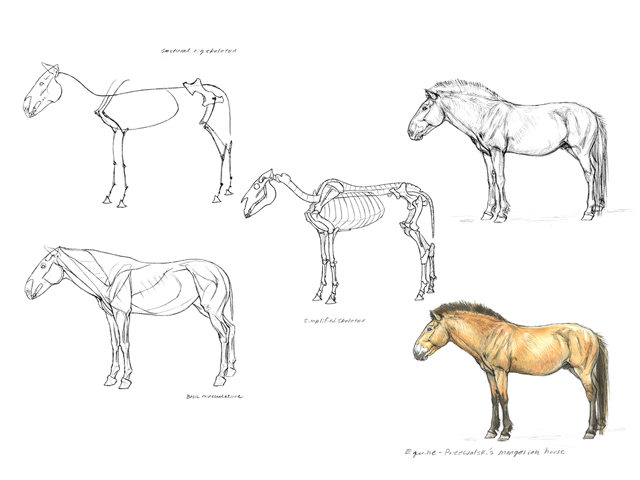
Most creature design is dealing with REAL ANIMAL ANATOMY, which many students conveniently want to skip, and which comes back to bite them as they start their professional careers. Think about it: of all the Disney films, for example, how many characters, primary, sidekick, and otherwise, are real species, compared to purely imaginary ones? And, as Chuck Jones so famously said, “If you want to draw a funny looking horse, it sure helps to be able to draw a real one.”
I found the stages of physiological “construction” you reveal in Science as fascinating and beautiful as each fully fleshed image—but you also include observational sketches and dynamically pose fantasy creatures on-the-fly. How much of your skill set has become instinctive now, and are there still areas of craft you seek to develop?

Real animals teach you how to draw. Fantasy animals of themselves do not—they are a distillation of what real animals have already taught you. You’re not really taking any sort of risk in creating a fantasy animal—it nearly always looks good to you and no one can tell you that you drew it wrong, since it has no peers in nature. In contrast, a tiger or a horse or your goldfish will always tell you how much farther you still have to go, and how so much, so very much, you still need to learn—there is no faking, no short-cuts. I am awestruck whenever I look at an animal (or person, for that matter). Thus, I cannot understand why so many prospective and even professional creature designers have no real animals in their sketchbooks or portfolios, even despite the fact that purely imaginary creatures are in the minority of jobs.
Achieving realism is clearly the cornerstone of what you do, but do you have a preference—the subjects of reality over those of fantasy, or vice versa—when it comes to your work?
Real animals are my preferred subjects, not fantasy animals. Drawing and observing them—this is what gets under the skin and into the psychology and spirit of imaginary animals. So drawing real animals on their own terms is my favourite, but I do also like to let loose and draw very exaggerated and stylized animal characters. Reality gives you wings to edit stylistically and go crazy. It’s fun, gives the brain a break, and recharges the art batteries. Jobs and projects that bring a lot of variety are good for the soul, and they stretch you, break down those ruts and comfort zones.
Is there a career omission, something you would love to tackle but which no-one has asked for?
I feel that I am now entering into a part of my life where I am developing my own IP’s—such as Katurrah, which once again has the green light, plus other world-building where real animals and their imaginary and prehistoric close relatives play an active part—in books that will include Augmented Reality. This is in addition to my educational books and instructional workshops, but I can’t talk too much about them at present as they’re in development. So, I’m very excited.
Your parents were an illustrator and a biologist respectively, so was it inevitable that you would distil these influences into the career you’ve made for yourself?
I think that how my vocation developed was inevitable—that of a paleozoological illustrator—in its purest form. My mother being an artist; my father being both a biologist, biology teacher, and naval officer who had sailed the world; my grandparents’ horse ranch. I suppose if I wasn’t an illustrator, I’d be a naturalist who also trains horses and sighthounds (greyhounds, borzoi, and the like).
You studied zoology before switching to specialise in artistic anatomy, and now teach animal anatomy and creature design to a new generation of artists. How has this educational scene changed since you were a student, and what is it like to participate from the other side?
While there really wasn’t a designated career as a ‘Creature Designer’ when I was growing up in the 1960’s, the closest would have been Ray Harryhausen and some Walt Disney animated films like Fantasia. I always knew that I wanted to draw and understand animals extremely well, even to the point of being about to reconstruct them, and I had as role models superb wildlife artists and illustrators such as Bob Kuhn, Bill Berry, and Jay Matternes. The real animal was the paragon, the paradigm, the acme. If you could begin to achieve this, you could go anywhere.
What I’ve noticed for many in this next generation of artists is a reluctance to get out of the studio and go to the zoo—or Pet-co, for goodness sake—and study real creatures. They seem content to google everything, without understanding, and then to quickly jump ahead to the make-believe. There is also a tendency to stylistically copy what is currently chic or popular in character design, rather than taking time to seriously study reality and innovate. This is like chasing the wind.
In Principles, you devote a whole chapter to addressing the frustrating experiences of the artist struggling along their own sometimes lonely path—and make the point that this can be a positive thing.
The term ‘artist’s angst’ wasn’t dreamed up out of a vacuum. It is one of the conditions that is part and parcel of being an artist. Used constructively, it can best be seen as recognizing that one needs to improve, and that no one will ever arrive at the goal we set for ourselves in our mind’s eye—we are all on that journey. It is a reminder that urges us to remain humble (and being truly humble is very very difficult!) and teachable, with soft hearts. If we are fearful, because we feel inferior or less skilled than this or that artist, or because we fear frustration (and no one likes frustration), then we need to look hard at ourselves. It is very possibly and quite probably our pride, and its corollary fear both of failure and frustration, that is undermining all that we’d like to be able to learn and accomplish. At its worst, it can produce the perfectionism that leads to procrastination that leads to paralysis. Working through frustration and persisting is one of the best ways to really learn and innovate. The only cure I know is to determine oneself as a lifelong student, accept imperfection, and let Somebody Else be the Diety.
Practice does not make perfect. Practice makes better. If we remain teachable, we will improve.
If one of your artistic students was struggling through that zone, what advice would you write on their bathroom mirror in lipstick?
God already took all the great Creature Designs and Animals will Always Surprise You.
And what would you draw with it underneath?
A horse catching a Frisbee (because, you CAN play Frisbee with a horse—just be very careful).

…especially if that horse is 50% tiger. Many thanks, Terryl.
All images Copyright and by kind permission of Design Studio Press
Interview by Andrew Leon Hudson – SFFWorld.com © 2016




Wow – what an inspiration. I can draw to save myself, but amazing work. Thanks for the interview, Andrew and thank you, Terryl, for all your work!
That’s supposed to be ‘can’t’ not ‘can’. Typos…
Gr8 THX to Andrew & Teryl for their contributions to the imagination of the mind .. & that Galaxy – far, far away!
So interesting to read “God already took all the great Creature Designs,” as that’s something I’ve been thinking about a lot. It seems like whenever I try to design a realistic creature, I find something similar actually exists today or in the fossil record.
Or if I make a design based on something real, any changes I make just make it less Fit than the animal was to begin with. I already have Terryl’s “Animals Real and Imagined.” Definitely going to get “Science” and “Principals”.