
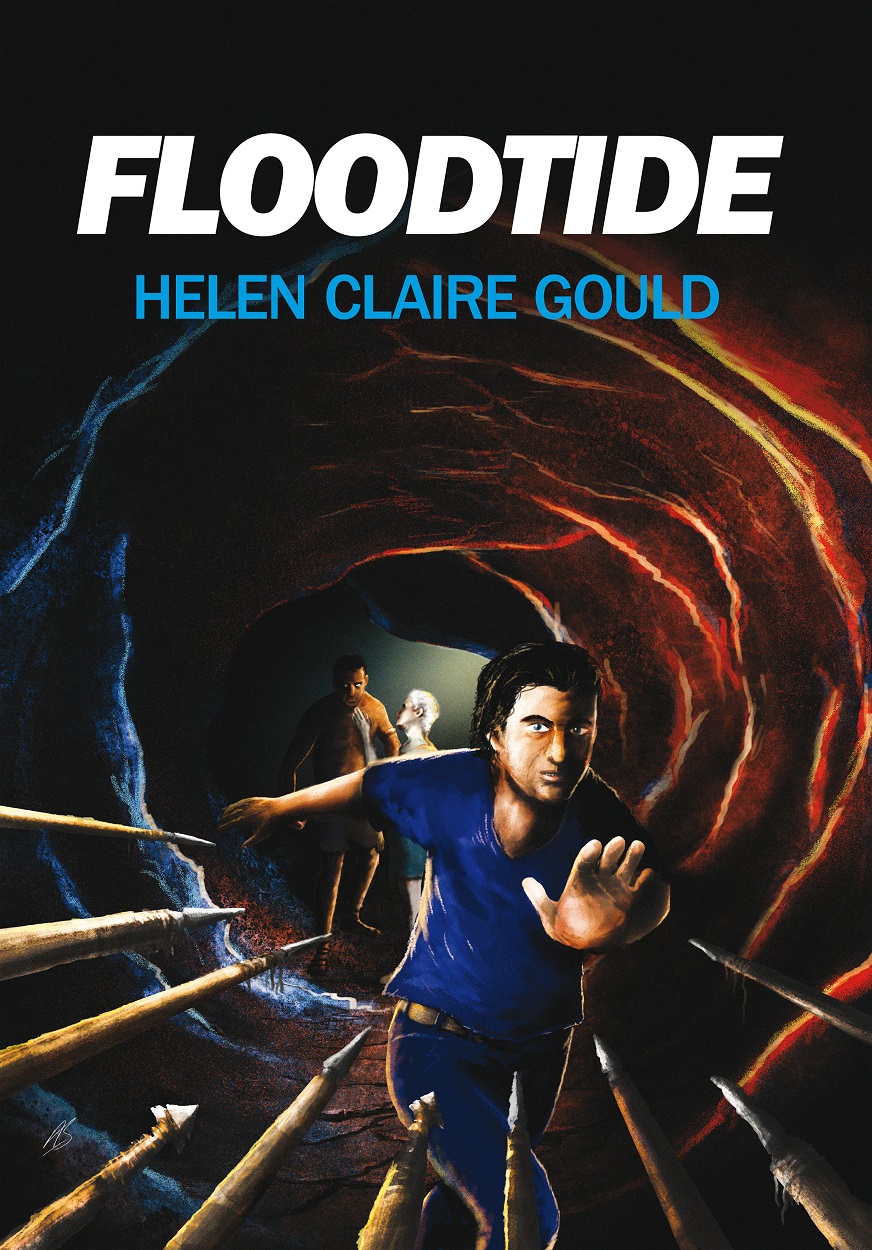
Something I get asked a lot, especially when I do a radio interview and reading, is how I came up with the idea for my novel Floodtide. The other thing I’m often asked is, “How long did it take you to write?”
The answer to the first question is easy. I had a dream. In the dream, I was two people at once, and it was the most emotional dream I have ever had. Specifically, I was two men at once (well, everything’s fluid in dreams!) and both of the men loved the mysterious third person in the dream, a female. The dream took place underground, but in the caves where it happened, there was both heat and ice. And the emotion I felt was passion, and it was the most passion I have ever felt in my life. It was more than passion. It was everything.
When I woke up, the dream was so vivid that it stayed with me. I kept thinking about it through the commute to London, jotting down ideas as the train swayed and clacked over the rails. We didn’t have a typewriter at home, so it was either handwrite everything or borrow someone else’s. I went to work, and asked my boss, Chris, if I could use the typewriter at lunchtime to jot down some ideas. He was fine with that. So I used to type a little of the novel up each day after that, from my handwritten notes done at home the previous night. I didn’t know why Jordas and Yado both loved the same woman (Soolkah), but it seemed like an important ingredient for the story, so I ran with it. It also seemed important that Yado was from a different, and opposing, tribe from Soolkah. As I worked on Chapter 1, it came to me that there had to be some important reason as to why Soolkah was risking her life away from her own tribe, and why Yado had left his tribe. Then I got it: Soolkah was being forced to marry someone she loathed, and no female in her tribe had ever stood up to her family and tribe before. As for Yado, he was on his initiation quest. The story developed, and I had a plan for what would happen, having just started writing to see where it would go. But I still didn’t know why both Jordas and Yado loved Soolkah. Nor did I know why, or how, Jordas and Yado had become telepathically linked; but I’d reasoned that was why, in the dream, I’d been both of them at the same time.
In those days we didn’t have computers in most homes, and even if that had been so, we wouldn’t have had one because my mum was a single parent. Life was quite difficult, and I’d had to leave school and get a job, so as to help out with the housekeeping. I never finished anything that I started writing, so the story eventually got put aside and I got on with the business of earning a crust.
I was 21 when I had that dream. When I was 33 I met my husband Mike, and when I was 35 we got married. We’d been married for a couple of years before we thought of starting a family, and of course, the pressure was on because I was getting older. I remember often thinking of some lines from a poem by Andrew Marvell:
 ‘“But at my back I always hear
Time’s winged chariot hurrying near…”’
I ended up having four miscarriages before I eventually produced a live baby, my son Jason, at the ripe old age of 42. From October 1992 to September 1995 I was out of work and stayed at home, writing furiously on the first computer I ever actually owned. The pressure of time was as much for getting the writing done as it was for having a baby.
In 1993, having finished one novel, joined a BSFA orbiter and sent it round for feedback, I started a rewrite of Floodtide. I started by typing in that 23,000-word draft from when I was 21 – and proceeded to gradually throw most of it away! The novel moved onto a new footing, and started to work much better, once I found out why Jordas and Yado loved the same woman: the Naxadans’ society, instead of being based on the nuclear family, was based on polyandry. I realised this after watching a TV programme on a tribe in either northern India or the Himalayas who practiced fraternal polyandry. The brothers in each family group were telepathically linked, and the link was so deep that they even experienced each other’s sense impressions – constantly. Furthermore, they could share information if necessary, simply by opening their minds to each other. Also, the all-enveloping nature of their form of telepathy required that they have a built-in safety net, the privacy shield. And of course, Jordas doesn’t have this at the start, despite (or perhaps because of) being highly empathic and sensitive to the emotions of others; though he does develop it later.
I also started doing a lot of research into geology and astronomy. I have always been interested in them, but first I did an evening class in geology and took the GCSE at the end of the year. I came out with an A*, the highest mark possible. By this time I knew I wanted to study geology at university (I’d never been due to not knowing what I wanted to do and the circumstances at home). Several of us wanted to do the A level, so the next year the college laid it on. I was actually the first person to do this course, and I became pregnant with my son during that time. I always say I must be the oldest person in the country to be a student and have a baby at the same time! Despite that and dyscalculia (the maths version of dyslexia), I passed my maths GCSE with a B, I came in the top 5 in the country for my English A level, and went to university on a raft of As and Bs to study geology. When I got to university I found I could study volcanology and planetary science, so that was just up my street! I came out of university with a 2:1, and came top in the dissertations. For that I compared volcano groups on Mars, Venus and the Moon with volcano groups on Earth.
Once I had introduced the idea of fraternal telepathy and polyandry, it affected the whole story. I developed a whole life system for the alien tribes: they lived in lava tubes, and the rock can be very sharp, so they needed tough skin, which evolved, making their initiation ceremonies for both males and females very necessary. The telepathic link between brothers is so deep that if one of them dies, the others feel it, and go through a trance-like state for about a month as they adapt: the maaj’nag’ur. And yes, I had to invent a language – English didn’t have the words I needed to describe  these new concepts. Sajamu is the Naxadan word for the sharing of the physical senses. Sometimes I had to use English words in a new way: day is represented, in an alien point of view, by ‘lighttime’, and night by ‘darktime’. Although I explained such words in the text as needed, on my website I published a glossary of the language. Of course, the computer threw a wobbly every time I typed “her fathers” or some variation, but eventually I sorted that out. Now it was time to send this novel around one of the orbiters I was in. I had encouraging feedback, but also had quite a lot of suggestions, all of which were either useful per se or which started me off in a different direction and led to the book evolving again. I still had some problems to solve, but eventually did so, and in a way which felt as if it were in keeping with the internal logic of the story, as well as in a way which is satisfying for the reader.
So Floodtide is very much a novel of first contact, but Jordas’s journey as he tries to rescue the tribespeople from their dire situation and safely rehome them elsewhere also parallels the journey I went on in writing it and publishing it. I had sent it off to various publishers in the 90s, (and received some useful feedback) and again when my health nosedived in 2008 due to me developing rheumatoid arthritis. The second time around there were fewer publishers and they all wanted submission via an agent. One of them kept the submission for a long time, but didn’t bite in the end, and I was becoming too ill to work at a job outside the home, and there was another recession, so my husband suggested I stay at home and concentrate on my writing. I’m not sure if he expected me to publish Floodtide myself, though. I eventually realised I wasn’t young enough or fit enough (at one point I could hardly walk) to wait for a publisher to take me up, and decided to publish the novel myself. As I began treatment and my health improved, I started looking into publishing on Kindle, and having done that I decided I needed a print version too.
The novel’s title went through several changes. It started off, in 1975, as Survival of the Fittest. At that time I was going to kill Jordas off at the end of the story, because I figured that he would prove not to be the fittest to be with Soolkah. That was before the polyandry idea. David Gemmell, whom I went on a course with whilst writing draft 2 of the novel, suggested that it wouldn’t be a good idea to kill Jordas off in case I wanted to bring him back later. Then later I toyed with the idea of calling it Calyx. The calyx in a flower is the outer part that protects the petals, so the idea was that as Jordas finds out more about the two tribes and their society each layer is stripped away. Then, because the approach of the asteroid to Naxada will eventually lead to the flooding of the underground tunnels they travel and caverns they live and farm in, I came up with the title Floodtide. I rejected Highwater Impact as too complex, although very much reflecting the alien point of view (the Naxadan term for a flood translates as “highwater”) and Jordas’s point of view (he is a geologist, astronomer and planetary scientist). Floodtide the book became, despite the fact that it’s not a unique title. And because the tribes practice polyandry, I had a way of keeping Jordas alive, and the means to bring him some relief from the jealousy and discomfort he feels as a result of having to share the woman he loves with the man he is telepathically linked to.
Floodtide isn’t just an SFF novel of first contact, it is also a story of mistaken jealousy, action adventure, a road movie, a disaster movie, and the alternative romance. If you think you’d enjoy all of these things rolled into one, you could take a look at it on www.Zarduth.com, my website, where it is currently being serialised. Chapters 6 – 8 are up there to read now. It is available to buy in print via Paypal from the website or on Kindle as an e-book. I felt the postage overseas would be prohibitive so suggest the Kindle version for anyone outside the UK wishing to read it.
So, how long did it take me to write Floodtide? A mere 40 years. I had the dream when I was 21 and I published the print version last September, when I was almost 61. I have lived, breathed, eaten and slept Floodtide for so many years that it is an irrevocable part of me. It has guided my life for a number of years, and I hope you enjoy reading it as much as I have enjoyed putting it together.


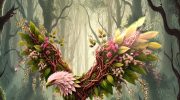

Can I just draw readers’ attention to the fantastic artwork on the back and front covers? It’s by Mr Alex Storer, whose recent guest posts can be read by clicking the two middle links below.
It might also be worth mentioning that currently Chapters 9 – 11 are up on the website.