We’ve talked to Ninth City Burning author J. Patrick Black about his new book being released by ACE on September 6th.

Welcome to SFFWorld, many thanks for giving us some time here. In your own words, who is J. Patrick Black?
Patrick Black is a long time fan of fiction in all its many shapes and forms, though sci-fi and fantasy have always held a special place for him. An amateur writer for years, he has recently graduated to professional status (and while this will make him ineligible to compete in the Olympics, he’s still pretty happy about it). While Ninth City Burning is his first novel to be published, he’s written several others that will likely go no farther than his own desk, all the while working a diverse if not necessarily exciting series of jobs ranging from video game design to writing briefs at a local district attorney’s office. He will, on occasion, refer to himself in the third person. He’s positively thrilled to be publishing a book, and also delighted to be here at SFFWorld.
How would you describe Ninth City Burning in your own words? What do you feel is unique about your story?
Ninth City Burning is, at its core, a story about people. The setting might be an alien one, and the events described fantastical, but I wanted to write a story around characters readers could recognize, characters they would find familiar and relatable. As long as I did that, I felt like I could get pretty wild with the plot. The plot itself centers around a war five hundred years after an invasion of Earth. The invaders brought with them a power humanity had never seen before, against which all our weapons and defenses were completely useless. It looked disturbingly like magic, and it allowed these invaders–dubbed the “Valentines”, after the day the invasion began–to sweep the planet in a matter of days. The only thing that prevented them from wiping out humanity completely was the discovery that, once this power was introduced into the world, we could use it too. We called it “thelemity”, and used it to develop tools, weapons, defenses, built an army to fight back. When the story begins, the resulting war has been at a stalemate for centuries, but the Valentines are about to mount an attack that will throw Earth into peril once again. The characters of Ninth City Burning come from all around this future world, from the gleaming cities built using thelemity, to isolated settlements whose sole purpose is to provide supplies and soldiers for the war, to the wilds of ruined Earth, where survivors of the invasion have built their own–often savage–societies. Each is drawn into the war in a different way and for different reasons, but to survive they have to work together, fight side by side. It’s these characters–their personal struggles, their relationships with one another–that, in my opinion at least, really make the story.
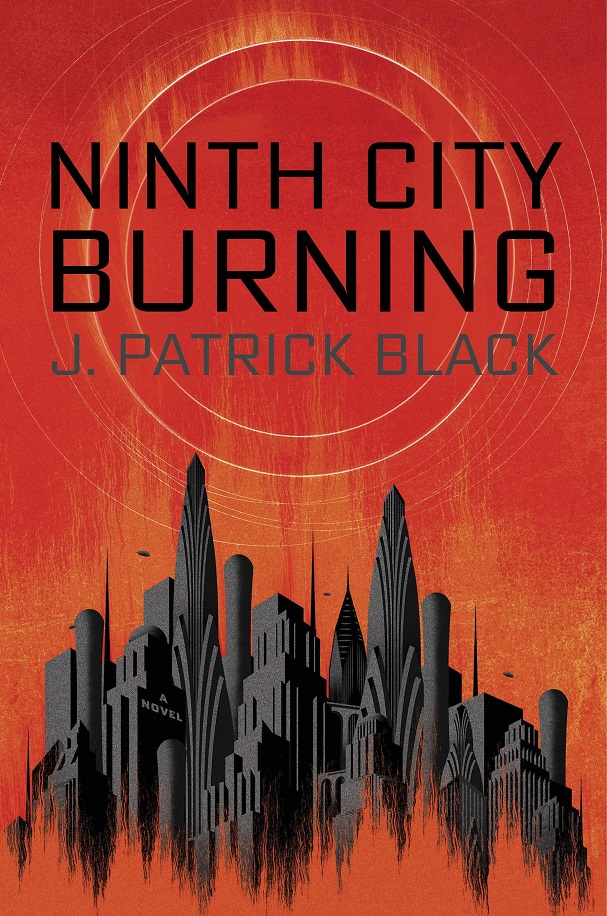 What goals might you have set for yourself when writing Ninth City Burning and how do you feel about the end result?
Probably the most significant goal–I thought of it more as a challenge, really–was to tell this story from a wide variety of perspectives, and to do it all in the first person. That meant coming up with a unique, distinctive voice for every character; it was definitely a daunting prospect, but I felt it was necessary if I wanted to achieve the story’s deeper aims. I wanted this to be the kind of story where everyone had a voice. I knew it was infeasible to do that for every single character from beginning to end, but I could at least choose a cast with very different backgrounds, experiences, and points of view. I’ll leave it up to my readers to decide how well I succeeded, but I do feel it produced something I wouldn’t have achieved otherwise. For one thing, it forced me to really delve not only into the life and history of each character, but into their patterns of thought as well, and that ended up expanding the story and its world in ways I hadn’t expected. This is a war story, and to me that means it should be possible for anyone to die at pretty much any time, so I wanted each character to be able to carry the story should the others meet an untimely end. It meant I couldn’t play favorites, couldn’t devote too much of the plot to any one person. They all had to have their own emotional arc and trajectory, all had to be closely involved with the plot. It certainly wasn’t easy, but it was an immense amount of fun (most of the time, anyway), and I’m very happy with the way it turned out.
How did you get the idea in the first place and have it evolved much since the first draft?
The story actually came together pretty gradually–it wasn’t one of those times where an idea arrives in a sudden flash of insight or a dream or something like that. I think anyone who really loves science fiction and fantasy has an idea for some alternative reality kicking around in their imagination, even if only in the form of vague ideas or questions, what-ifs you like to ponder. That’s just the kind of reader speculative fiction draws, it seems to me. In my case, I’d had little bits and snippets floating around for years and years, but nothing that I thought would make a really good novel, one I would be excited to read myself. It wasn’t until I began mulling the idea of war and its effect on young minds that something began to take shape. This was probably late 2012 or early 2013, when the Syrian Civil War was in the news quite a bit, and I expect that colored my thinking somewhat. I read books about child soldiers, in particular Ishmael Beah’s A Long Way Gone, and what struck me most was the way these kids who had been forced into real war, and experienced all the awful aspects of combat, would still sometimes think and act with all the innocence of children. It made me think about Ender’s Game by Orson Scott Card, one of my all-time favorite novels, and how in a lot of ways the characters who populate that story aren’t really children–you can almost forget while you’re reading that Ender is only six years old when the story starts. It made me wonder what a normal kid, raised in relative security–not a super genius like Ender Wiggin, or someone like Ishmael Beah, who had to endure the lawless insanity of Sierra Leone in the 1990s–would react to the necessities and responsibilities of war, and what sort of war would require such a soldier. That gave me the idea for NCB’s first characters, and they became the kernel of a much larger story. All those floating snippets of ideas began collecting around them, and before too long I had a whole world.
The basic idea has indeed gone through quite an evolution since I began putting it to paper. I started out with three very young protagonists–all around twelve years old–but eventually expanded the cast to include a set of older characters as well, and even ended up cutting one of the original three (well, let’s say “reserved for later” rather than “cut”). The overall plot actually remained pretty static throughout successive drafts; what changed the most was who told the story and how it was being told.
Ninth City Burning is the first book in a series. Do you have the whole series mapped out already?
Yes and no. I’ve plotted out most, if not all, of the story’s large-scale events, but as for the characters themselves, the future is more vague. They all have their own goals and challenges ahead of them, but I wanted to leave room for them to grow in ways I hadn’t necessarily intended from the outset. One of my favorite things about writing is the way ideas present themselves in the moment, so I had to allow for that. Also, this is a war story, and war is by nature unpredictable–I want the story to include something of that chaos, that feeling of upheaval. I’m afraid if I plot out too much ahead of time, I’ll end up telegraphing that to the reader. And of course writing is a process; you can never be exactly sure where it’ll end up (I can’t, anyway).
What are your hopes and expectations now that your first novel is being released?
Well, naturally I’d like every man, woman, and child on the planet to read it, but being published at all is so far beyond my expectations starting out that everything else feels like a windfall. I’ve been writing for years without generating much interest from anyone, and I was fully prepared for my latest manuscript to get the same response, so when I found out actual literary agents (agentS, multiple!) wanted to represent me I was pretty over the moon about it. A multi-book deal seemed almost too good to be true. There are still days when I don’t quite believe it. I get to be a professional writer, get to send my work out to the world, and it seems crazy to ask for more than that. But I will anyway: please buy my book, and don’t stop with one copy, either–buy as many as you can, for yourself and all your friends.
Getting published by a major publisher has to be every author’s dream. Can you tell us a bit about the process that led up to Ninth City Burning being published?
Yes, definitely. It was a long, long way to go, for one thing. NCB isn’t my first book, or my second–I did a lot of writing before I got to this point. There was one book, an historical novel, that I started in college and rewrote periodically about every two years, occasionally taking a break to work on something else. My most recent version, more of a young adult take on the same historical premise, got some nice comments from agents, but still no offers of representation. This was around 2012 or so, when a lot of self-published authors were beginning to find some real success, so I started looking into that as a possible avenue for my work as well. After taking a really hard look at the market, though, I wasn’t convinced my book was the kind that could really succeed through self-publication. So instead I decided to take another story I’d been fiddling with, one I thought would stand a decent chance as a self-published novel, and make a serious go of it. I told myself when I’d finished I’d look for representation, and if I didn’t have an agent within a year, I’d distribute it as a self-published title, either free or at a very low price. This time around, however, I got a lot of interest almost immediately. Kirby Kim was one of the agents who’d given me some really kind and thoughtful feedback about my last novel, so he was right at the top of my list when I started querying this time around. Once I signed with him, things happened relatively quickly: we did another round of revisions, and soon after that we had an offer with Ace. Jess Wade at Ace had some really great ideas for the book, so there was some more revising to do to bring everything into alignment, but after that I got to watch the actual, physical book come together, which has been pretty thrilling. I started writing NCB late in 2013, so it’ll be just under three years from then to publication in September. It’s definitely been a trek.
How did you start writing? Was there a particular book or moment in your life that spurred you on?
I’ve loved fantasy and science fiction as long as I’ve been able to read. Ursula K. LeGuin’s novels were particularly significant for me, especially in my earlier years (Brian Jaques’s Redwall series was another standout). I didn’t seriously set out to become a writer until college, though. I took a creative writing course and just had a blast. After that, I was hooked. I’ve been discouraged at times, but I never really stopped. Writing is fun for me; it’s really my only hobby–or was, I guess, now that I’ve gone pro. As a writer, I think there’s inspiration to be found in just about everything I read, even those books I don’t quite connect with, but there’s something very special about encountering a book that really knocks your socks off. Vonnegut does that for me, particularly Slaughterhouse-Five. So does Margaret Atwood. Michael Chabon’s The Amazing Adventures of Kavalier & Klay. The History of Love by Nicole Krauss. One Hundred Years of Solitude by Gabriel Garcia Marquez. Richard Russo’s Empire Falls. I remember first reading George R.R. Martin’s A Game of Thrones as a kind of revelation, though. I’d been in something of a rut with fantasy, and his books really opened me up to how versatile the genre could be. I’d don’t have much formal training in writing fiction, but I feel like I’ve learned a lot through reading, especially short stories. Lorrie Moore, Junot Diaz, and Alice Munro are a few of my favorites. Really, though, I could gush about books I love all day.
What’s next? Do you have more new and exciting projects you’re working on?
Right now I’m hard at work on the followup to Ninth City Burning, but, as always, I’ve got snippets of ideas rolling around all over the place. I think it would be fun to try out a short story or novella, but for the present I’m sticking with the epic scale. Oh, and I’d like to get a puppy–does that count?
*****
Interview by Dag Rambraut – SFFWorld.com © 2016