“…it seemed as if there was nothing else happening in the world but the discovery that there was a parallel universe and it had been settled by the English…”
The time for tiptoeing around spoilers is over. The Fractured Europe Sequence has reached its third instalment, to be released on November 3rd, and what was tentatively revealed in the first book and was a central secret in the second has now become common knowledge in the world of Europe In Winter: we are not alone, and the aliens are more or less ourselves. Dave Hutchinson uses this as a platform for reflecting on strands of ideological extremism that trouble or control contemporary society, depicting both the normalised and unacceptable sins we inflict on each other, as well as the drives for independence and solidarity that stand against them.
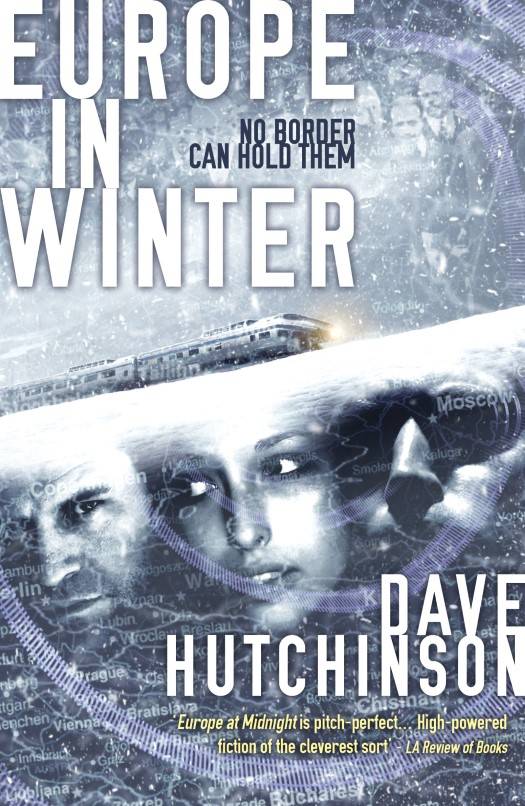 Here is what is known: decades before the first world war, a crackpot English cartographer discovered a small rural community existing off the map, and began defining this pocket universe into ever greater existence. This madman eventually charted an entire continent lying alongside Europe where a very traditional English culture flourished, unknown to the world’s governments and unconstrained by the tussling of modern geopolitics. Yet, for those with the knowledge to do so, “The Community” lay close enough to Europe for individuals to cross over at a few carefully hidden locations — allowing it the freedom to influence, spy on, and strike out at its neighbours from perfect hiding. You can’t suspect your enemy if you don’t know your enemy even exists…
Now that ignorance has been dispelled, and The Community has stepped out of the shadows of reality itself to take a place at the global table. If there is an opposite of a power vacuum, The Community embodies it: decades of stealthy subterfuge give them an intelligence edge that extends to having loyal agents already in high places; beyond their unseen borders lie vast and largely untapped material resources, with the ordinary world a ready-made marketplace desperate to buy; their environments, unsullied by pollution and over-population, are a tourist’s dream; they have a blank slate with the other nations of the world, able to offer friendship or enmity without ties to ancient conflicts; but most of all, they are both rich and ruthless.
Europe has effectively doubled in size. At a stroke, the world has become a larger place for the first time since mankind left orbit and looked down on the planet. But the irony of globalisation has been the shrinking of the world — and as different cultures come into ever more intimate contact whether they want to or not, conflict is more inevitable as collaboration. Europe has always been a target for terrorism, and the splintered Europe of the future is no exception. The latest strike is a devastating atrocity, but who is behind it, and is it truly terrorism or “just” an act of lethal industrial sabotage? While the new super-powers exchange shots and hostages with each other, an assassin who neither knows who he works for nor his own mind lies in wait for a target whose knowledge could change the world in ways that, until recently, were unimaginable.
Enter Rudi of Les Coureurs des Bois, a mostly-secret, semi-legal organisation of smugglers and message-bearers who view borders as an inconvenience to be stepped over, if also their raison d’être. Rudi joined their number to discover new sides of the world, but ended up discovering proof of the entirely new world lurking behind the old one. His decision to dig deeper has grave consequences for himself and for those close to him, and maybe for the fates of his fracturing Europe and The Community as well, setting him against aloof figures of authority on both sides.
But Les Coureurs themselves may be far from what they appear. Rudi’s interventions in the game at hand could find him kingmaker of a complex new world — or he may be little more than a pawn commanding other pawns, his moves anticipated by players he cannot even see. Not yet.
Europe In Winter heralds the welcome return of Rudi to centre stage. The former chef turned smuggler-spy who kicked off Europe In Autumn became only a background influence in Europe At Midnight. Now we find him risen through the ranks of Les Coureurs to a position of seniority in something that arguably doesn’t even exist and certainly has no leaders; the kind of mysterious maestro who orchestrates from the shadows and acts as though he knows all the answers, even if he doesn’t share them with the agents he directs. However, despite gradually taking on a mantle of command and engaging in actions that could redefine more than one world, Rudi remains relatable whenever he lets his guard down, often over a good meal.
There’s something of a tradition in espionage fiction for presenting spies as gourmands. James Bond knew his way around a dining table, as did many of his enemies; even more so Harry Palmer, whose romantic escapade in The Ipcress File came at the end of a home-cooked meal rather than a cocked eyebrow and a suave one-liner. Rudi’s culinary background takes this a step further, and as with his predecessors it adds some humanity to a larger-than-life role. His evolution into what is effectively a spymaster never supplants his interest in food, and there’s never any question that he’s happier sweating over a hot stove than he is over the independence and survival of continental culture — an element of the ordinary in the midst of the extraordinary.
Of course, anyone who’s visited Europe knows that food and the culture go hand-in-hand, it is at least as much a point of pride as any other national characteristics. On this point there is a clear distinction made with The Community, which earlier in the series is criticised for having on its menus only the kind of stodgy, post-war British cuisine which ex-pats on the continent still have to deny persists to this day (this slander in spite of the UK having all the best restaurants, chefs, etc. etc.). Forget about assassinations, WMDs, bioweapons and genocides: dinner may be the clearest indication of The Community leadership’s villainy… and acceptance of what’s offered a damning indictment of its population’s largely complacent conformity to their rule.
If The Community represents the top-down model of a quiet, civilised society long imposed by the Old World’s old cultures, Les Coureurs echo the functional anarchism at the heart of Ursula Le Guin’s The Dispossessed: a wholly decentralised quasi-entity, not so much self-governing as spontaneously reforming to satisfy the needs of others. If Les Coureurs ever have leaders, they only come into existence when the client in question also happens to be a member — and Rudi has a job that needs doing. However, as on Le Guin’s Anarras, misdirection of resources (or even just offending individual or collective sensibilities) could lead to impediments or reprisals. It’s a tightrope-walk between independence and co-commitment that anyone exploring collaborative freelancing in the real world may find familiar, if on a rather less threatening scale.
Europe In Winter brings the story of Rudi’s growth full circle, encapsulating within it the weird discoveries he and his allies have unveiled during his journey back to the place he started. But outside that circle we also glimpse another layer to this world, already expanding into new and unknown territories — if there’s a flaw to the novel it’s that we don’t get to explore them right now, and are left to hope for much more to come. Europe In Winter is both a fine conclusion and an enticing set-up within a series that promises to continue overturning expectations as it grows.
Review by Andrew Leon Hudson – SFFWorld.com © 2016