

 “Yet across the gulf of space, minds that are to our minds as ours are to those of the beasts that perish, intellects vast and cool and unsympathetic, regarded this earth with envious eyes, and slowly and surely drew their plans against us.” (Chapter 1)
In Science Fiction there can be few other books that have been so important. Perhaps HG Wells’ earlier science-fiction romance, The Time Machine, published in 1895, might be close, or Jules Verne’s 20 000 Leagues Under the Sea, published in 1870, may match it in terms of the inspiration it created, both then and now. Some, such as Brian Aldiss, would suggest Mary Shelley’s Frankenstein (1818). But even those may not be as well known as The War of the Worlds. Multiple film versions, television programmes, audio versions, comics, musicals and radio shows, including the infamous Orson Welles Mercury broadcast on Halloween in 1938, have kept the plot, at least in general terms, in the public zeitgeist. Even those not fans of the genre know the story of this one.
Ironically, I think that in some ways this universal presence may have meant that the novel has become less-known than it should. People don’t read it as often, because they know the other versions and therefore feel they don’t need to read it.
In my opinion, they are missing out.
Some slight context here. As a youngster of about seven or eight, in the early 1970’s, I first encountered Herbert George’s books through George Pal’s movie versions of The Time Machine (1960) and War of the Worlds (1953) when shown on British national television. I was amazed by the concepts of alien invasion and time travel and this led to me reading the text versions. By the age of fourteen I had read (and reread) all of Wells’ ‘scientifictions’ – The Invisible Man, Food of the Gods, Days of the Comet and so on. The Time Machine and War of the Worlds were still my favourite Wells novels, though I had expanded my reading list to Clarke, Heinlein and Asimov. I was hooked, and The War of the Worlds was a major reason for it.
Nearly forty years on, I’m still reading the genre and still reading Wells, especially the two novels that got me started.
So: what is it that keeps me reading a book over one hundred years old?
What surprises me most, even now, is how accessible the book is. Though it can’t be regarded as modern, its vocabulary is not as dense and difficult to read and understand by readers in the 21st century as some of its contemporaries. It is still eminently readable, which is why in part I think the book has never gone out of print.
There is no flab here. The book is honed to just ‘the important stuff’. Whereas a more modern book would build on the history of the Martians, create sub-plots and expand the list of main characters, as indeed some of the other versions have done, the original is surprisingly, and pleasantly, succinct.
This is mainly because the mainly linear plot is told by one person. Though a wider picture is given when the Narrator tells of events in London through the events of his medical student brother, other than this, the story is all about the effects on our reporter narrator.
The benefit of this is that the narrative creates a focus that concentrates the reader. The story is not about the epic-ness of global invasion but instead the effects of a global invasion on a much smaller group of people (though admittedly still a few million people) in one city. What Wells does extremely well here, as he does in much of his writing, is examine the situation through social context. Whilst there is the old lapse into Cock-er-nee dialogue, it is nothing that is too ‘Dick-van-Dyke-loike’. Instead we get glimpses of the collapse of society and the effect on the general public – a businessman taken by the Martians for food, an old man trying to save his valuable orchids from stampeding people. There is little or no mention of the government, which creates a timeless element to its sense of place. What this does is, despite the book’s age, base a science fiction story into some degree of mundane normality, which makes it all the more memorable. Whether it happens now, or happened a hundred years ago, it is the reactions of the people – the shock, the bravery, the horror, the despair, the hope – that make it successful, and make it work, even now. It is a story about the collapse of a society – the English social classes and the imperialist British Empire – because, in the onslaught of an alien invasion, all are equal.
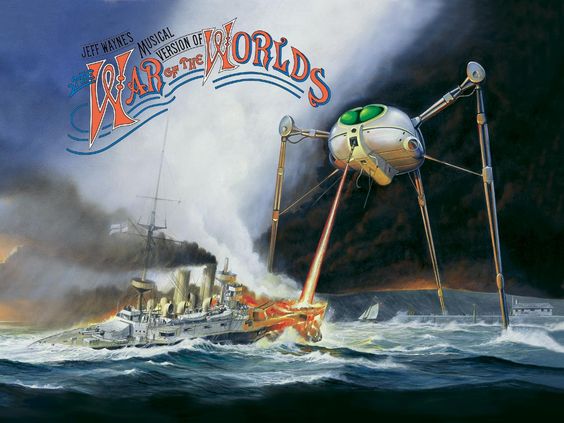
Those who know the story through other sources may find the original different. For those who know the George Pal film version, you may be disappointed that the novel is set in Victorian England rather than 1950’s Los Angeles. For those who know the Jeff Wayne Musical version, there is no Carrie, but instead a wife that our narrator leaves (hopefully) safe in Leatherhead. Nevertheless I did find it refreshing to read of travels by horse carriage and bicycle rather than jet plane and motor car (though both are mentioned.)
Part of the reason the book works is because that the calamitous events do not happen quickly. Telephones barely exist, so news is passed on through newspapers, often incorrectly reported and usually a day or so later. The result is that we have people running away from the Martians whose solution is to get to the nearest pub and get the gossip whilst getting something to eat. The world of Victorian England is one strangely of isolation, with parts of urban London still retaining rural characteristics. Whilst one part of the city is being consumed by the Heat Ray, a neighbouring region has the public wandering alongside the Thames. This gives the horror time to evolve and grow, rather than all be seen instantly on global news, as it would be today.
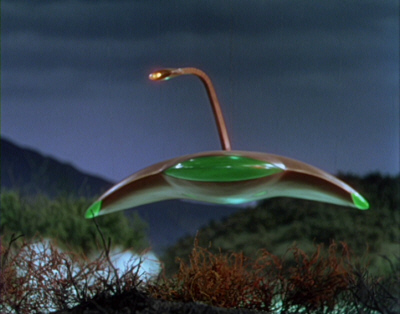
The ending is now a cliché (and no, I’m not going to repeat it here), but at the time of first publication must have been a logical and plausible – and, dare I say it, a resoundingly scientific – conclusion. One of the strengths of the book is that the ending is a proper one. There is no obvious set-up for the next book in the series, no cop-out conclusion so that sequels can be produced.
I look forward to reading how Stephen Baxter manages it in his authorised sequel, due January 2017.
For all its age, The War of the Worlds is still surprisingly, shockingly good. It has stayed in the human consciousness for good reasons. Whilst undeniably dated, there is a certain charm and power that is retained, even now. It is worth a read.
The War of the Worlds by HG Wells
First published 1898 by Heinemann; first serialised in Pearson’s Magazine April – December 1897.
Review by Mark Yon


Your introduction to Wells sounds exactly like mine at the same age (and we are surely far from the only ones). Yes, last time I read this one years back, it was very accessible.
Thanks, Stuart. I’m sure we’re not the only ones to have found Science Fiction this way too…
Wells and Verne remain among my favourites, up with Asimov (IMO the greatest).
Jeff Wayne’s musical of War of the Worlds is among my favourite albums of all time (and I’m a muscician, playing guitar, bass, banjo, mandolin, etc).
The Orson Welles radio version, is basically the original troll. All credit to him.
I’m forever bothered by flaws in modern sci-fi. Pew-pew bang in space. It’s a vacuum you idiots, there is no medium for sound travel. Never ending paradox without reason or cause in every time travel flick.
Can someone please write some plausible sci-fi for film/TV in the 21st century? It seems not.