
When Tad Williams published The Dragonbone Chair, the first installment of the Memory, Sorrow and Thorn trilogy, fantasy was in a transition state, though many people weren’t aware of just how transitory the time was. It was 1988, when The Dragonbone Chair hit bookshelves, exactly a decade after Terry Brooks’s The Sword of Shanarra became the first Fantasy novel on the New York Times Bestseller list. As a result of that (along with the success of Stephen R. Donaldson’s Thomas Covenant novels), Epic Fantasy grew and became a more commercially viable genre making for shelf space dedicated specifically to Science Fiction and Fantasy.
Many would say that Memory, Sorrow and Thorn is a darker, more modern approach to the same type of story Tolkien was telling in Lord of the Rings. Although Lord of the Rings did heavily influence Tad Williams, a couple of writers / books published prior to Lord of the Rings had as much influence. One of those works is Mervyn Peake’s Gormenghast, a dark literate fantasy published in 1950 featuring an ancient (possibly haunted?) castle. Tad has also mentioned in quite a few places how influential Michael Moorcock was on his own writing. Tad wrote an introduction to one edition of Gormenghast and contributed a story (“Go Ask Elric”) to Tales of the White Wolf an anthology of Elric stories by various authors.
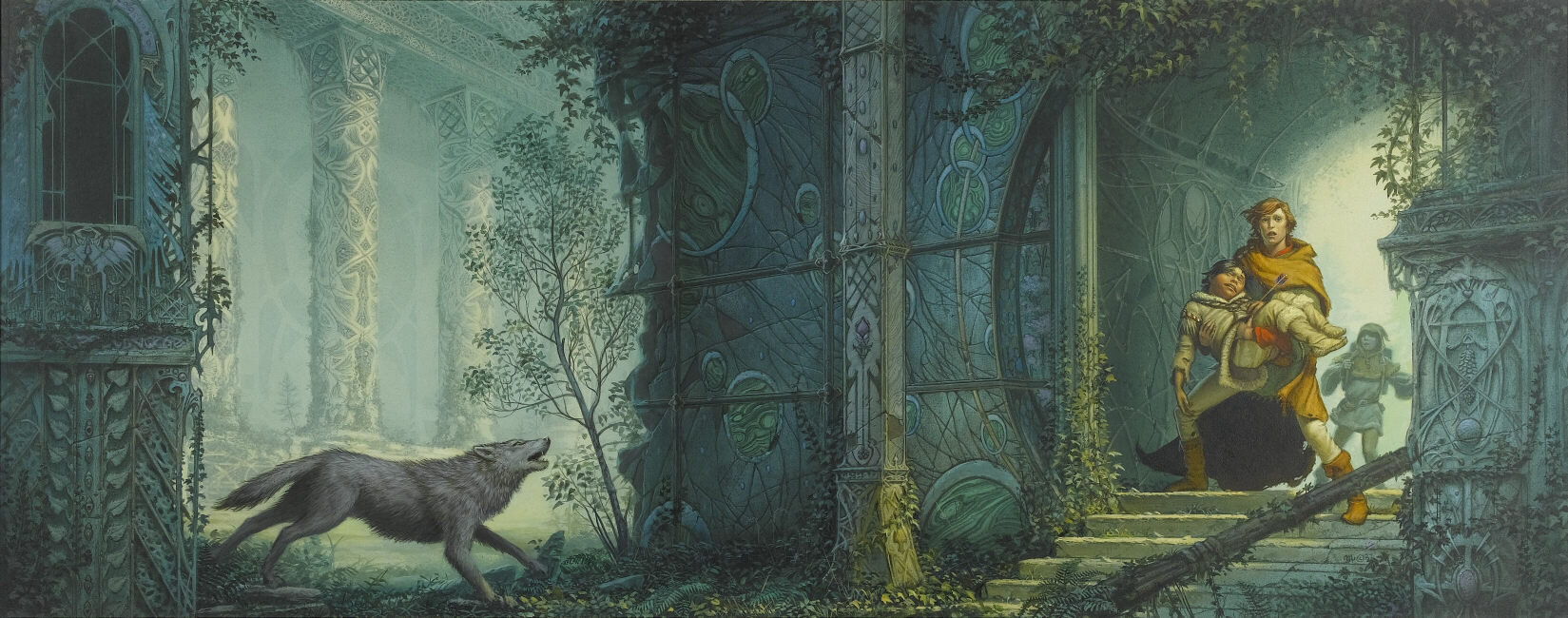
In The Dragonbone Chair, you can see these writers influence early and often. Most blatantly, the Hayholt is dark and ancient much like the castle in Gormenghast. The Sithi are long-lived and can be seen as a commentary on the ancient race of elves as depicted in The Lord of the Rings. The darker of the elves, the Norns, can very much be seen as a hybrid of the beautiful Tolkienish Elves blended with Moorcock’s albino Melnibonéans, the race to which his most famous character Elric belongs. Tad also mentioned (in this reddit AMA):
As I recall (it’s been a while!) the main inspiration was me wondering what happens after a mythical (or semi-legendary) Great King like Arthur or Charlemagne dies. That started me on thinking about the two brothers, then the story just started to accrue ideas. There was also an entire level of my commenting on Tolkien and post-Tolkien epic fantasy, but that’s a long answer just by itself.
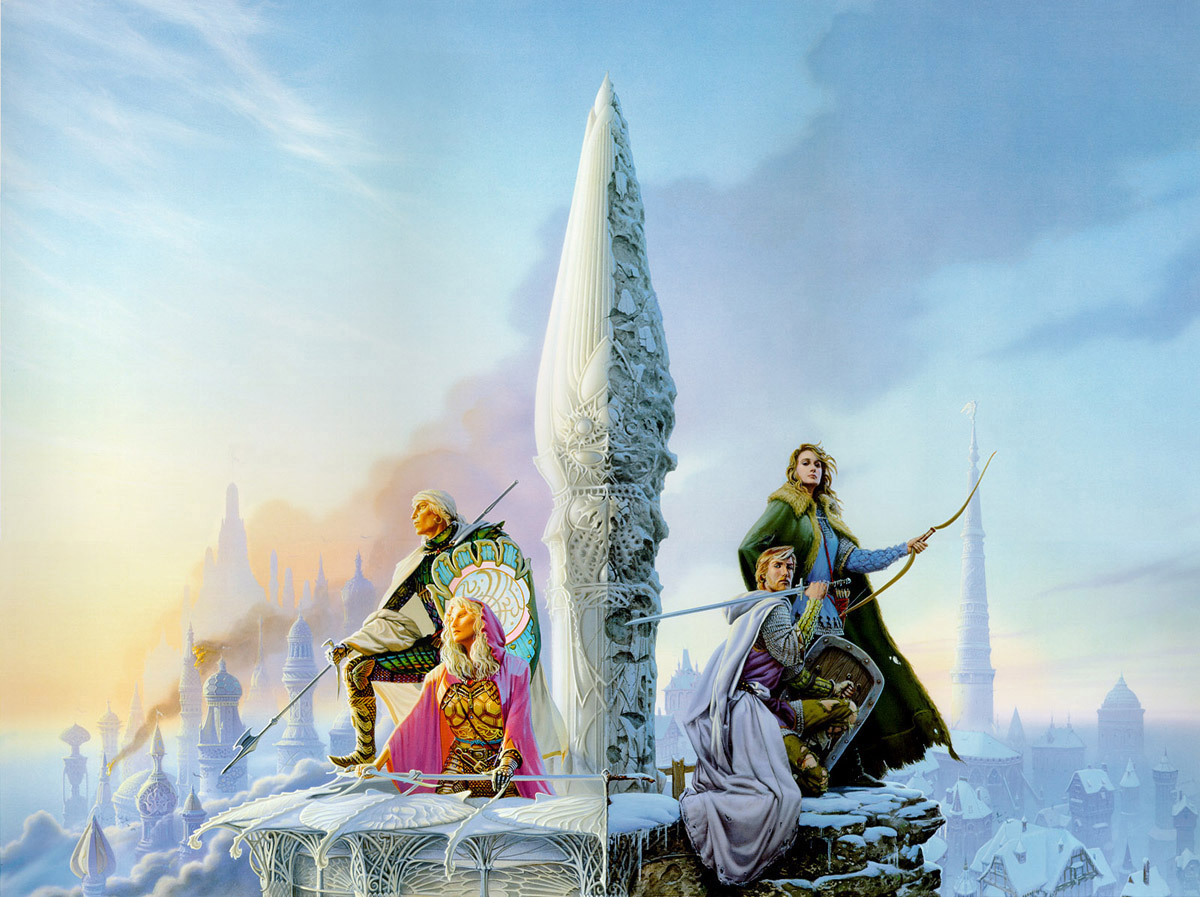
As the fate of the publishing world would have it, Moorcock’s Elric stories were published in book form via DAW books with iconic covers by Michael Whelan, the same publisher and cover artist for the three books of Memory, Sorrow and Thorn. Few artists are as associated with the genre and time as Michael Whelan was with fantasy and science fiction for much of the 1980s (and of course before and after that decade, too). The art is put most simply, gorgeous. Protagonist Simon Snowlock features on all covers and you can see his maturity and growth over the course of time as depicted by Whelan on each of the covers.

The trilogy was published over the course of five years and three novels, with The Stone of Farwell publishing in 1990 and To Green Angel Tower in 1993, hitting the New York Times Bestseller list. In other words, Tad’s audience grew and though his debut Tailchaser’s Song was well received when published in 1985, Memory, Sorrow and Thorn is the work that put him on the map of the genre and remains his most popular work.
Another way in which this series echoes Lord of the Rings is the fashion in which the mass market paperback(s) of To Green Angel Tower was published. Much like Lord of the Rings was split into three books, To Green Angel Tower was split into two books when published in mass market paperback, because it was so large. Anybody who has read through the hardcover of To Green Angel Tower might have required an eye doctor visit after finishing the book since the font was so small. As such, splitting the final novel into two books has many people considering this a quadrology, though I think “three book trilogy” as George R.R. Martin notes below is appropriate.
Two major publishing events after The Dragonbone Chair occurred – The publication of The Eye of the World by Robert Jordan in 1990 and the publication of A Game of Thrones by George R.R. Martin in 1996. That second one is the important and relevant one to this subject, because as many fans of Memory, Sorrow and Thorn know, George R.R. Martin has directly cited Tad’s work on this trilogy as inspiring him to write A Song of Ice and Fire:
Tad’s fantasy series, The Dragonbone Chair and the rest of his famous four-book trilogy was one of the things that inspired me to write my own seven-book trilogy. I read Tad and was impressed by him, but the imitators that followed — well, fantasy got a bad rep for being very formulaic and ritual. And I read The Dragonbone Chair and said, “My god, they can do something with this form,” and it’s Tad doing it. It’s one of my favorite fantasy series.
George went so far as to name characters in A Song of Ice and Fire as homage to Memory, Sorrow and Thorn: House Willum whose house of arms is a skeletal dragon and three swords, with the warring brothers of Josua and Elyas.
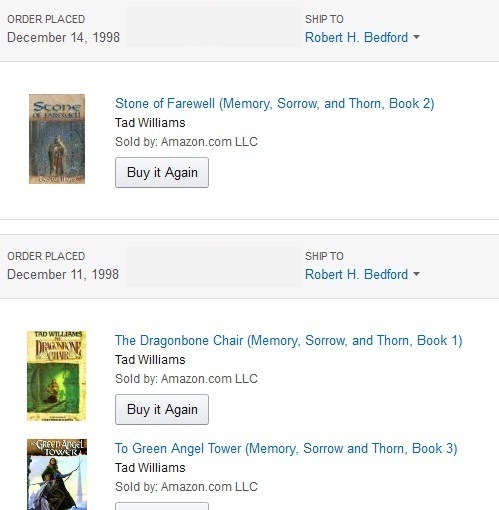 Personally speaking, Memory, Sorrow and Thorn is one of the first fantasy trilogies I read once I completed college (1997) and had more reading time that didn’t involve textbooks or assigned reading. I don’t recall *exactly* how I learned about the books, but seeing the series mentioned in the nascent days of online book reviewing (like this Web site or some trusted reviewers at amazon) was perfect timing when I wanted to devour whatever fantasy I could at the time since I came across this complete series. I was lucky enough that at the time, I was able to snag each book in the series in Hardcover from amazon.com (in fact, the second order I ever placed with amazon was for these books). I also was a big fan of Michael Whelan’s art (introduced to his wonderful work through Stephen King’s The Gunslinger) and I saw that Whelan did the art for these books and I knew I needed to read them. I also recall seeing Memory, Sorrow and Thorn on this list, “Judgment Day: 100 Books Thou Shalt Read Before You Die,” from an old issue of Inquest Magazine. My then girlfriend and now wife’s brother had a subscription at the time and this was laying around the house. It is interesting to compare a list from nearly 20 years ago to what folks consider similarly themed lists.
While the series is grand and epic in scale, a major theme and focus of the novels is the clash of civilizations/societies with a goal of the antagonists to be an unmaking, there are also intimate notes throughout. Like many Epic Fantasies, there is a wide cast of characters, and multiple groups of characters in different parts of Osten Ard through whom we see the upheaval set in motion by Ineluki and the Norns. Set against that epic backdrop is the Bildungsroman of Simon; from his introduction as a kitchen boy who knows only the confines of the Hayholt (and a limited knowledge of the ancient structure) to his coming of age in the wide world and how the epic events shape the man into whom he grows. As I’ve remarked elsewhere, Tad has a firm grip on telling dark tales and there are some horrific scenes in these three books that evoke terror.

As of this writing, it has been nearly 30 years since The Dragonbone Chair published and in 2014, Tad announced to the delight of many, many fans that he was returning to the world of Osten Ard with a story set 30 years after the conclusion of To Green Angel Tower, which is what prompted my re-read of the series a couple of years ago. With The Heart of What Was Lost now published, we only have a few days before the sequel series The Last King of Osten Ard begins with The Witchwood Crown.
© 2017 Rob H. Bedford




Tad is also really in-touch with his readers and fans. I wrote him a letter, back in the 90s when I was still a starry-eyed kid dreaming of being a professional sci-fi writer. He took the time to write me a very personal and encouraging response… something that has always meant a lot to me. I’ve read and enjoyed all his work, and am thrilled that he will be sharing more of his Osten Ard adventures with us.