Kevin Hearne, author of the enormously successful Iron Druid Chronicles, launches a new series with A Plague of Giants, the first installment of The Seven Kennings. Although the Iron Druid Chronicles features global mythologies and spans centuries, the focus on one character give the series a more intimate feel, especially with the first person narrative structure. Kevin employs a first person narrative structure here in the(this?) Epic Fantasy saga, but the cast of characters who “speak” to us is significantly greater.
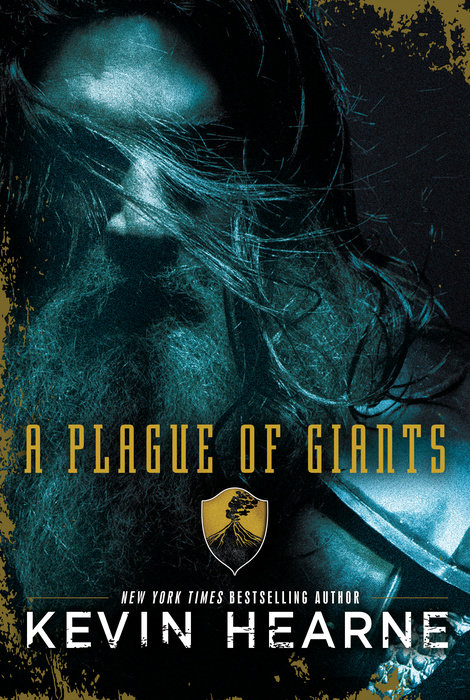
From the author of The Iron Druid Chronicles, a thrilling novel that kicks off a fantasy series with an entirely new mythology—complete with shape-shifting bards, fire-wielding giants, and children who can speak to astonishing beasts
MOTHER AND WARRIOR
Tallynd is a soldier who has already survived her toughest battle: losing her husband. But now she finds herself on the front lines of an invasion of giants, intent on wiping out the entire kingdom, including Tallynd’s two sons—all that she has left. The stakes have never been higher. If Tallynd fails, her boys may never become men.
SCHOLAR AND SPY
Dervan is an historian who longs for a simple, quiet life. But he’s drawn into intrigue when he’s hired to record the tales of a mysterious bard who may be a spy or even an assassin for a rival kingdom. As the bard shares his fantastical stories, Dervan makes a shocking discovery: He may have a connection to the tales, one that will bring his own secrets to light.
REBEL AND HERO
Abhi’s family have always been hunters, but Abhi wants to choose a different life for himself. Embarking on a journey of self-discovery, Abhi soon learns that his destiny is far greater than he imagined: a powerful new magic thrust upon him may hold the key to defeating the giants once and for all—if it doesn’t destroy him first.
Set in a magical world of terror and wonder, this novel is a deeply felt epic of courage and war, in which the fates of these characters intertwine—and where ordinary people become heroes, and their lives become legend.
There aren’t many Epic Fantasies told through the intimacy of a first-person narrator, primarily because of the large cast of characters in such epic tales. Undaunted, Kevin has pulled off an ingenious device for retaining the first person narrator, despite the number of characters. A Raelach bard named Fintan assumes the guise of characters (through a ‘seeming’) to relay that specific character’s experience to a crowd of people, as if a historical tale is being told. In this case, the history of the land of Ghurana Nent being invaded by two armies, the unknown Bone Giants and the known and feared Hathrim Giants. Through Fintan’s seemings, the characters who witnessed these invasions, the magics of the world both known to some characters and newly discovered by others, and even some characters who were part of the invasion come to vibrant life. The bulk of the novel is comprised of chapters wherein Fintan does a seeming and assumes the guise of characters, but those passages are bookended by passages featuirng Master Dervan du Alöbar, a historian who shadows Fintan transcribes the oral history delivered by Fintan into more of a written history.
The magic in this series is what gives the series its name; Kenning. The characters are all aware of five Kennings, suspect there is a sixth Kenning, and have considered the Seventh Kenning all but myth. The thing is, they don’t know exactly what this Seventh Kenning is, but by novel’s end a few characters do know and much like any kind of military advancement (nuclear weaponry in World War II, Airplaines in World War I), the world will never be the same. As this is only the first of a planned trilogy, that change is only hinted at by some characters, though they know their own lives are irrevocably altered.
As to the domains of magic, or Kennings, one Kenning grants its bearer the abilities and powers that align with water, like traveling rapidly through water; another grants its bearer fire-based powers and abilities; yet another grants its bear earth-based abilities like our aforementioned bard; still another harmony and powers connected to plants; and finally, a wind-based power. These magics are indeed very-much tied to the world’s elements and their use comes with great cost, in some cases shaving many, many years off the lives of the characters who wield the magic.
Well-designed magic can get a story so far, but the characters who live in the world really help to carry that magic and connect with the readers and with this wide cast of narrators, Kevin Hearne has outdone himself. These characters are endearing, genuine, and hard to leave once Fintan closes a chapter on one to restart the story of another. Over the course of the novel, whilst Fintan assumes the guise of many characters, a few stood out more than others. One of which is the older gentleman Gondel Vedd a linguist tasked with deciphering the language of the Bone Giants who enjoys mustard perhaps too excitedly; Abhi Khose, a young man who breaks from his family for reasons he didn’t quite expect and comes into a power yet untapped in the world; and Tallynd d ö, a mariner whose kenning allows her to essentially become one with water allowing her to traverse oceans and extract the water of any living creature.
I’ve remarked in other reviews about the balance between global/epic and intimate/characterization and utilizing this clever storytelling device, Hearne manages to pull off that balance like an expert high-wire acrobat. Further, the immediacy is felt because of the relatively short timeframe in which the novel takes place, just three weeks.
If there’s anything that didn’t work for me, and I’m really picking nits here for balance, then it is how much this novel is set up and how little is resolved. A Plague of Giants is very much an opening novel of a series and as such lays a groundwork that raises more questions than it answers. A few characters had their arcs move significantly, others it seemed only the tip of the iceberg is shown. This is all par for the course with an Epic Fantasy series, but given what I just said in this paragraph, Kevin Hearne has me hooked with what he has shown and the potential paths this story and characters may take.
The easiest and most apt comparison is to Patrick Rothfuss’s Kingkiller Chronicle. Hearne’s prose is reminiscent of Rothfuss’s and the storytelling device is also reminiscent, even if Hearne turns the dial to eleven with the various point-of-view characters. Between Peter Brett’s Demon Cycle sequence, and now Kevin Hearne’s A Plague of Giants, Del Rey has been producing books that are physically as enjoyable to hold as they are to read. For A Plague of Giants, a glorious map by Kevin adorns the end papers and some lovely character portraits in a “Dramits Personae” precede the novel itself.
I’ve enjoyed the Iron Druid Chronicles a great deal and having followed Kevin Hearne on social media for a few years, I’ve been really looking forward to this novel. It did not disappoint. Hearne’s linguistic aptitude and prose are more potent here, I get a sense he was attempting to level up on many fronts with this series and he mostly succeeded. There’s a great deal of depth to this world, from its deep history, its magic, its characters and how they all come together rather organically.
Highly Recommended
© 2017 Rob H. Bedford
Book One of The Seven Kennings
Review copy courtesy of the publisher, Del Rey
Published October 2017
http://kevinhearne.com
Excerpt: http://www.unboundworlds.com/2017/10/50-page-friday-plague-giants-kevin-hearne-2/