Five books planned, five books finished at the rate of about one per year. That alone is an impressive accomplishment for a fantasy writer. What’s more impressive is the quality of the story, from impressive debut novel through to an even more impressive series finale, and how the writer grew over the course of the series. In The Infernal Battalion, Django Wexler brings satisfactory resolution to the lives of Raesina, Janus bet Vhalnich, Marcus d’Ivoire, and Winter Ihernglass – the four primary characters through which we see the epic, flintlock saga of The Shadow Campaigns told. Because of how the previous volume, The Guns of Empire, concluded, there are BIG SPOILERS here, so be wary of scrolling beyond the publisher’s blurb if you aren’t caught up with the previous four books in the series. If you aren’t go back and read those four books because you will likely not be disappointed.
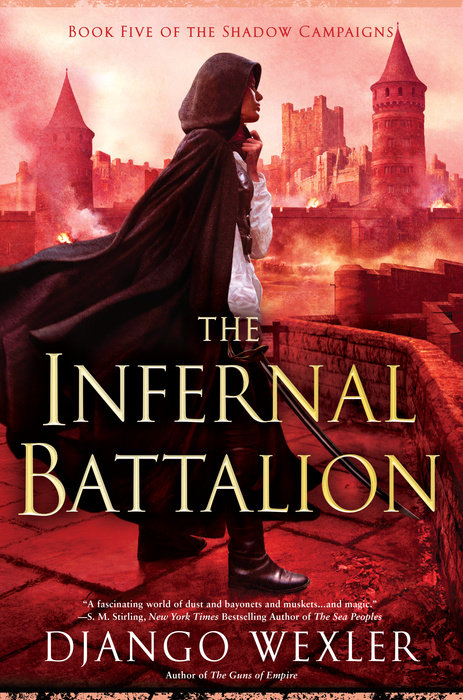
Military might and arcane power clash in Django Wexler’s thrilling new Shadow Campaigns novel.
The Beast, the ancient demon imprisoned beneath the fortress-city of Elysium for a thousand years, has been loosed on the world. It absorbs mind after mind, spreading like a plague through the north. The fell army it has raised threatens the heart of Vordan, and it is under the command of the Beast’s greatest prize: legendary general Janus bet Vhalnich.
As Queen Raesinia Orboan and soldiers Marcus D’Ivoire and Winter Ihernglass grapple with the aftermath of a hard-fought military campaign, they soon discover a betrayal they never could have foreseen. The news arrives like a thunderbolt: Janus has declared himself the rightful Emperor of Vordan. Chaos grips the city as officers and regiments are forced to declare for queen or emperor.
Raesinia must struggle to keep her country under control and risks becoming everything she fought against. Marcus must take the field against his old commander, a man who has seemed an unbeatable strategist. And as Winter recovers from her injuries and mourns her losses, she knows the demon she carries inside her might be the only thing standing between the Beast and the destruction of everything in its path….
A war has been fought but that is not the only danger in the still in danger. The Beast has possessed both Winter’s former lover Jane and Marcus’s former leader, Janus. The Beast is a powerful entity, a demon who possesses multiple bodies and spreads much like a disease. While Janus has declared himself Emperor of Vordan in a move directed against Queen Raesina’s power as the queen, he is leading a powerful army to overtake Vordan, the seat of her throne. With the Beast controlling Janus to an extent (unbeknownst to Raesina and Marcus), the largest threat to the Beast is Infernivore, the demon inside Winter. Complicating Raesina and Marcus’s situation are a few contentious elements including the fact that the parliament of Vordan does not appoint Marcus to lead the armies against Janus. Rather, a less experience general is appointed, and one who has far less experience with Janus. Raesina and Marcus have also come to understand their love for each other.
Unfortunately, as happens in war and especially in wars depicted in fiction, primary characters are often separated by a great deal of distance, which makes the conflict all the higher, especially when communication is so delayed. Winter is at one end of the geographic conflict and Raesina departs Vordan to strengthen an uneasy alliance with a nation whose military power may help to prevent the Vordan army from being utterly defeated at the hands of the larger army, led by the most brilliant military mind in the world who also happens to be the former ally Janus, while Marcus helps to lead the military force approaching Vordan.
Often in large scale stories, characters who’ve been enemies for a large duration of the story come together as allies to confront a larger threat. Wexler spins that convention by throwing two of the strongest allies against each other on opposite sides of the chess board for much of the finale, with Janus now appearing to be the large enemy, even if he is something of the Dragon to the Big Bad (http://tvtropes.org/pmwiki/pmwiki.php/Main/TheDragon).
Another slight turn from the conventions of typical fantasy is where other epic fantasies have included an uncomfortably uncountable cast of characters, Wexler elegantly focuses on those few characters, at least in terms point of view characters. From the very beginning of the series, this was the case and when the series grew in volumes, it would perhaps be natural for other writers to add more primary characters to the mix. By keeping things to a literal handful of characters, Wexler makes the Epic Tale a personal story for each of the characters. I’ve enjoyed Winter’s evolution a great deal throughout these five books as she comes to grips with who she is but here in The Infernal Battalion, Raesina shined the brightest for me. Wexler has always portrayed Raesina as an extremely intelligent, forward-thinking character who overcame her fears. Through very crucial scenes that helped to bring resolution to some of the conflicts over the course of this novel and book, her maturation as a premier character landed perfectly. Marcus also comes to the full of his potential and moves beyond some of the preconceived notions (i.e. women in the military) he held early in the series.
Django Wexler remained true to his original vision for this series with The Infernal Battallion, capping off a stellar series with a satisfying novel both on its own merits, what it introduces and resolves as well as closing out The Shadow Campaigns as a whole. I’d been in a slight reading rut for a handful of recent books and Wexler grabbed my attention fully with this novel.
Ace, January 2018
Hardcover, 500 Pages
http://djangowexler.com/
Review copy courtesy of the publisher, Roc