Having averted disaster in At the Table of Wolves, Kim Tavistock is still working for the British Government to help thwart the German enemy in (what she and the other characters don’t realize) is the ramp-up to World War II. As Serpent in the Heather begins, very little time has passed since Kim helped to save the world.
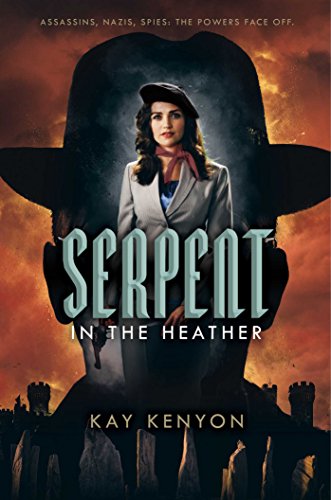
Summer of 1936. Assassinations are underway in Europe, targeting people with meta-abilities. It is an undercover German operation to deprive future targets like Poland and France of important Talents.
Now the killings have begun in England and they are young people, their bodies left in public places, ritually murdered. But how can the killer know which youngsters have Talents?
Kim Tavistock is sent to penetrate a religious cult tied to the Earth Mysteries movement, a cult that believes there are places of power linked to neolithic henges and stone circles. In the forbidding Sulcliffe Castle in Wales, the elderly matriarch of this movement is Baroness Ellesmere, an ardent Nazi, who, though dying, wants to confer spiritual power on her handsome but Talent-less son.
With a foundation for the world strongly laid down in the first novel, Kenyon dives headfirst into the murder mystery she’s set up for readers. That mystery is of a serial killer targeting children with emerging Talents. Kim is still also a reporter and under that guise for the British Intelligence Agency, she investigates potential connects to the murders at Sulcliffe. Her father is also one of the primary characters and he still works in the British Intelligence agency and he’s examining the murders, though no to the knowledge of his daughter. A third primary character is the young boy Martin, whose Talent is emerging, so he joins a group of other similar kids at school since he finds no support at home from his parents.
Kenyon does a great job introducing Martin into the conflict, especially considering kids his age with talents are disappearing until they are found dead. Martin draws the attention of not only the killer, but eventually the attention of Kim and the British government.
Although Kim is not entirely new to the espionage game, she still has quite a bit to learn. One of the stronger elements of the novel was watching Kim truly come into her own, to trust her instincts, and to learn and grow from the missteps she made. Although she’d like the relationship with her father to be stronger (she still thinks he’s a traitor, but he’s keeping her at a distance to mask his own role in British Intelligence), she sees Martin as a young man she can help.
Where the first novel established the world and familiarized readers who may not be too intimately familiar with the years leading up to World War II, Serpent in the Heather builds on that solid foundation. Having the foundation in place also allows Kenyon to focus more of the narrative energy on the mystery/thriller plot and developing the characters to an even stronger degree. The characters, especially Kim, were particularly well-drawn in At the Table of Wolves, so again, a great starting point makes for an even richer experience and characters with more depth who can build more empathy here in Serpent in the Heather.
If there’s any issue I had with the novel, it is a slightly slower middle portion. I seem to be having that problem with more regularity in the books I’ve been reading, so it could very well be me as a reader and not the book. However, the conclusion to the novel is full of energy and pays off some of what was promised in the opening of the novel as well as threads from the first novel.
Everything I’ve read from Kay Kenyon has been imaginative and full of empathetic, well-drawn characters and Serpent in the Heather continues that trend.
Recommended.
April 2018 | Saga Press
Hardcover | 416 Pages
http://www.kaykenyon.com
Review copy courtesy of the publisher, Saga Press