
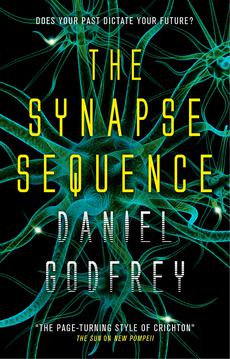
 Recently SFFWorld reviewed The Synapse Sequence, the latest book by Daniel Godfrey (LINK). Here Daniel explains his thoughts on a possible upcoming employment crisis which led to this book.
————–
Technology taking peoples jobs is not new. Since way before the industrial revolution, tasks have been made more efficient (and more often than not safer) by replacing people with machines. Anyone with an interest in genealogy will understand this: census records give us a stark insight into the type of work that was done in the past. For example:
Knocker-upper: Need help waking up in the morning? Why not pay for someone to rap on your windows? Time was called on these jobs by the invention of the alarm clock.
Lamp lighter: Streetlights fed by gas needed lighting by hand. These jobs were extinguished following the adoption of electric streetlights.
Gong farmer (night soil worker): The unlucky sole that dug out human excrement from cess pits and privies. This profession was flushed away by the invention of the modern toilet.
Added to the above could be ice men, fullers, clock-winders, switchboard operators, signalmen, elevator operators…and anyone who worked at a video rental store. I myself currently live within the Derbyshire / Nottinghamshire coalfields, and the ghosts of former mass employment sites are not difficult to find. However, whilst the pace of employment change has varied, and often caused periods of crisis that left many behind, the overall pattern has not been one of an overall reduction in the total amount of work. Rather, we’re all doing different jobs than we would have been doing in the past. Many of the old heavy industrial sites have been re-developed. And wouldn’t jobs in tele-sales, call centres, social media and IT seem as weird to those living in the past, as a knocker-upper does to us today?
The current concerns relating to employment focus on the falling price of automation and the increasing sophistication of machines that marry information technology and mechanical engineering. Perhaps the most eye-catching examples of these are found in the distribution centres of online shopping sites, with palettes of stock being moved by robots that are becoming more efficient than human ‘pickers’. To me, however, this is simply an extension of the production line philosophy that has long dominated the motor car industry. Robots have always been better than humans at repetitive tasks that require a high degree of accuracy. In a factory environment, what we’re seeing is simply robots becoming cheap enough to replace a greater proportion of the human workforce.
More interesting (and worrying, I think!) is the move of automation, robotics and now AI into the service economy. The start of 2018 saw the opening of a fully automated shop, without the need for checkouts. No ‘unexpected item in the baggage area’ here: the items you want are scanned as soon as you pick them from the shelves, and your account debited as you leave the shop. In the next few years, I would also expect the number of jobs in call-centres to vastly reduce given that chat-bots could handle the majority of calls based on common queries and answers. Again, however, some may shrug their shoulders. This is another impact on so called ‘lower-end’ jobs.
I suspect AI has its eye on ‘higher-end’ white collar jobs too. A lot of this innovation is currently happening in the field of medicine. One of the main issues facing the health service in the UK is a lack of GPs, meaning services are difficult to access and a lot of our health service staff are working when tired. Many studies have shown that properly designed AIs are more accurate at detecting the early signs of cancer than human doctors. The introduction of chat-bots armed with diagnostic algorithms may soon replace the local GP. There is also every reason to believe that many white collar jobs (including work in legal, accountancy, management) could be replaced by AI equivalents that would be more productive and cheaper than employing highly qualified (and expensively trained) human staff.
In my new novel, The Synapse Sequence, the main character is a former Air Crash Investigator. She has lost her job, and gone to join a start-up technology company with a neat way of solving crime, because planes no longer crash with the frequency requiring investigation. Pilots are no longer at the controls. Science fiction? The first auto-pilot was invented in 1912, and modern aircraft leave the pilots with less and less to do. And, whilst in the air, planes have to monitor fewer variables than driverless cars, which now seem a realistic proposition.
So should we be worried? After all, this has happened in the past and we’ve always come through it: there has always been generally enough work to go round. Possibly, but a recent report by the McKinsey group (link below) identified that 50% of work could be automated by technologies that already exist, and six out of ten jobs include a large proportion (greater than 30%) of activities that could be automated. That’s a lot of people who in future could be looking for new work: at least on a scale of the agricultural or industrial revolutions.
And that’s the key word. Revolution. We’ve always come through these previous employment crisis, but not without significant social unrest. Governments are clearly concerned. Multiple studies are already looking into who is likely to be affected, where they are living, and how to re-train people. Except the key part of the answer to these studies are always missing. What will be the equivalent of the knocker-upper or social media manager of the future? How will we be spending our time if nothing appears to fill the gap?
What will the world be like if there is not enough work? How will we earn our money?
So next time a robot-picked parcel arrives for you from that online shop, stop and think a minute about your job. Could that be done by a robot? Would it be cheaper and better than you?
Daniel Godfrey’s new novel, The Synapse Sequence, is out in June 2018.




Right now people still have a lot of say in programming how computers use the data they see and what is done with it. That alone causes bottlenecks when people’s individual demands that have nothing to do with machine performance are allowed to be the overriding factor. Keeps jobs safe for awhile.
The medical industry is seeing heavy inroads into who runs the computers using the data by non doctor entities. The IBM Watson project is coming along and is starting to make a difference. In hospitals where the care is top notch and the doctors are well paid because they are well versed in their fields the use of the smart machine can be a hindrance. But in hospitals that don’t have top of the line equipment, adequate staffing or the know how, it can already make the difference between good treatment and no treatment.
The machine needs a heck of a lot more data keyed into it before its sponsors can even think of claiming they can cure cancer. Where the machine excels is in taking the all the information about what people have already done, already tired, and uses that to recommend courses of action. It just crunching numbers, and when that is used to provide medical treatment in places that don’t even have cancer units it makes all the difference in the world for the patient. Doctors are not going to these far off place, like Mongolia, and probably never will. That is where the machines are getting a foothold and as the machine collects more data, a habit which is only increasing in exponential jumps, it will be better able to provide up to date practical information at any location, except in the exact locations that just provided it with the latest data.
Contrary to claims that Watson can read medical journals all day long and be light years ahead of doctors who can be 2 years behind in their journals, much of the information Watson relies on is inputted still by humans. Information entered into records by humans putting their own unique traits into their patient’s notes is hard for a machine to decipher. But for how long.
Every year less people are needed to physically handle the data before it gets saved in the machines. Secretaries are a vanishing species. Once filling entire office floors, one or two people can now handle an entire departments requirements. Now its doctors and nurses who are doing the manual entry, and doubtless the same fate eventually awaits them.