

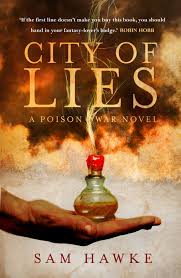
 We’re very pleased to welcome Sam Hawke, whose new book, City of Lies, has had a fantastic response. In this article Sam writes about diversity and the little things that writers can do to make the world authentic and inclusive.
SFF is an inherently innovative genre, premised on imagination: imaginary futures, technologies, aliens, worlds, beasts and cultures. Yet for all the rich potential for inclusive storytelling, too often our storytelling has failed to reflect even the diversity of our own world. Race, gender, sexuality, age, disability, physical and mental illness, cultural backgrounds, religion, body type, class… our world holds a rich variety of people who are different in so many ways. Yet there is still an over-abundance of conventionally attractive fit & healthy cishet white dudes from the dominant culture wandering around our futuristic, supernaturally altered, or entirely fictional worlds.
The good news is, it’s changing! If you haven’t been living under a rock you’ve probably seen discussion about how this diversity is or isn’t reflected in SFF in recent years, both in the characters and worlds portrayed in SFF literature and in the identity of their creators. Even if you’re not personally concerned about seeing yourself represented because you’re one of those cishet white dudes who’ve never had to struggle to see a protagonist just like you (hell, I’m a little white brunette, at least I get Every Female Star Wars Hero), I’m here to tell you to take a deep breath and recognise this for the Good Thing that it is. Don’t bemoan the loss of the status quo. Lean in and enjoy the new opportunities it gives us to explore the greater breadth and depth of human experience. I’m not telling you what you should or shouldn’t write or consume – I’m not the boss of you – but here are some reasons why you might find that you actually like it. Why, indeed, writing, reading and viewing diverse worlds and characters is in fact a joyful thing.
In a genre that should be limitless but which can feel oversaturated with particular flavours, delving outside the expected norm in terms of worldbuilding (including setting and aesthetics of the world and the cultural and social structures of the civilisations presented), story style and structure (the classic Western structures and favoured styles of storytelling aren’t the only ones out there) and most importantly, in character, can open up refreshing new worlds and experiences. Choosing not to limit yourself to things you’ve already seen exhaustively depicted gives you a chance to glimpse something new, something wondrous. Isn’t SFF the genre of wonder?
There’ll never be a shortage of western European/British middle ages, militarily-run spaceships and dark neon futuristic cities that somehow still look a bit like Blade Runner, but if you haven’t gone on an adventurous ride through the Middle Eastern inspired world of Saladin Ahmed’s Throne of the Crescent Moon, flown between living bone towers in Fran Wilde’s Updraft, found family with the crew of a patched-up spaceship on The Long Way to a Small, Angry Planet (Becky Chambers) or experienced the enchanted city and the six Djinn tribes of S.A. Chakraborty’s City of Brass, you’re missing out on a hell of a lot of fun.
And if every character looks and thinks like you or people you know, or archetypes you recognise from decades of fiction, aren’t you also missing out on the chance to expand your own sense of empathy and understanding? Don’t great characters, written thoughtfully, engage our own sense of empathy, creating the emotional bonds that lift an ordinary story into a great one? Humans learn through stories and we learn things about ourselves not just by seeing a mirror to our own experiences but by broadening those experiences and asking questions about our own behaviour and identity. Riding around in the heads of people not like us gives us a new perspective we might never get a chance to experience in our real lives.
Lofty goals of literature aside, there are all kinds of practical advantages to writers putting a bit of effort into being inclusive in the worlds they portray. Thinking about what makes each character different and distinct from the others is half the challenge in making them memorable. Nothing flattens a story more than characters who all meld together into an indistinguishable lump. Utilising different classes, cultures, ability levels and age ranges, for example, immediately makes your cast distinguishable, and opens up some ready-made conflict, backstory, or motivation. It can also help take the plot of a story out of over-trod territory. If characters aren’t fit and healthy, for example (something that is still massively under-explored in SFF, I believe), writers have to think outside the usual tropes to get the characters out of a jam if the usual SFF staples of fighting, chases and escapes or feats of physical skill or endurance aren’t readily available. All kinds of plot complications can be created by characters’ status quo being poor and hungry instead of able to meet their every basic need without question. Cultural and linguistic differences between characters can lead to unexpected problems or solutions. The possibilities are endless.
And it’s not just entertaining, it’s authentic. Even things that look the same on the surface usually aren’t if you pay a bit more attention. Have you ever seen a picture of sand under a microscope? No matter how plain and white it looks when you’re standing on the beach, it’s made up of a breathtaking array of colours and shapes and textures. Even a culture that looks homogenous, perhaps because of climate or geography, isn’t really, not in any meaningful sense. Some SFF fans care deeply about purported ‘historical accuracy’ (even in fictional secondary worlds which do not share our world’s history) – well, you’ll be delighted to know that there was no period in time in which the world was a monoculture or that there were no LGBTI people or disabilities or mental illnesses or everyone was 20th century model-sized. So if you get warm fuzzies from glimpsing a world that resembles ours at some point in history, hurray, you can rest easy knowing that pretty much every society in history has been diverse in a whole range of ways.
In short, writing inclusively isn’t about filling quotas, but about showing the world in all its breathtaking beauty and detail. It costs you nothing to turn your mind to portraying the world with your eyes a bit wider, and you never know, it might mean the world to someone to see a little glimpse of their life in the midst of a fantastic adventure.
Sam’s debut novel, City of Lies, from Transworld/Random House, is out this week.


“too often our storytelling has failed to reflect even the diversity of our own world”
The problem may be that the story simply reflects the lack of diversity in the author’s own world. 🙂