Octavia Butler passed away in 2006, but her work continues to engage and inspire readers everywhere, so much so that her Parable series (Earthseed) has new editions coming out this year. According to Boing Boing, the new edition of Parable of the Sower will be published April 30th and Parable of the Talents later this year. Boing Boing states: “The new edition features a brilliant introduction by NK Jemisin, whose Broken Earth trilogy made Hugo Award history last year when all three volumes won the prize for Best Novel.”
In other news, according to the Los Angeles Times, Amazon is also developing a series based on Wild Seed, the fourth book in Butler’s Patternist series. The show is being produced by JuVee Productions, a Los Angeles company led by actors Viola Davis and Julius Tennon. Deadline reported:
Co-written by award-winning sci-fi novelist Nnedi Okorafor and Rafiki filmmaker Wanuri Kahiu who is set to direct, Wild Seed is a love (and hate) story of two African immortals who travel the ages from pre-Colonial West Africa to the far, far future. Doro, a killer who uses his power to breed people like livestock, encounters Anyanwu, a healer who forces him to reassess his millennia of cruel behavior: for centuries, their personal battles change the course of our world as they struggle against the backdrop of time — master vs slave, man vs woman, killer vs healer.
For Butler fans, this news is welcome, and for others not having read her works, it’s a wonderful chance to delve into some great storytelling and get to know one of the classic writers of our times.
I wrote about Butler in my series at Dragonfly.eco called Authors Tackling Climate Change, which is now being rerun at Artists & Climate Change in their Wild Authors series. My spotlight on Octavia Butler will appear there in a few months. Following are some excerpts from that article, which focus mostly on the Parable series.
Octavia Butler, an African American science fiction writer, was born in 1947 and died in 2006. A Hugo and Nebula award winner, she wrote fairy tales as a young girl. By the time she was a pre-teen she got her first typewriter, ignoring her Aunt Hazel telling her, “Negroes can’t be writers.” (Source: Butler, Octavia Estelle. “Positive Obsession.” Bloodchild and Other Stories. New York, Seven Stories, 2005. 123-126.) Octavia’s series include the Patternist, Xenogenesis, and Parable (also called Earthseed). In addition, she wrote two stand-alone novels, two short story collections, and several essays and speeches.
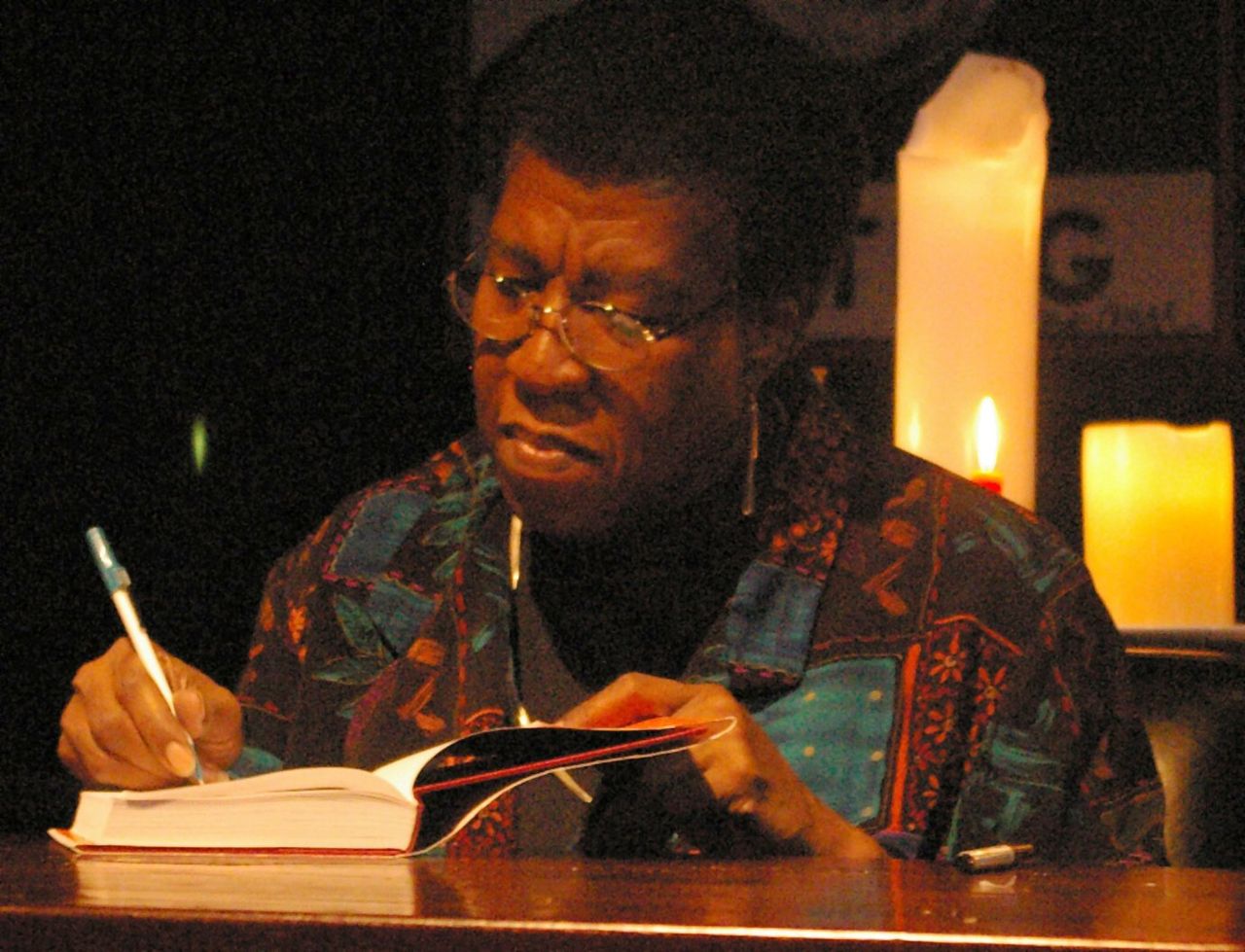
Earthseed contains two novels: Parable of the Sower and Parable of the Talents. A third in the series, Parable of the Trickster, was not completed before her death. Sower opens in 2024, which once seemed so futuristic, even in the year 1993 when the book was published. But time marches impossibly on, and for those of us who clearly remember 1993, the vacuum that has sucked out space from then to now seems both eternal and too quick.
Talking about the Earthseed series as a very real tale should not drown out the story itself. Octavia helped usher in the genre of YA dystopian fiction. She wrote powerfully, imaginatively, and creatively. The worlds she built were beautiful, harsh, and grim. Her protagonists were stoic and inspiring. Despite tackling multiple issues–politics, environment, segregation, religion, social injustices–her prose was concise. Her stories were powerful and believable.
According to Inverse (“Octavia E. Butler: Why the Author Is Called the Mother of Afrofuturism,” by Kat Tenbarge, June 22, 2018), Afrofuturism is a type of cultural aesthetic that explores the intersection of African culture with technology and futurism. Inverse calls Octavia Butler the “Mother of Afrofuturism” and describes four themes used in her books: critique of modern-day hierarchies, violence, survival, and diversity. The Earthseed series seems to accurately envision the near-future world’s downfalls, brought on by climate change and economic disparity, which have resulted in growing populism and demagoguery around the world. In African Arguments (“This is Afrofuturism,” March 6, 2018), Bolanle Austen Peters states:
The term Afrofuturism, coined in 1993, seeks to reclaim black identity through art, culture, and political resistance. It is an intersectional lens through which to view possible futures or alternate realities, though it is rooted in chronological fluidity. That’s to say it is as much a reflection of the past as a projection of a brighter future in which black and African culture does not hide in the margins of the white mainstream.
Note that climate change is a historical, present, and future concern. Perhaps this future is something Octavia could envision as a child in a world where a critical dystopia didn’t seem that unimaginable, existed already, and had signs of continuing, though it is reasonable to suggest that in her novels, Octavia created hopeful heroes. Perhaps she imagined herself as one such type of protagonist, and rightly so. Octavia spent her childhood in Pasadena. Her mother worked as a maid and her father a shoe-shiner. According to the New Yorker (Octavia Butler’s Prescient Vision of a Zealot Elected to ‘Make America Great Again,’ by Abby Aguirre, July 26, 2017):
In one of Butler’s first stories, “Flash—Silver Star,” which she wrote at the age of eleven, a young girl is picked up by a U.F.O. from Mars and taken on a tour of the solar system. Butler ignored the received idea that black people belonged in science fiction only if their blackness was crucial to the plot…She later made a habit of explaining, as here to the Times, “I wrote myself in, since I’m me and I’m here and I’m writing. I can write my own stories and I can write myself in.”
In Parable of the Sower are signs of climate change, such as drought and rising seas. The main character, who tells her story through journal entries, is a 15-year-old black girl named Lauren Oya Olamina, who, as the New Yorker points out, is wise enough to determine that people have changed the climate of the world. The title of the series, “Earthseed,” comes from a Darwinian religion that Lauren makes up. She also has hyperempathy, which makes her keenly attuned to the pain that her fellow residents in southern California experience in their impoverished life behind a wall of segregation made of brick and steel. Issues of skin color, violence against those perceived as different, political movements against science, and class divisions growing wide sound all too familiar. In Parable of the Talents, which opens in 2032, further oppression of women, designer drugs that help people numb out, mutilation of body parts, and slavery are common. Cities are privatized, and literacy is decreasing.
The Earthseed series tells of what we will continue to experience. Electric Lit points out: As Gloria Steinem wrote in 2016, in an essay celebrating The Parable of the Sower‘s 25th anniversary, “If there is one thing scarier than a dystopian novel about the future, it’s one written in the past that has already begun to come true.”
I leave you with this quote, from Parable of the Talents, by Octavia E. Butler:
Choose your leaders with wisdom and forethought.
To be led by a coward is to be controlled by all that the coward fears.
To be led by a fool is to be led by the opportunists who control the fool.
To be led by a thief is to offer up your most precious treasures to be stolen.
To be led by a liar is to ask to be told lies.
To be led by a tyrant is to sell yourself and those you love into slavery.