You may know James Lovegrove for his Cthulhu Files (his Sherlock Holmes and Cthulhu mash-up that we loved here at SFFWorld). Here’s what James sent us when we asked him – “Why write tie-in fiction?” and, as his latest is a novel in the Firefly universe, we also asked him what the attraction was there.
Here’s what he said!
I never thought I’d write tie-in fiction.
Not that I have anything against tie-in fiction. Who doesn’t love seeing their favourite fictional worlds being expanded? Learning more about much-loved characters? Discovering new tales that slot into an existing continuity and deepen and strengthen its connective tissues?
I myself have read countless tie-in novels and comic-books, some good, some great, some bad, some indifferent. Star Wars, Star Trek, Alien, Predator, Terminator, Robocop, Buffy the Vampire Slayer, The X-Files – all of these wonderful, seminal movies and TV shows have offered suggestions of a wider lore that their fans want to know more about. They play themes that hold out the promise of almost infinite variations. They’re rich seams begging to be mined.
And among the miners there’s been a number of established, talented authors. Digging away at various licensed properties with their metaphorical shovels, they have drawn on their skills and experience and brought back gold. Alan Dean Foster is one name that immediately springs to mind, perhaps the pre-eminent exponent of the tie-in field, but also James Blish, Peter David, K W Jeter, Kristine Kathryn Rusch, Christopher Golden, Nancy Holder, Max Allan Collins, Diane Duane… It’s a long list.
There’s been some hackery along the way, don’t get me wrong. Some blatant “for the money” efforts, churned out in a couple of weeks with an eye on the payday and nothing else. However, there’s been superb stuff too – this constitutes the majority, I’d say – written with a genuine love for the source material and an honest desire to create something that is both new and at the same time true to the original.
But, like I said, I never thought I’d become a tie-in author myself. It just wasn’t in my game plan. I had other priorities. I had no interest in doing it.
Until the day I did.
It happened like this. About five years ago, I was chatting with Miranda Jewess on the phone. Miranda has edited most of my Sherlock Holmes novels for Titan Books (and if those are a quality product, she deserves much of the credit, because she makes me work exceptionally hard on them and her contribution to shaping the plots and the manuscripts is invaluable). She asked if I’d be interested in doing some tie-in work for Titan, and I said not really. “Unless,” I added, half-jokingly, “you have the licence for Firefly, because I love Firefly.”
Titan did not have the licence for Firefly. Not then. But two years later, they acquired it, and Miranda, remembering our conversation, got back in touch.
I couldn’t possibly say no, could I?
And if ever a franchise was crying out to be enlarged, it’s Firefly. Poor, tragic Firefly. That witty, gritty “space cowboys” TV show that was adored by many, but not by enough. Cancelled halfway through its first season. Cut off in its prime.
Sure, there’d been the Serenity movie, that miraculous if brief resurrection, which brought some sort of closure (and killed off two members of its ensemble cast, but let’s not go there). Still, there was so much territory that remained uncharted, so much of Joss Whedon’s ’verse left to explore.
Naively, or perhaps arrogantly, I felt I was the right person for the job.
Which is not to say I wasn’t nervous when I sat down and started writing. I was keen to capture not just the personalities of the main characters themselves but the overall tone of the show, from its mellifluous, Western-movie dialogue to its unique mix of Frontier-style brutality and moments of surprising sweetness. I was desperate not to let the show’s fans down. I wanted to give them what I myself was after, which is more of the same but with a few added wrinkles.
A novel, with its internal monologues and third-person viewpoints, enables you to get inside characters’ heads in the way a screenplay can’t. I’ve tried to make the most of that, while also delivering quick, sharp adventures containing everything that loyal Browncoats would expect: bar brawls and gunfights, betrayals and reversals of fortune, hissable villains and bantering backchat.
I’ve done my utmost to get it right. I feel I was handed a huge responsibility. I hope I’ve honoured it.
– James Lovegrove
Thank you, James!
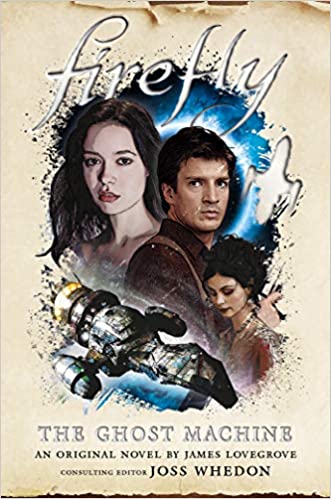
James’ novel Firefly – The Ghost Machine, from Titan Books UK, is out now as an e-book from all the usual sellers.
It comes out as a hardback in May (virus permitting).
Thanks to Titan UK for helping sort this interview out at a difficult time!