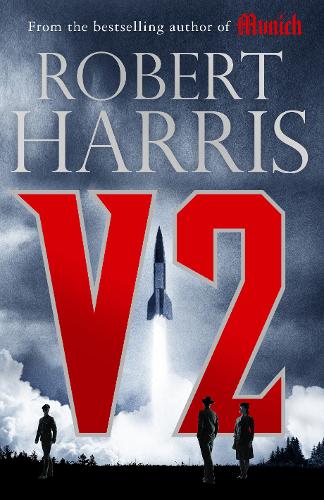
 I am a bit of a sucker for stories that illustrate the early days of rocketry which led to the so-called Space Race of the 1960s. And as a result, I was drawn to this one. V2 is not our usual fare at SFFWorld, admittedly, though it does have elements that are influenced by science fiction.
In addition, the author may be known to those of you who like “counterfactuals” – that’s alternate history to most of us – for the novelist is perhaps best known for his novel Fatherland, a multi-million seller back in 1992 which showed a modern Germany unbroken by World War Two.
In V2, Harris returns to similar territory as he tells a story focussed around the use of V2 rocket weapons on England by the Germans in November 1944, the last years of the Second World War.
Though the principal characters are imaginary, this is a more straightforward historical-style tale than Fatherland. Mixing real events with some real people, Harris’s fictional characters show us what it was like for people at that time. The story begins with V2 strikes on London, before telling us of the German scientists at the rocket development site of Peenemunde who designed and built the V1 and the V2.
This is mainly achieved through the eyes of Dr Rudi Graf, an assistant to Dr Wernher von Braun, who was the real leader of the German rocket scientists. Graf’s job is to prepare the rockets for their takeoff, a post fraught with difficulty and danger as you might expect with temperamental new technology. The situation is made more difficult with the Nazi leaders demanding more and more launches each day in a last attempt to win the war. Like Braun, Graf is unhappy with the demands of the German military, yet has hopes that his work will eventually lead to men on the moon.
As a counterpoint to this, through the character of WAAF Kay Caton-Walsh we are also shown the work of the RAF reconnaissance analysts, first in England and then to Belgium where a dedicated group try to track the mobile rocket sites before they move on to send another rocket across the English Channel. I found the methods of detection interesting, as they are based on real events even though they are in a fictional setting here.
V2 is nothing really new, but for readers who like this sort of thing, it is a solid and engaging story. The characters are not particularly deep or insightful – there’s few navel-gazing moments of introspection here – but there’s enough here to get a feeling of what it might have been like on both sides of the war. It is fairly even-handed in depicting the desperation of the Germans and the weary war-torn determination of the British. Harris doesn’t stint on the murky unpleasant elements of this history either, mentioning von Braun’s dealings with Hitler and the Nazi military to keep the rocket programme active, as well as the fact that prisoners of war were used as slaves in the construction and running of these rocket factories. There is a real feeling that the Space Race starts here, though its origins are rather unpleasant.
In short, V2 is a good page-turner, filled with acts of sacrifice and heroism that you might expect from such a novel. I found that the pages turned easily and the short chapters soon went past. Harris can tell a good story, giving enough details to make the reader feel knowledgeable about the situation without bogging the plot down with information dumps. The ending is rather abrupt and a little unconvincing, but generally the book kept me entertained throughout. A good beach read.
V2 by Robert Harris
Published by Hutchinson
314 pages
ISBN: 978-1786331403
Review by Mark Yon