 […] there came the skurry of feet in a perfect frenzy of haste on the flags without; the front door flew open; and the rector, hatless, his cloak rent and trailing, his staff a splintered fragment in his hand, sprang into the hall, slammed the door behind him and flung himself against its panels.
“The wolf,” he gasped as he shot the bolt and upon the word came the thud of mighty paws, the rattle of talons.
–from chapter 4
New Dortrecht, a small village in the Hudson Valley struggling to maintain prosperity after the American Revolution, receives the Comte de Saint Loup, a French aristocrat fleeing the excesses of the French Revolution. He arrives with the stated intention of settling, at least until it is safe to return to France.
Robert Farrier, our narrator, is assigned by his uncle the duty of meeting the Comte when he lands and escorting him around the village; de Saint Loup is wealthy and Farrier’s uncle is hoping for some of his business. Given his clothing and bearing, Farrier wonders at his settling in New Dortrecht, but the Comte explains he had lived in the country. No, the city holds no attractions for him. He is a “countryman” by experience and inclination, and he is in want of a house so he may send to New York for his wolfhound, De Retz.
The brutal death of an old hermit and, by reputation, a miser, provides the Comte de Saint Loup a home, and is the first of several deaths over the next months, deaths in and around the village caused by the unprecedented appearance of a murderous wolf.
The Wolf in the Garden is an obscure example of the well-written thriller published during the Great Depression and so, unsurprisingly, much of the plot revolves around money: those who have it and flaunt it, and those who need it and their desperation. From the start, Bill does nothing to disguise that he is tapping into lycanthropy, and that straight-forward approach heightens suspense as the reader wonders how soon the characters will realize the threat. A slim volume, it contains elements rather like movies from the 1930s, coming complete with a beautiful damsel in distress (named appropriately, Felicity); an earnest hero (Robert); their hopeless romance stymied by a ruthless villain, the cruelty of whose past and future planned debauchery is implied over and again (sometimes more explicitly than I expected); and Mr. Sackville, village rector and Van-Helsing-in-residence. Bill’s writing is vigorous and direct, if a bit more descriptive than contemporary fiction, and you may want a dictionary or at least Google close at hand for a few word choices which are, as far as I can see, appropriate for the era in which the story takes place
Considering the novel’s vintage, for those who find trigger warnings helpful, here are three:
First, the novel’s attitude towards race is complicated: Is it Bill’s attitude or is he depicting the attitude in post-Revolutionary America, a time in which slavery was still legal? Either way, the two main Black characters, and especially Vashti, a female servant to the damsel in distress, are allowed a level of dignity I do not believe was common in fiction of that time. Still, it’s reasonable to see Vashti as an instance of the “magic negro” or “magical negro,” whose existence in a narrative is to aid or save a white character. This may (or may not) be mitigated by the second trigger warning …
Second, in post-Revolutionary times (and for some time after) women could be used as bargaining chips at the disposal of the men in their lives, fathers, guardians, or husbands, and that helplessness comes through here. To Bill’s credit, I think, he suggests without preaching that in the wrong marriage, a woman in Felicity’s position was little better than a slave. It was still a “man’s world” and often in the worst possible ways. (Not to imply there were best possible ways, but there may have been less worst ways.)
Lastly, the wolf does not attack only humans. And there are some descriptions that would not have been out of place in the gorier books and movies of later decades.
On a personal level, The Wolf in the Garden stands as a reminder to check my shelves more closely for books I’d forgotten and should have read years ago. If you can find this book, and if you can accommodate for the time of reading the cultural attitudes it records, it’s also an engaging example of the early 20th century thriller and maybe even something against which to gauge more recent thrillers.
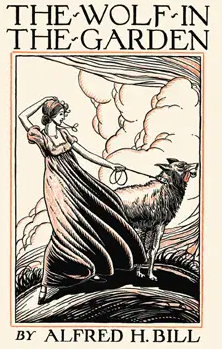
THE WOLF IN THE GARDEN by Alfred H. Bill
(Centaur Press, 1972)
148 pages
ISBN: 978-143 4479 235
Review by Randy Money