World-building is a double-edged sword, especially for the inexperienced writer. On one hand having a fleshed out and internally consistent world is crucial to ensuring a believable narrative. On the other, world building can be a rabbit hole of counter-productivity, and many a would-be author has ended up spending more time building a lush, lavish world than they have actually writing their story. It’s entirely too common to visit a writing forum and see statements like “I’ve spent three years writing my first book, I have 200 pages of backstory and history”.
The primary reason is this: World-building is easy compared to actually writing the book, in large part because the reader is never expected to see most of the contextual information that gets used to frame the story. Think of the book’s world as a pond. A reader often does not know how deep or shallow the pond is, they only swim at the surface. They see and evaluate the ripples of the character’s passage. So then it becomes easy to keep making that water deeper and deeper, whether it be with royal genealogies, complex magic systems, or a complete accounting of the thousand year war between three alien empires. It’s easier because we know it’s essentially free writing that will never be judged, critiqued, or reviewed on Amazon. World-building typically contains no dialogue and requires no formal editing. It doesn’t even always have to make perfect sense. And in truth, it’s fun. Sometimes more fun than actually writing the story.
But how deep is too deep? At the end of the day our goal isn’t to only build the world, it’s to write the story that takes place within it. From a straight business standpoint, any world-building that isn’t directly required to frame the story and doesn’t directly contribute to the events is wasted time and energy. Lean and efficient world-building is critical to successfully finishing a Fantasy or Science Fiction novel in a reasonable amount of time. I tend to think of it as a three-tier approach.
Let’s flesh out that pond metaphor a bit more.
If the story takes place on the surface of the pond, a person sees only that because their head is above the water the whole time. But the rest of their body is underwater, they and they feel the effects of the water. They feel its currents and temperature, and occasionally perhaps even things passing beneath the surface that may emerge later (also known as foreshadowing). In this same way, the reader needs to feel enough of the world-building to be able to interpret these narrative undertones of how the societies and systems within the book function and interact. They need to be able to swim in this pond and move freely without ever encountering the bottom. If their toes ever touch the bottom of the pond, the illusion shatters and they realize exactly how deep (or not) the world is. Conversely, any more depth than required to keep their feet from touching the bottom is, again, a loss of efficiency. Now we have three distinct tiers. The surface, just below the surface, and out of reach.
Let’s put it in more practical terms.
In Vick’s Vultures, the story is about Victoria’s efforts to secure advanced technology for Earth, despite all opposition. Her ship, the Condor, the aliens she encounters, and the conflicts she faces are all above the surface of the pond. The reader can clearly see them as they are explicitly spelled out through dialogue, action, and exposition. The reader is able to see the effects that her passage leaves on the world and the way characters react to her presence. The surface is where her actions have direct consequences, and she must deal with those consequences. Just below the surface are the stories behind the major set pieces, such as Taru Station (a neutral trading outpost inside a honeycombed asteroid) or the allies and enemies of Earth and the main character. Beyond the reader’s reach are the hows and whys of those alien cultures, the motivations of characters that don’t interact directly pertain to Victoria, and things that are known to the author but never even mentioned in the text. Let’s look at an excerpt from Vick’s tense arrival at Taru Station, and her encounter with one of the primary antagonists of the book. Then we’ll separate it into the three tiers of world building.
Victoria took her detail of two marines in the direction of the closest thing they had to an ally in Taru Station, a Jenursa by the name of Hibbevox. His office moved around a lot. Jenursa were migratory by nature, shuffling about the ocean floors and marshes of their planets. They made good cohabitators with a few of the human colonies, an effort by Union Earth to share the burden of defense.
“Let’s check the fifth deck cantina, maybe he’s sipping on a brine shake.”
“HUMANS”
Victoria froze, hand hovering over her sidearm. There was that other shoe dropping. She turned. Toward her strode on six legs something halfway between a rhinoceros beetle and a nightmare.
Let’s break it down piece by piece.
Victoria took her detail of two marines in the direction of the closest thing they had to an ally in Taru Station, a Jenursa by the name of Hibbevox. His office moved around a lot. Jenursa were migratory by nature, shuffling about the ocean floors and marshes of their planets. They made good cohabitators with a few of the human colonies, an effort by Union Earth to share the burden of defense.
There’s a lot of exposition in this line, but also a lot of information. Think of it as an establishing shot in a movie, the focus is wide to give context before narrowing on the action. On the surface, Victoria is looking for a (somewhat) friendly alien by the name of Hibbevox because she needs help. Just below the surface, we see some of the world building show through. We learn that humans don’t have many allies in this part of space, we learn a bit about the physiology and habits of the Jenursa, and we learn that humanity trusts them enough to risk cohabitation. Beyond the reader’s reach are the strength and disposition of the Jenursa, why they have an agent at Taru Station, whether he is the only one of his kind aboard, and how a race of aquatic pseudopods even made it into space in the first place.
“Let’s check the fifth deck cantina, maybe he’s sipping on a brine shake.”
Straight dialogue, but it still contains world-building details. On the surface, Victoria suggests that the best way to locate Hibbevox might be to visit a cantina. Just below the surface, we learn that Victoria knows the alien well enough to anticipate his movements, and that Taru Station has at least five decks. Beyond the reach of the reader: what are the exact dimensions and population of Taru Station, who staffs the cantinas, and how do commerce and taxes work at Taru?
“HUMANS”
This line is a single word, but it still contains world-building based on its context. On the surface, someone has seen and recognized Victoria. They are obviously interested in her presence, though whether in a good way or bad way has not been established. Just below the surface it tells us that Victoria has some measure of notoriety to be recognized and, since we’ve already established that her only ally on the station is not present, that whoever it is most likely is no friend of hers. Out of reach to the reader is whether this character spotted her by chance, or was alerted to her presence by some other means, and why this character chose to reveal himself.
Victoria froze, hand hovering over her sidearm. There was that other shoe dropping. She turned. Toward her strode on six legs something halfway between a rhinoceros beetle and a nightmare.
On the surface, this tell us a few things. The first is that this character is significant enough to mark the reason for tension that had been mounting since Victoria’s arrival at Taru. An alien approaches Victoria, clearly one for which she has little love if she’s resisting the urge to pull her sidearm. Just beneath the surface it tells us that insectoid aliens exist, and that they have some sort of history with humans. Beyond the reader’s reach is what this alien’s business at Taru really was, why they are so aggressive in nature, and why Victoria felt confident in leaving her sidearm holstered.
In each case there are both elements implied by context (below the surface), and further questions raised (beyond the reader’s reach). What are the answers to these questions? In fact, sometimes there aren’t any. In other cases, there are answers but they don’t truly matter. Other times the answers are critical, because they come up later in the book, or even later in the series. And that’s the entire point, sometimes there don’t need to be any because it doesn’t benefit either the author or the reader to know whether Victoria’s encounter was chance or planned. Those facts are too deep in the pool for the reader’s toes to touch. The reader has to assume they exist because their feet haven’t touched the bottom, and so they stay swimming and continue to be immersed. The author is able to push on with the story without giving excessive attention to trivial aspects.
This three-tiered world-building can be a useful tool in managing the time and effort required to craft your narrative. It’s especially useful as a way for new authors to limit a tendency to overindulge in world-building by offering a lean and efficient way of determining which aspects are necessary and which aspects are ultimately trivial.
***
Scott Warren got his start in writing while living in Washington during the summer of 2014 when he entered the world of speculative fiction by writing Sorcerous Crimes Division, followed shortly by Vick’s Vultures.
Mr. Warren blends aspects of classic military fantasy and science fiction with a modern, streamlined writing style to twist tired tropes into fresh ideas. He believes in injecting a healthy dose of adventure into the true-to-life grit and grime that marks the past decade of science fiction, while still embracing the ideas that made science fiction appeal to so many readers.
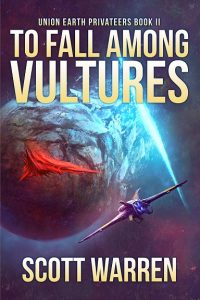
TO FALL AMONG VULTURES is the follow-up to last year’s VICK’S VULTURES (A novel which The Verge included as one of its October must reads and Evan Currie called an important new addition to the military SF genre). TO FALL AMONG VULTURES takes place in a near future where humanity has just begun to make their way into the stars and discovered that the galaxy is a very dangerous, very crowded place. The Union Earth Privateers are our tentative presence in the galaxy, working along the fringes of battles between advanced civilization and scavenging tech to help humanity carve out a place for ourselves among the stars. You can learn more about the book here: www.parvuspress.com/uep2