
Hadrian Marlowe, the first-person narrator of Christopher Ruocchio’s debut novel Empire of Silence is a monster, as he would lead us to believe. In this remarkably page-turning novel, Marlowe tells us part of his life, from a distance of years after he’s become this infamous monster. For not all “monsters” are born monsters, some are born into life that molds them into these monsters.
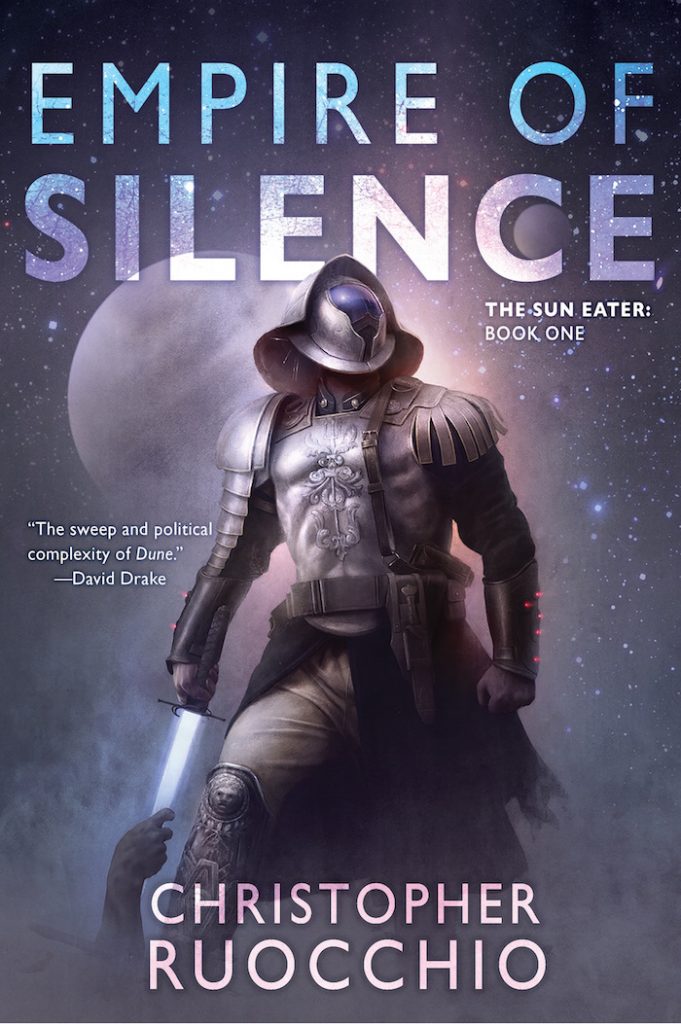
Hadrian Marlowe, a man revered as a hero and despised as a murderer, chronicles his tale in the galaxy-spanning debut of the Sun Eater series, merging the best of space opera and epic fantasy.
It was not his war.
The galaxy remembers him as a hero: the man who burned every last alien Cielcin from the sky. They remember him as a monster: the devil who destroyed a sun, casually annihilating four billion human lives—even the Emperor himself—against Imperial orders.
But Hadrian was not a hero. He was not a monster. He was not even a soldier.
On the wrong planet, at the right time, for the best reasons, Hadrian Marlowe starts down a path that can only end in fire. He flees his father and a future as a torturer only to be left stranded on a strange, backwater world.
Forced to fight as a gladiator and navigate the intrigues of a foreign planetary court, Hadrian must fight a war he did not start, for an Empire he does not love, against an enemy he will never understand.
Hadrian begins his story where life forced him to choose…he begins at home, when Hadrian’s brother Crispin is born and the two boys are princes with sometimes conflicting goals all within the grasp of their father’s fist. Their father is a powerful man on a small world, largely because he controls much of the uranium supply for the galaxy. While Hadrian is the eldest of the brothers, this doesn’t necessarily mean he is the most favored. He is more introspective and questioning of what his father asks of him, including first fighting in his homeworld’s coliseum, questioning why their sworn alien enemies (the Cielcin) are truly their enemies, then being forced into the priesthood. Eventually, Hadrian’s path diverges from that of his family and away from his home planet.
He has great plans of joining a group known as the Scholiasts, which is very much against his father’s wishes, but his plans run off the rails. Or rather, his plans crash on a backwater planet and Hadrian literally starts from the bottom up, living on the streets, living off of the streets and finding himself becoming that which he bemoaned – a gladiator.
Hadrian, despite not fighting in the combats at home, he was still trained for most of his life so to say he does well is only touching on the surface. But, his skill gets him noticed and he finds himself back in the world of courtly machinations. …and back in the position of empathizing and trying to understand the enemy aliens…the Cielcin. He realizes they are far from the evil monsters humanity makes them out to be. I wonder if this could be a hint of the series as a whole, too.
My “summary” only touches the surface, Ruocchio’s narrative is nuanced at times, magnetic to the reader’s eyes throughout the great majority of the novel, and despite everything, he makes Hadrian an empathetic character. That said, at times, I did find myself questioning whether he was just a whiny rich kid whose daddy didn’t wuv him – which to an extent he is. Ruocchio doesn’t falter from that in what he implies, especially through the characters surrounding Hadrian, but he’d put enough in the emotional and narrative bank that Hadrian’s positing through the narration felt earned and genuine. Knowing where Hadrian is telling this story from – a perceived historical framing as a supervillain, may help to give this bildungsroman the weight of a legendary, mythic, and epic tale.
A novel this audacious and ambitions is absolutely going to draw comparisons. Dune, for one is obvious. One planet gaining power because of its ability to control an all-important product. With the plan that Hadrian’s father had for him as the equivalent of a torturer and the first person narrative, it is hard not to draw comparisons to Gene Wolfe’s landmark Book of the New Sun, also maybe because the series title is Sun Eater. But for me, I felt the most resonance between Empire of Silence and Patrick Rothfuss’s The Name of the Wind – again, a first person narrative told from a distance of many years from the point of view of a very infamous character.
Ruocchio’s debut is impressive for all of these reasons, the great power of his storytelling ability, character development, and narrative prose. His ability to echo some of the great works of the genre, making his own story, without a filing-off-the-serial-numbers-repainting-of-the-work.
This just might be the most impressive SFF debut novel of 2018.
Note: Hobbit/Mark Yon reviewed this book upon its UK release in May: https://www.sffworld.com/2018/05/empire-of-silence-by-christopher-ruocchio/
© 2018 Rob H. Bedford
Hardcover | 624 Pages
DAW Books, July 2018
The Sun Eater, Book 1
Christopher Ruocchio on twitter: @TheRuocchio
Review copy courtesy of the publisher
An excerpt can be found on the publisher’s page for the book: https://www.penguinrandomhouse.com/books/550136/empire-of-silence-by-christopher-ruocchio/9780756413002/


I must disagree. There were two major things wrong with this book.
The first one is the first person narrative told by his older self. This creates too much ‘telling’ what is going on and not enough ‘showing.’ This slows the story down and makes it less dynamic, as there is a lot of ‘telling’ between the parts of the book where stuff is actually happening.
The second issue is that it is just short of a direct copy of Dune. If I had written Dune, I would think about a law suit. An SF with swords, body shields, rare element, nobility, gladiators, mentats (I forget what the book calls them), Spacing Guild type organizations, etc.
These are too much for me.