

With only hints of our world in the narrative, Edward Lazellari goes full-bore into Epic Fantasy with Blood of Ten Kings, the finale to his Guardians of Aandor trilogy. While fairly limited time has passed in the world of the books, it has been about five years since the second book, The Lost Prince was published. Ed provides a very brief recap prior to launching into the narrative, but it isn’t long before characters and the full scope of the situation fall into place.
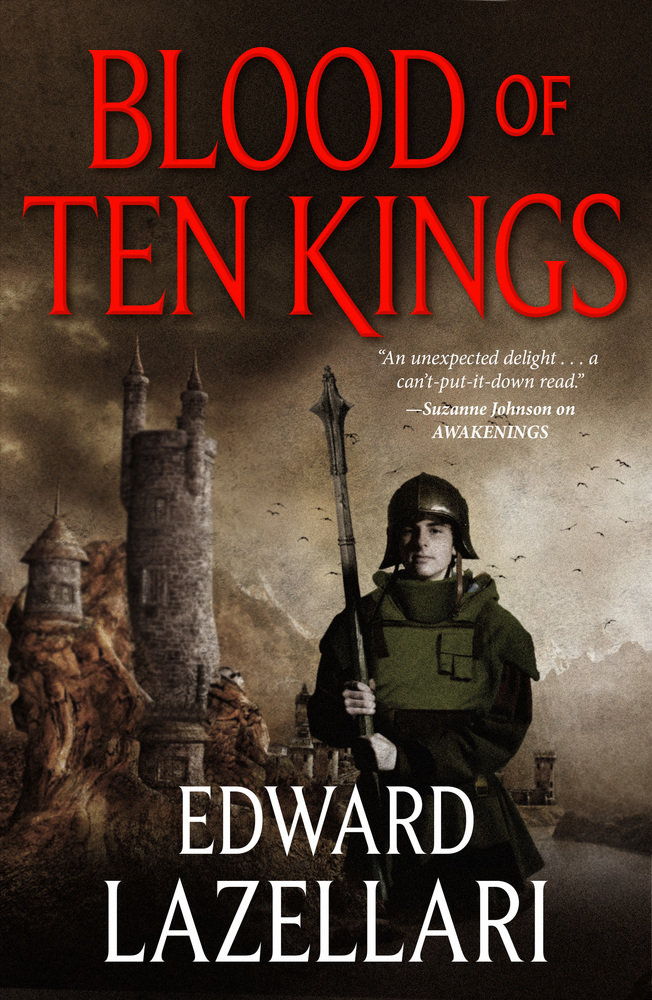
The Guardians return to their reality, ill-equipped to fend off Farrenheil’s invading soldiers, which have saturated the kingdom. Daniel and Seth must vanquish ancient ghosts to claim the powers of their birthrights even as Cat MacDonnell fights to retain her husband against a kingdom that would rather see Callum wed to Chryslantha Godwynn.
Their fellowship broken, Seth, Catherine, Callum, and Daniel must deftly navigate the dangers of Aandor or face oblivion at the hands of their enemies.
With the first two novels having established that a multiverse exists and Daniel/Danel is the missing prince of Aandor, Lazellari is ready to fully tell the story of the rightful heir taking the throne and go fully into Epic/Kingdom fantasy. There’s quite a bit to unpack and he divides the narrative through several viewpoints, with Danel being almost a supporting character in the story of his ascent to the throne. That’s largely fine since he was never truly the central character. One thing was initially surprising about Danel, but once it settled in made some more sense: he had little knowledge of the world on which he was born when we initially met him and was expected to catch up very quickly on the history of the world He really came into his own, in terms of the knowledge of Aandor he possessed and his commanding presence here in the third volume. While the way in which he came to this knowledge and assumption of his stature felt somewhat convenient, the implication that being back in the land of his birth making everything fall into place, allowing him to truly become the ruler does make sense.
If Callum, the police officer introduced in book one Awakenings and revealed to be from the world of Aandor and sent to Earth to find Danel/Daniel, was the central character early in the trilogy, he takes a bit of a back seat in the finale. A considerable portion of the narrative focuses on his Earthly wife, Cat, as she is suddenly displaced from Earth and forced to assert herself in a land not her own, with people who may potentially hold her in contempt. Her only choice is to dig deep into her soul and survive. Her journey was perhaps the most fascinating and admirable. I really thought Ed did a fine job of seamlessly interweaving the vulnerabilities she felt with the strength she needed to draw upon to “succeed” on this new-to-her world.
Another supporting character he grew nicely over the series was Seth, the mage whose powers weren’t consistent. He also came across as selfish in the earlier books and Lazellari managed to allow the character to both grow and stay somewhat true to himself throughout. But the problems he had with magic, hinted at in Awakenings (book 1 of the series), are brought to light here in the finale.
Danel, Callum, and their allies are not all that made it through to Aandor. They brought Earth weaponry with them, too. Guns and yes, helicopters. Of course, magic and technology don’t mix well in Lazellari’s milieu, which is a common but effective trope. After all, we wouldn’t want it to be too easy to overthrow the usurper and return Danel to his throne!
That’s a big part of what I liked about this novel, Lazellari’s ability to make things challenging enough that the characters’ success isn’t guaranteed (and some don’t make it), but hopeful enough that things could turn out well for them. The characters largely earned what they fought for here in the finale and throughout the series, and that is what helps to make the saga and novel as a whole, very satisfying. Although there is definitely darkness in leaps and bounds, especially as it surrounds Daniel in the early portion of the trilogy and other characters throughout (poor Lelani!), the heroes/protagonists are very much driven by hope. That hope helps to pull the narrative along quite strongly.111
Although the trilogy was long in the making (in terms of the time from the publication of Awakenings (Book One) to Book Three here with Blood of Ten Kings), there’s a feel that Lazellari had a fairly structured plan in the making from the start. Having spoken to him a few times, he suggested as much. Of course, many authors say they have a plan for their series when it begins. But it is satisfying to see an author, especially one who has a grasp of storytelling the way Lazellari does, manage to follow-through with a plan and tell a story through to resolution as satisfyingly as does Edward Lazellari.
I’ll reiterate my statement from my review of Book Two, The Lost Prince, The Guardians of Aandor is a series that deserves more attention than it gets. With the trilogy now completed, I’m hopeful that more readers may be willing to try out the books. Lazellari manages to pull off portal fantasy, epic/kingdom fantasy, urban fantasy, along with touches of military fantasy over the course of three books. He wanted to have his cake and eat it, too. For my reading time, I’d say he pulled off all those things – and more – quite successfully.
Recommended
© 2018 Rob H. Bedford
Guardians of Aandor, Book 3
December 2018 | Hardcover | 494 Pages
Sample Chapter: https://us.macmillan.com/excerpt?isbn=9780765327895
http://www.edwardlazellari.com
Review copy courtesy of the publisher, Tor Books





I am on record as completely agreeing.