 One of my favourite Fantasy series in recent years has been the Empire of the Wolf trilogy, which finished last year (and the final book, Trials of Empire was in both mine and Rob’s favourite books of the year list.)
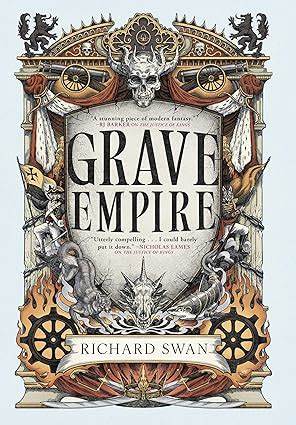
With Grave Empire Richard begins a new trilogy. Set in the same world as the Empire of the Wolf trilogy, could lightning strike twice for this relatively new author?
From the publisher: “A new age of exploration and innovation has dawned, and the Empire of the Wolf stands to take its place as the foremost power in the known world. Glory and riches await.
But dark days are coming. A mysterious plague has broken out in the pagan kingdoms to the north, while in the south, the Empire’s proxy war in the lands of the wolfmen is weeks away from total collapse.
Worse still is the message brought to the Empress by two heretic monks, who claim to have lost contact with the spirits of the afterlife. The monks believe this is the start of an ancient prophecy heralding the end of days-the Great Silence.
It falls to Renata Rainer, a low-ranking ambassador to an enigmatic and vicious race of mermen, to seek answers from those who still practice the arcane arts. But with the road south beset by war and the Empire on the brink of supernatural catastrophe, soon there may not be a world left to save . . .”
So: Grave Empire is the latest in a new trilogy set about 200 years after the events of the previous series. (You don’t have to have read the previous books to read this one.) Things have clearly moved on, although the revelation in the last series (spoiler for the previous series here) that the afterlife is a real thing with spirits and other nasties determined to encroach upon the physical world still stands. (end spoiler.)
We are shown a Napoleonic or Imperialist British Empire sort of tale, but one which appears to be in decline. Whilst some things have changed, other things remain the same. Richard has taken the trappings of Regency England and Europe – all bureaucratic diplomacy and coffee shops – sorry, kaffeehauses * – with subversive pamphleteers on the streets and merchant companies, often prevalent in whaling, now dominant – and reimagined them into this world.
Whilst some things are different, other seem to have remained the same. Sova is still fighting Casimir, as well as the wolfmen of Kyarai. Countries like Tolland and Draedaland, Manaeisland and Saekaland, once part of the Sovan Empire are now separate. The Neman religion is a presence (has it ever left?), although restricted in its practices. There’s a new Empress in Sova, Zelenka Haugenate, whose presence seems to be both revered and divisive. She seems to be turning things around, although not everyone is pleased with the changes.
The story focuses on three main characters this time, all with their own plotline. Perhaps most important is Renata Rainier, who is a minor official for Ambassador Didacus Marushka, the Empire’s contact with the underwater kingdom of the Stygion. Although initially appearing to be doomed to a life of administrative boredom for a negotiator with no contact with the Stygion, Renata and Marushka are called to travel north to investigate strange rumours that may affect the Empire.
In an alternate plotline we also have Peter, a young officer in the Sovan army, currently fighting a war with Casimir. Peter is a reluctant combatant, limited in experience and one who joined the army because it seemed like a good idea at the time. He spends most of his time afraid, shadowed by mysterious and strange creatures that decapitate unwitting men. A warning? A punishment? Part of a ritual? Peter doesn’t really want to find out. This is real Heart of Darkness stuff, with the physical hardships being possibly less important as the psychological trauma of travelling into the unknown.
Thirdly, we have Count Lamprecht Von Oldenburg, a crotchety, irascible member of the once-elite, who is determined to reintroduce magic back into the world, despite it being outlawed in The Trials of Empire. His dabbling in the banned occult practices has consequences for Sova and the surrounding countries, not to mention our other characters.
These three plotlines intertwine as we progress through the narrative, becoming connected by the end of the book.
In terms of characterisation, I was at first struck by how similar some of the characters were to the earlier novels. It could be said that initially Renata is similar to Helena Sedanka, as is Oldenburg to Konrad VonValt, although as the story progresses it is clear that the characters are very different.
As the book progresses, I felt that this is a bigger, bolder and richer experience than the other books to date. This may be because unlike the earlier books where the story is mainly told from the viewpoint of one character (Helena), here this story is told in the form of third person-narrative. As a result, we are less restricted in our viewpoints; the perspectives are more varied and the world seems bigger, giving an epic-ness to the narrative from fairly early on. I thought that this was shown by the scenes in the underwater world, which are impressively imaginative.
Swan has managed to continue the sense of horror that the last trilogy emphasised. Nasty things of an almost cosmic, Lovecraftian nature vie for attention with all of the other elements introduced before. If The Trials of Empire was akin to a Hammer Horror movie (as I alluded to in my review of The Justice of Kings), then this is perhaps more Universal Monsters, with its talk of wolfmen, mermaids (the Creature from the Black Lagoon, perhaps?), vampires, zombies and all.
With that in mind, it must also be said that like the first books, Grave Empire is remarkably violent. The battle scenes are impressively gory but not for everyone. with limbs torn away, bodies exploding when hit by musket and cannon fire, and hand-to-hand sword fighting remarkably visceral. Like the earlier books, torture is graphically depicted, and with some explicit eviscerations this makes Grave Empire not a read for the faint-hearted.
The ending is rather sudden, not really being anything other than a pause in the proceedings before the next book in the trilogy – not necessarily a bad thing, but those expecting all to be resolved will be disappointed. Much of this book tells us that The Great Silence is coming…. But not yet.
In summary, Grave Empire marks a step-up in this remarkable world. Whilst maintaining the strengths of the original trilogy, Richard has broadened the scope and the narrative to create a new story that is imaginative and gripping, violent and horrific. Whilst not a stand-alone novel, Grave Empire sets things up for what should be an impressive continuation in the next book.
It’s good to be back.
*Richard uses an eclectic mixture of non-English languages throughout the book – there’s French, German and even Dutch in places to show different races and species.
© 2025 Mark Yon
Hardcover | Orbit Books
GRAVE EMPIRE by Richard Swan
February 2025 | 528 pages
ISBN: 978 035 6523 866
Review copy courtesy of the publisher, Orbit Books