
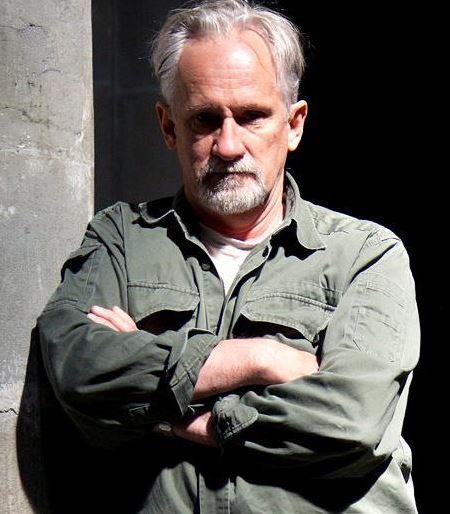
 The Way of Sorrows, the final installment of Jon Steele’s Angelus Trilogy is now being released. We have talked to him about the trilogy and his life behind the camera covering some of the worst conflict areas.
First of all for those not familiar with The Angelus Trilogy can you tell us a bit about it?
Angels, demons, a private eye without a memory of a life, a high class hooker on the run, a mysterious brain injured young man who lives in the belfry of Lausanne Cathedral (Switzerland) and calls the hour through the night, a fat grey cat who talks, a Swiss cop in a cashmere coat; drugs, drink, merciless killers, lost souls, quantum mechanics, creation mythology, religion, evolution, an ancient prophecy buried in the Dead Sea Scrolls; beforetimes and nowtimes, Planck time, nuclear Armageddon in real time … all coming together as the Voyager One spacecraft (launched from Earth in 1977) crosses a previously unknown region of the heliosphere and breaks into interstellar space, with a gold disc onboard bearing an SOS to the creator of the universe that paradise is headed for a mass extinction event.
Can you give us some insight into your main characters?
The Watchers (book one of the trilogy) is built around a trinity of players who occupy center stage (in one way or the other) through Angel City and The Way Of Sorrows. Marc Rochat: the young lad who calls the hour from the belfry of Lausanne Cathedral. He talks to the bells and the statues, and they talk back. He thinks the cathedral is a hiding place for lost angels. Turns out he’s right. Then there’s Katherine Taylor: devastatingly beautiful, craves pleasure, makes ten grand a night turning tricks with the uber-rich through an escort agency called The Two Hundred Club. Last, but not least, is Jay Harper: lately of Her Majesty’s Special Reconnaissance Regiment. He wakes from a drunken stupor, discovers he’s now working for something called Guardian Services Limited. They’re sending him to Switzerland to engage in “the usual sort of job.” Harper has no idea what that means; doesn’t matter, because something tells him he has no choice.
How do you feel your characters have evolved throughout the series?
Massively. They took me on a wild trip. And they did the evolving. Through the entire trilogy I felt like a scribe in the corner (and, indeed, inserted myself into the opening of The Way of Sorrows as the last scribe of Qumran) watching and listening to the characters move through the bounds of the story. I didn’t write The Angelus Trilogy so much as jot down the action and words as it played out in my imagination.
What is it with fallen angels you find fascinating?
Look at the state of the world.
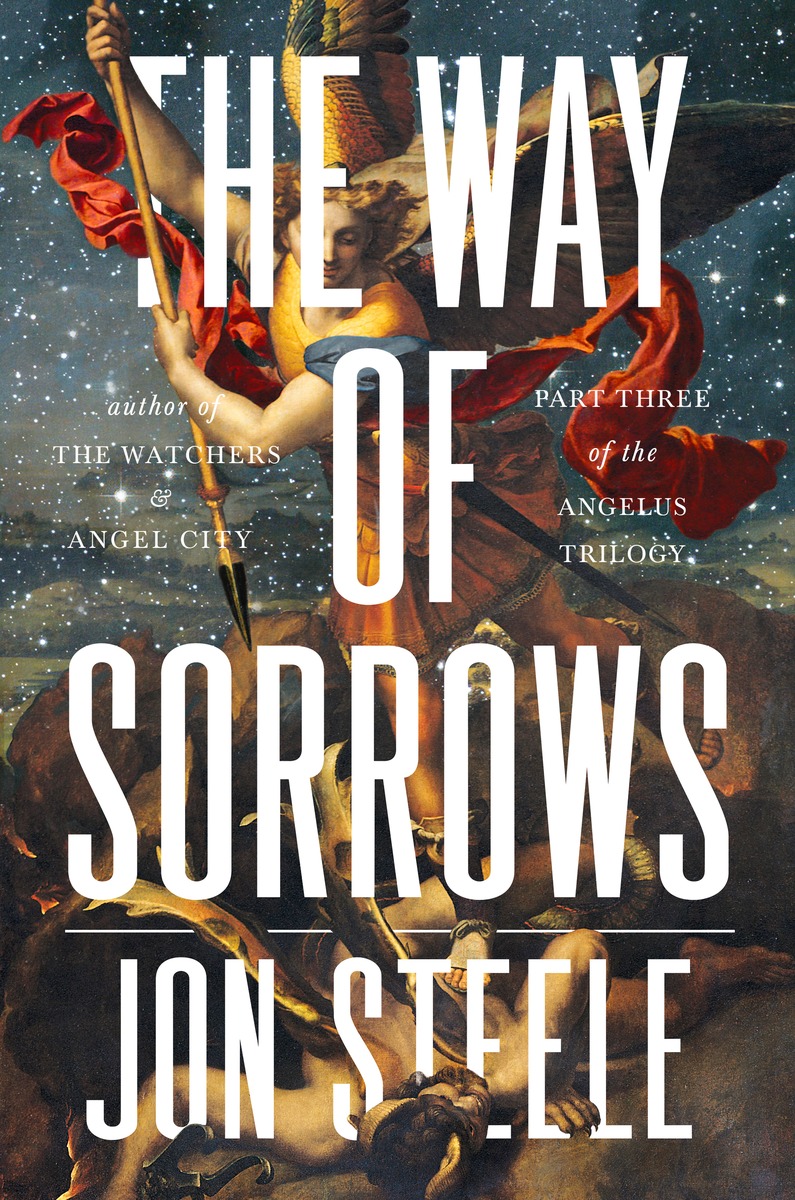 The third and final book in the trilogy, The Way of Sorrows is released on August 4th. Without giving too much away, what can we expect?
Crunch time for paradise. Life on earth being ground down to a singularity in time and space from which light cannot escape. The only hope for mankind rests on the shoulders of one broken angel as he walks The Way of Sorrows because he has no other choice.
Looking back, what about The Angelus Trilogy are you most proud of? And if you had the chance, is there anything you’d want to go back and change?
That I finished the bloody thing. Something I would not have been able to do without my wife, my dog, my two cats, my editors and publishers, and my literary agent (Georgina Capel). Trust me, no writer is an island; especially novelists. With War Junkie ( my autobiography about a year in the life of a front-line news cameraman) and The Angelus Trilogy, I’ve written four books. When I’m done with the editing and sign off on the proofs, that’s it. I never look at the book again, precisely because I know I would so want to change things. Not being able to do so would torture me beyond belief.
How did you start writing? Was there a particular book or moment in your life that spurned you on?
War Junkie was published in 2002. My first interview about the book was with BBC radio. I did not prepare, or think about answers a head of time. First question from the presenter was “Why did you write this book?” Without considering it, I said, “It was either that or jump off a bridge.” It sounded flippant, but I had actually revealed the truth to myself about why I started writing. I had already had a nervous breakdown and been diagnosed with severe PTSD, but I kept working. Truth was, I was too terrified to stop working. I feared if I stopped taking pictures at the sharp end of human existence, I’d stop breathing. But I was a bloody mess. I was overcome with an urge to understand what the hell was happening to me. So one night, at the back end of a bottle in Moscow, I sat down with a piece of paper and wrote the first sentence of WJ, “This is how it happened.” That started it, and I’ve been writing ever since. I write to keep the demons away from the door.
What is your favorite and least favorite part of the writing process, and why?
Favorite: When a character (usually in some grim circumstance) says something unexpected and wonderfully funny. It reminds me of working in the trenches of some hellhole on the planet. Me and a reporter and a producer hunkered down, wondering if we were going to get out alive, fearful to the point of pissing our trousers, and someone says something hilarious. It’s the sort of thing that reminds you you’re not dead yet, and that means there is hope. I love living through the voices of my characters. Least favorite: Staring at a black page for hours and feeling a hole in your soul because you cannot write. It happens sometimes. Actually, it happens a lot.
What sort of challenges, as a writer, might you have faced before your first book was published? Any insights you would be able to share for those aspiring writers seeking advice?
When I meet people at signing events or such, I often ask how many writers are in the room. I always tell them how much I admire them because writing, published or not, is an act of supreme bravery. And I’m always happy to engage in conversations with aspiring writers about the process as I see it. It’s important to remember that writing is an intimate and private endeavor, unique to each writer. The one thing we all know is writing is painful and lonely, but it’s in those hard places where the best words are born, so that’s where a writer must live. That’s why it’s important to have a roadmap when writing, to keep from getting lost along the way. My roadmap through the trilogy read like this from day one: know why you want to write this story; do your bloody research so know what you’re writing about; and most importantly for me … know the last sentence of your story before you know the first one.
As a cameraman you have covered some of the world’s worst war zones. How has that influenced your writing?
My life behind a camera lens (and learning how to tell a story through pictures and sound) more than influences my writing, it defines it on every level. I visualize every scene as if I’m filming it, because it’s the only way I know how to do it. I have to see it, hear it on the big screen in my head before I can write a bloody word. More than that, The Angelus Trilogy is a reflection of my life as a cameraman. There were times, walking through fields of human slaughter, that I truly believed I was walking the front lines of Good and Evil. To this day I am haunted by the faces and voices of the those who suffered and died in my lens. There were thousands of them. I once watched twenty thousand people choke to death from cholera on a waterless African plain. Sometimes I imagine their souls, all of them, are still with me; afraid to leave, begging to be comforted. I set out with The Angelus Trilogy to write a tale about the last of the good angels trying to save the souls of men from the claws of evil; I did not know I was writing about my own soul, and the souls of the ones I carry with me … all of us looking to be saved.
For your own reading, do you prefer ebooks or traditional paper/hard back books?
Make mine paper, please.
What kind of books do you read, any favourite authors?
I never read while I’m writing, except for research and background info. When I’m not writing, I read all kinds of books. I gravitate towards mystery fiction, science fiction, magic realism, and history. Fave writers: Raymond Chandler, Philip K Dick, Graham Greene, William Faulkner, George Orwell, Jack London, Declan Burke, Mario Vargas Llosa, James Ellroy, Mikhail Bulgakov, Cormac McCarthy.
What do you do when you’re not writing, any hobbies?
I like to take long walks with my dog through the forests and farms around my Swiss Village. I don’t say a word, either does he. We just move through the universe in silence, and in awe.
What’s next, what are you working on now?
I’m working through the last draft of a story set during the last Iraq War called Saddamistan: a story of love and war. It’s a book I’ve been working on for years, and nearly fifteen years since all that “Mission Accomplished” bullshit, the book’s time has come. It would be a part of something I’d call The Third world Trilogy; based on three unconnected tales about Americans in far flung places of the world who end up on the wrong side of fate. The other two books would be Banana Republic (about a mid-level drug runner hiding out in Panama City as Noriega goes down), and Fags (about a blue-blooded chap from a prominent ,but cash poor Boston family, who graduates last in his class from Harvard Business school and goes to work for an international tobacco manufacturer in charge of ‘duty free’ cigarette distribution in the Siberian Oblast.) Or, drop all that and just pick up where The Angelus Trilogy leaves off, and continue down the same road marked “Mystical Noir Lane”. Or I may move to Colorado and grow weed. Who knows?
* * * * * * *
Interview by Dag Rambraut – SFFWorld.com © 2015




Nice insights into the background of the Angelus series. I’ve read the first two and besides being totally original stories that grab you from the start, the characters are amazing – my favorite is the Chandleresque detective and his wisecracks under fire. Epic story – can’t wait for the third installment.
I am so proud of you Denis and I know Athy is looking down smiling hugs
Make mine paper too…
Cormac McCarthy!
Graham Greene!
Part of me wants to know what kind of story a mind likes yours can conjure, the rest of me is worried what I might find. Which is the best endorsement I can give, because no matter what, it sounds interesting.