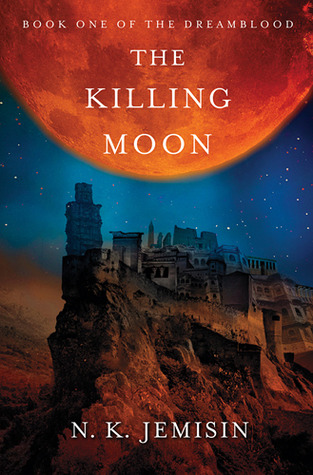
Nila jumps fearlessly into the dream world with N. K. Jemisin’s Book 1 of the Dreamblood: The Killing Moon.
The Killing Moon by N. K. Jemisin
Published by Orbit Books, 2012
Review by N. E. White.
The Killing Moon is a story of greed and peace, of emotion and ambition, and of a place in our minds and hearts. That may seem muddled and over-reaching, but those are the things that came to mind when I sat down to review N. K. Jemisin’s first book in the Dreamblood series.
 The story primarily follows three main characters, Ehiru, Nijiri, and Sunandi, as they try to avert a war the Prince of Gujaareen does everything in his power to start with Kisua, a neighboring state.
Ehiru and Nijiri are priests of the Hetawa, a church dedicated to the worship of this world’s moon goddess. They act as agents of their goddess, wielding power derived from the citizen’s of Gujaareen dreams to dole out justice in the form of death. There are other priests of the Hetawa, their purposes being far more innocuous. Like any religion, where there is grace, kindness, and healing, there is also merciless and misguided justice. For the later, the religion uses people like Ehiru and Nijiri for their natural ability to cleanse the city-state of corruption (by killing) and then to collect a tithe for doing so.
At the start of this journey, Ehiru is commissioned to do just that, however as he attempts to send his target with good memories into the realm of their goddess, something goes terribly wrong. Unbeknownst to Ehiru, the ultimate corruption, a demon, is lurking within the city and preying upon its people.
Nijiri is a novice priest. At the cusp of gaining status as a Gatherer, he is put to the ultimate test of love and faith. He must follow his mentor, Ehiru, into dark places of corruption while keeping his own faith and morals, and ultimately to do what is right. His story is the one that most drew me into this world and made me care about what happened there.
Sunandi is a young diplomat from Kinsua, embassador to Gujaareen, and she has just replaced her own mentor who had been in that position. He was murdered by the very agents that purport to bring peace to the city. Her task is to stop the looming war, but with a Prince who has been planning for years, since he murdered his father and butchered his family, she may not succeed.
Reluctantly thrown together, these three flee Gujaareen and its Prince across a desert and into Kinsua where they hope to find information and prepare for war. Once there, they learn (or confirm) uncomfortable truths and the task set before them will pit the two priests against the ultimate trial for the lives of thousands of people and the peace of their souls.
The Killing Moon is more about a time and place of Jemisin’s making than it is about any of these characters, but they will make you rejoice and weep as you follow them into the dream world and struggle to overcome the corruption that seeps through the fabric of their lives and their religion. This is the book’s greatest strength: its richly layered world and its incredible characters.
It’s weakness? The plot is well conceived, but it didn’t surprise me. However, I felt The Killing Moon’s fascinating world didn’t need an awesome, twisty plot. What we have here is a well paced story set in an alluring world, and that very much kept me thumbing through this book.
Based on both Egyptian mythology and Nairobi traditions, I actually found the book to be too short. I wanted to spend more time with the characters in the places they found themselves, from the streets of the outer city of Gujaareen, to the desert oasis, and further afar into Kinsua. I found the cultures Jemisin created in the two city-states. as well as the religious Hetawa. to be both an interesting interpretation of African mythology as well as a relief from our own cultural hang ups concerning sex and gender. Not that the cultures in this book are perfect in that regard, but different from our own western sensibilities – and I liked it. I wanted more ‘meat’ to this story and would have been glad if the book was twice as long.
Ms. Jemisin’s writing style is provocative, giving the reader a sense of immediacy. I even found myself enjoying the interludes (myth-like stories place throughout the book to explain religious or cultural norms). The author also has a gift of showing her characters’ emotions without making them into caricatures of those emotions. Overall, I found the prose very easy to read and at times, lyrical. As is the case in most fantasy books, it did take me some time to sort out all the names, but now that I have, I’m ready to read more.
Lucky for me, there’s another book available in this series: The Shadowed Sun. I’ll be starting on that one very soon.
I recommended The Killing Moon for anyone searching for something with a unique magic system and a refreshing world view.
N.E. White, June 2013.
Copyright; sffworld.com. If quoted, please credit “sffworld.com, name of reviewer”.