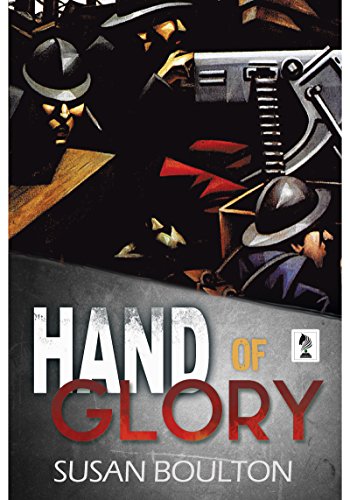
 “Where do you get your ideas from?” is an often-asked question to authors. In this article Susan Boulton, author of Hand of Glory, published by Penmore Press, gives her answer. It’s a fascinating and inspiring explanation of how an idea becomes a novel.
One Christmas I received a book from a friend. This friend is a writer, himself. He also knows how I love the myths and legends of my county and country, so A Companion to the Folklore, Myths and Customs of Britain by Marc Alexander was a win, both in the buying and the receiving.
Go forward a few years and it happened that late on Boxing Day, full of food and having given up on Christmas TV, I opened the book. As I read I began to make mental notes, hoping the fog of Christmas excess would allow me to remember ideas at some point.
One of those mental notes was about ‘The Hand of Glory’. Interesting… There was also a reference to the Victorian poem, The Nurse’s Story by Richard Harris Barham, as it appeared in his, The Ingoldsby Legends.
At the time I was toying with the idea of writing a story set during the First World War, the so-called Great War or War to end all Wars. This idea had been sparked by research I had been doing into the family trees of both myself and my husband. I had always had an interest in the conflict, although at first it was a reluctant one, having to study WWI poetry while doing my ‘O’ levels many years ago (the precursor of today’s GCSE examinations.) Over the years my interest grew, fuelled by reading the series of books by Lyn MacDonald. Her work, based on, and including first-hand accounts, brought the conflict my own grandfather took part in to life.
So what type of tale to tell? A straight ‘war story’ or something different? I then remembered something I had read. After the war, perhaps a reaction to the horror of industrialised warfare on a previously unimagined scale, the great loss of life and changes in society, there was an upsurge in the belief of supernatural, myths and legends. The war had created its own myths, such as the ‘Angel of Mons’ and the archers from the battle of Agincourt who allegedly appeared on the WW1 battlefield, to name but two.
It was a struggle in some ways between the pre-war England and the new world of increasing technology, new political and social beliefs, which people found themselves in.
So, a ‘ghost story’, I thought. Maybe, but I needed something to bring my protagonist into play. I also needed to give the antagonist reasons for his behaviour other than just being bad. And so I created Archie Hawkins. Archie is not a traditional villain. In a way he is an innocent caught in a trap of his upbringing and by what the world had done to him. His pain, his loss, forces him down the only route he believes can save him. Just as my hero Giles Hardy’s choices and his path are changed by his experiences, his guilt at being still alive, his loss of friends and his place in the world.
This motivational device turned out to be the Hand of Glory. Archie’s desire for revenge blends with his belief in the old ways. It gives him a cause and a faith. It opens a dark pit, which eventually swallows him.
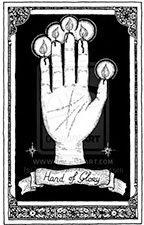 At the same time, for Giles, fighting against this belief and the events brought into being because of it, the Hand of Glory saves him and gives him hope for the future.
So the reality is that the Hand of Glory, while fascinating and creepy, as in folklore is the device of the story, not the main focus of the story. It’s a dark, tense, tragic ghost mystery with black magic and a search for redemption.
But how to use the myth of the Hand of Glory? Which parts of the many fragments of legends concerning this tool of robbers and witches to use? Well, I went back to my book of inspiration.
Part of the entry stated that the Hand of Glory, which is in the Whitby Museum, Yorkshire, was donated in 1935. Had it, I wondered, been in use until then? Could the belief in its powers have lingered well into the 20th century?
All the sources I read said that the Hand used was that of a hanged murderer, taken from a gibbet. So my dilemma as a writer was then how to have Archie acquire this hand and how would it fit into my story.
One of the ugly truths of warfare was that men were killed because an officer made the wrong decision, through misjudgement, arrogance, or plain stupidity. And, though not well documented, men have in various conflicts during the centuries taken it into their own hands to remove an officer they believed was more of a threat to them than the enemy was. So into my story enters the young lieutenant, the man Archie believes killed his brother, Jim. A scene in the book that binds Giles and Archie to the different sides of the same path.
 As for the creation of the Hand in the story, this was quite difficult. Various sources listed different elements. From using the urine of man, woman, dog, stallion and mare, herbs, saltpetre, peppers, ashes from the fire etc., the list seemed endless. In the end I used what I believed Archie could find or have acquired in his situation and focused on the one thing all the articles I had read agreed on – that in making a Hand of Glory you were doing a deal with the devil and had to abide by the contract your soul had signed. Like all such contracts, you were not going to win. The devil would have your soul sooner or later. In Hand of Glory I made this more poignant because Archie’s devil speaks with his brother’s voice. Archie believes it’s his brother, the brother that had protected him and looked out for him.
As to the actual use of the Hand in the novel, I owe a great debt to by Richard Harris Barham, and his poem. It gave me a base from which to build my robber gang and to map out their fate.
The stories that surround the legend of a Hand of Glory play on our fear of the place we feel the safest, our homes, being invaded and ourselves being unable to do anything to prevent it. This fear has not gone away in our technological age. With our ability to connect to world in so many ways our personal safe places are at risk from others and our technology is in some respects a modern Hand of Glory, opening the doors without our permission.