Current Non-Genre Reading III

Reading "Death in Londinium" by John Drake currently. A murder mystery set during the time of ancient Rome's rule of Britain. Little bit of a slow start, but coming along nicely now. It looks to be a 2 book series. Will review after I finish.


Finished up "Death in Londinium" and "Games in Londinium". Ikaros of Apollonia, engineer, former Grecian senator & soldier. Now a roman slave in Britannica. In the first book, his master is murdered. The act is pinned on the barber. Another slave. Under an old Roman rule, if a slave kills his masters, the entire household of slaves is killed.

Ikaros is a man of many skills. For saving a highly favored slave girl for the Roman Governor of Britannica, the governor grants him the boon of a favor should he ever need it. Ikaros calls in that favor to halt the slaying of the household slaves...including himself. Unfortunately it is beyond the governor's power to stay the execution. But he does have the power to grant Ikaros some time to find the real killer. Paired with the Roman General Morganus, the 2 race across ancient Britain tracking magic, druids, assassins & merchants looking for clues.

I knew that Rome had a footprint in Britain. But I didn't realize how much. One of the reasons I love historical fiction is that it educates (at least from the author's viewpoint) as well as entertains.

The second book is as much about the developing relationship between Morganus & Ikaros as they both come to understand each other as equals instead of master / slave. This novel deals with the machination of the Druids to bring down the Roman occupation.

The author has left room for the continuation of series and I look forward to it.

The other thing that was incredibly fascinating was at the end of the second book. Translated from early Roman documents, the author included the Rules for Gladiators. Gladiatorial combat as a controlled martial art as opposed to the free for all battles favored by movies and TV.
 
Last edited:
I haven't read this one but have read a fair few about Rome and Roman Britain e.g. Simon Scarrow, MC Scott, Sidebottom, etc. Not all of them good, I hasten to add. I'll keep an eye open for John Drake, though.
 
After starting three different SFs that have been sitting around and not getting more than several pages in each, I picked up Riviera Gold, one of the two most current Mary Russell/Sherlock Holmes books by Laurie King.
I love the period placement (1925), the occasional appearances by Sherlock, the aura of mystery and the somewhat introspective narration by Mary Russell. As much as I like it, I would recommend picking up one of the earliest books in the series, The Beekeepers Apprentice or whatever, if the above sounds interesting. If you are familiar with Russell, or have somewhat of a Sherlockian taste, know that after several volumes that got muddied by circuitous plots (but were still enjoyable) this and the previous volume get back to the strength of Mary and Sherlock being firmly at the center.

Note: Glancing at specifics on this book, I noted that there was a later adventure in the series that focuses on Marie of Romania and her castle in Transylvania. This is not a fantasy series, but I wonder who else might be wandering around that locale?
 
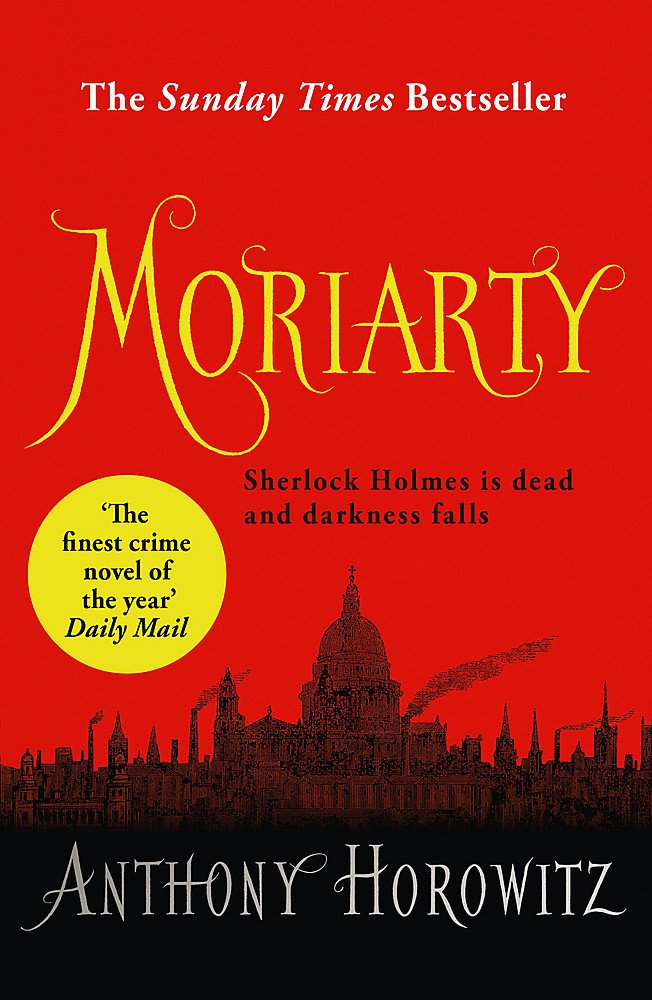
Moriarty

61uiRHoMNKL.jpg


With little else at hand, or more precisely little that I was in the mood to read, I plucked Moriarty from the shelf on which it had been sitting neglected for several years. As the title suggests, the book is set in the world of Sherlock Holmes, specifically after the events of Conan Doyle’s story The Final Problem in which Holmes was killed off after a confrontation with Professor Moriarty above the Reichenbach Falls in Switzerland. This story by Anthony Horowitz fills the vacuum (a temporary one as Conan Doyle succumbed to public demand and revived Holmes many years later) following the death of Holmes and is told by Frederick Chase, a Pinkerton agent from America.

It has been many years since I last read a Sherlock Holmes story but Moriarty, despite not featuring Holmes in person, brought the memories back. Chiefly through Inspector Athelney Jones, the Holmesian attributes of logical deduction and scientific reasoning are put on show, and Chase plays the role of Watson by expressing an appropriate level of amazement at Jones’s deductive skills. Along with the late Victorian London setting and range of period characters, I felt that Moriarty was a convincing homage to Conan Doyle’s work. There is also a major surprise not revealed until near the end of the book which I am happy to admit I did not spot. Most of the books I have read by Horowitz have been aimed at children or young adults (but should not be disregarded because of that) whereas this book is sometimes bloodier, more adult material.
In short, Moriarty is a good read.
 
Moriarty

61uiRHoMNKL.jpg


With little else at hand, or more precisely little that I was in the mood to read, I plucked Moriarty from the shelf on which it had been sitting neglected for several years. As the title suggests, the book is set in the world of Sherlock Holmes, specifically after the events of Conan Doyle’s story The Final Problem in which Holmes was killed off after a confrontation with Professor Moriarty above the Reichenbach Falls in Switzerland. This story by Anthony Horowitz fills the vacuum (a temporary one as Conan Doyle succumbed to public demand and revived Holmes many years later) following the death of Holmes and is told by Frederick Chase, a Pinkerton agent from America.

It has been many years since I last read a Sherlock Holmes story but Moriarty, despite not featuring Holmes in person, brought the memories back. Chiefly through Inspector Athelney Jones, the Holmesian attributes of logical deduction and scientific reasoning are put on show, and Chase plays the role of Watson by expressing an appropriate level of amazement at Jones’s deductive skills. Along with the late Victorian London setting and range of period characters, I felt that Moriarty was a convincing homage to Conan Doyle’s work. There is also a major surprise not revealed until near the end of the book which I am happy to admit I did not spot. Most of the books I have read by Horowitz have been aimed at children or young adults (but should not be disregarded because of that) whereas this book is sometimes bloodier, more adult material.
In short, Moriarty is a good read.

I didn't get to this because I wasn't impressed by his previous Holmes novel, The House of Silk. But recently read Magpie Murders which was very good, so maybe I need to re-evaluate.
 
Have started Graham Greene's The Power and the Glory and have La Carre's Tinker, Tailor, Soldier, Spy and Raymond Chandler's The Big Sleep waiting to be read.
Nice, Winter, I have read the Chandler (must revisit him to see how he does what he does!) But the other two have been on my shelf unread for decades... Both have towering reps. Let's see what you think of them. :-)
 
Just starting The Postman Always Rings Twice by James M. Cain, a reread for a book group on GoodReads. I think it's at least 35 years since I first read it.
 
Opportunistic studies - ease stress through understanding?

-Penguin Atlases of World History. Review conflict region, Vols 1-IV
-Dust off Vernadski History and browse

-Re-visit my Russian Language forays (including custom program)
-Review language differences, (alphabet and pron.) and 3-5 commonest phrases

-Study meaning and history of various military and national symbols
-Practice drawing, painting, multi-media crafting, etc. of symbols
-Color match pantone colors exactly in tempera and other media

Please Take a look at this Artist!!

-Learn about life of Repin, order Repin Art Book
-Quick sketch copy Repin art (pencil, ink, etc.) Esp: Ivan Terrible painting
-Drink in "The Barge Haulers" in awe-struck amazement, AGAIN, et al :-)
 
I finished reading Memorial Day, the 7th in the Mitch Rapp spy/thriller series by Vince Flynn. This was back to the fast-paced form that the last 2 books lacked a bit; as Rapp hunts down terrorists planning a nuclear bombing on the US, while pushing against the bureaucrats in government. His wife didn't feature at all which I think made it better - much of their interaction comes across as cheesy (and pace-slowing).
 
Castle Shade by Laurie King.
Mary Russell/ Sherlock Holmes mystery located in Transylvania.
The period is the late 1920s.
See post #824 above for my general reaction.
Well written. Intriguing. The only vamps are (spoiler) pretenders.
As such they are subject to Russell/Holmes powers of deduction.
Highly recommended.
LINK
 
Last edited:
Started Bernard Cornwell's "The Winter King". Three novel Arthur Pendragon series. My first foray into Cornwell. Just a few pages in, but pretty good so far.
 
The Postman Always Rings Twice by James M. Cain. A reread. Pretty much the point at which hard-boiled fades into noir, focus shifting from the anti-hero cop/P.I. to the criminals and the consequences of crime. The ending still provides a gut punch of a sort of brutal, dirty poetic justice.
 
Moriarty

61uiRHoMNKL.jpg


With little else at hand, or more precisely little that I was in the mood to read, I plucked Moriarty from the shelf on which it had been sitting neglected for several years. As the title suggests, the book is set in the world of Sherlock Holmes, specifically after the events of Conan Doyle’s story The Final Problem in which Holmes was killed off after a confrontation with Professor Moriarty above the Reichenbach Falls in Switzerland. This story by Anthony Horowitz fills the vacuum (a temporary one as Conan Doyle succumbed to public demand and revived Holmes many years later) following the death of Holmes and is told by Frederick Chase, a Pinkerton agent from America.

It has been many years since I last read a Sherlock Holmes story but Moriarty, despite not featuring Holmes in person, brought the memories back. Chiefly through Inspector Athelney Jones, the Holmesian attributes of logical deduction and scientific reasoning are put on show, and Chase plays the role of Watson by expressing an appropriate level of amazement at Jones’s deductive skills. Along with the late Victorian London setting and range of period characters, I felt that Moriarty was a convincing homage to Conan Doyle’s work. There is also a major surprise not revealed until near the end of the book which I am happy to admit I did not spot. Most of the books I have read by Horowitz have been aimed at children or young adults (but should not be disregarded because of that) whereas this book is sometimes bloodier, more adult material.
In short, Moriarty is a good read.
Just read it on AC's recommendation. As you can see from my previous posts I am currently on somewhat of a Sherlockian roll.
It certainly carried me along. I did suspect the surprise as the events were otherwise inconsistent.
But the tail end of the story did not enthuse, including what I felt were event choices in the narration. Close, but for me, no cigar.
 
Last edited:
Just finished Bernard Cornwell’s “The Winter King”. The first book of an Arthurian trilogy. The story is narrated by an elder Derfel Cadarn. A Christian monk describing to Queen Igraine how he came to serve Arthur. Before Derfel became a monk.

I’m not sure where Igraine fits in this narrative. I thought Igraine was Uther Pendragon’s wife and the mother of Arthur. But the book is a mix of historical fiction and Arthurian legend, so maybe Cornwell will explain who this Igraine is in the context of his story.

Derfel’s story take place in the ages after Rome has left Britain. Some tribes still live in the decaying ruins of Roman buildings. Some Kings still mimic Roman customs. The various britiannic tribes fight as much with each other as they do with the constantly invading Saxons, Franks & Irish.

Young Derfel is taken into Arthur’s service as a trainee. And is placed in Lord Owain’s levies for training as a spearman. Eventually ending up in Arthur’s cohort and serving him in various localities across the British Isles. As Arthur tries to unify the various tribes to address all the invaders as one country.

Arthur’s plans are often at odds with his desires. Though a superb warrior, he can’t help but get in his own way. Chaos of one sort or another reigns wherever he is, for the most part.

It is an interesting take on Arthur, Lancelot, Galahad & Merlin. I like Arthurian stories as Arthur might have (had he actually been a historical character) been instead of the Knight in shining armor / round table fables so prominent in modern lore.

Parke Godwin’s ‘Fire Lord” books are another Arthurian favorite as well.

Great read overall. On to the next book in the series, “Enemy of God”
 
Last edited:
Finished the 2nd novel in Bernard Cornwell's "Winter King" trilogy..."Enemy of God". Carrying forward in the tale. Britain is slowly losing its Druidic past to the Christian faith. The Saxons are taking more and more land as well as allying with the Christians against Arthur and his Pagan allies.

Yet the 15 years between Mordred's birth and eventual crowning are years of relative peace and prosperity for everyone. Unfortunately the relationship between Guinivere and Lancelot causes strife (as it always does in all the Arthurian iterations).

Still, a fine read and a really interesting take on Arthur's story. Starting the last novel of the series, "Excalibur" tonight, after work.
 
Haven't read these but good to hear you like them. Cornwell is usually a good bet as his research is second to none.

Now I've amassed all of the Long War series by Cameron, I'm ready to get started on Killer of Men.

 
Off and on dipping into The Destiny Thief by Richard Russo, a collection of essays on life, literature and writing. He's a very entertaining writer.
 
Back
Top