
 Do you remember when the first cell phones came out in 1984? I certainly don’t because I was only four years old at the time, and besides – I have enough trouble remembering what happened last Tuesday, let alone thirty-two years ago. But we all know the basics about the first cell phones, don’t we? They were the size of seventeen hardback books taped together, they weighed more than a small car, and they cost more than Elizabeth Taylor’s engagement ring. I am of course exaggerating, and I’ve been told a billion times not to exaggerate.
One thing that cannot be exaggerated however is the impact the cell phone has had on us as a species. Think about it – twenty years ago, we all got by perfectly well without them, but these days it’s hard to imagine what life would be like without the ability to order pizza on the move whilst listening to the new Muse album whilst checking the directions to where you are supposed to be going whilst updating your status on facebook and then tweeting about it whilst playing Candy Crush. Many of us are now totally dependent on our phones – take them away and most of us would probably end up walking into walls not knowing what time of day it was. And look at the companies that have risen and fallen over the years as the phone has woven itself into the fabric of our lives (and into the fabric of your jeans if you are unfortunate enough to leave it in your pocket when you do your laundry) – it’s amazing how the landscape has changed so much in such a short space of time.
But I’m certainly not the first person to cover this topic, so why am I bothering to mention it at all? What else is there to add that hasn’t already been said? Well, centuries ago, the ability to talk to someone on the other side of the planet was the stuff of fantasy. You’d be crazy to even suggest it might one day be a possibility, alongside other ridiculous notions that Australia might be allowed to enter the Eurovision Song contest, or that they might one day perfect microwavable mashed potato. Yet here we are. It makes me think about what other ‘crazy’ technologies might be around in the future – things we can’t ever imagine becoming a reality – and what impact they might have on us should they ever exist.
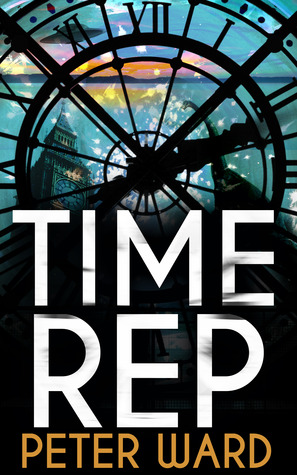 Take the ability to travel back in time. Impossible right? Today, yes – it’s generally agreed that going back in time is a little bit tricky. But what if one day such technology actually existed? What if one day we could actually go back in time and have the power to change history? My first book, Time Rep, explored this possibility, and specifically looked at how holiday companies might exploit the technology and put it to commercial use, allowing people to travel to any time period for their vacation. In this story, Geoffrey Stamp is an ordinary guy living an ordinary life in the 21st Century, until he is approached to work as a ‘Time Rep’ – a tour guide meeting people who travel back in time for their vacation.
This all sounds pretty cool to him, until he discovers the reason he’s been picked is because he’s one of the most insignificant people that’s ever lived in all of human history, meaning the people from the future can approach him with the job offer (and therefore change his destiny) without disrupting the original course of the space-time continuum. And this is just one of many safe-guards time-tourism uses to prevent the technology from creating any paradoxes: tourists are scanned by a supercomputer that can predict causality before they travel back to ensure they won’t interfere with history, and no-one can take any future technology back with them. However, despite all of these checks, Geoffrey soon discovers a conspiracy to use the technology to change history, and it’s up to him to save the day!
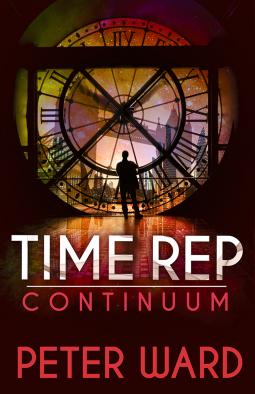 The sequel, Time Rep: Continuum, is released next week, and begins to explore what the wider ramifications might be for humanity if time travel-technology improved and became even more accessible, just as it was impacted by the rise of the cell phone. In this story, two years have passed since Geoff’s first mind-bending adventure, and time travel-technology is much smarter. Now, a new holiday company called Continuum are allowing people to go back in time for their vacation and change whatever they like, yet they are somehow able to do this without creating those nasty universe-destroying paradoxes. Imagine it. What if we had this power? What if we could relive the best moments of our lives? Correct our biggest mistakes, or any mistake for that matter? If you thought the temptation to check your e-mails on the bus was too much to resist, what about the temptation to go back and un-say something you wish you hadn’t said, like that time you confessed to Aunt Marjory that you didn’t like her fruit cake?
I think it would be total chaos, like giving a child an unlimited amount of money and letting them loose in a candy store. Eventually, the child would be slumped in the corner, stuffing its mouth with sweets, not knowing what to eat next, despite being full. With the ability to change anything, there would no longer be any repercussions for our mistakes. We could try and fail as many times as we liked until we got things right, which would remove the sense of achievement we normally get when things go well. And with no sense of achievement, there we would lose our sense of ambition – there would be no sense of uncertainty driving us to better ourselves anymore. In short, things would get boring real quick.
It would also be quite interesting from a legal perspective. Let’s say I committed a robbery, but then went back and changed things so I didn’t do it anymore. Where would that leave the law? And if you could commit a crime and then un-commit it, surely this would begin to warp people’s sense of right and wrong. Suddenly, people would be able to morally reconcile the most terrible actions, because they would know they could always go back and change things so it never happened. But it would be like robbing a painting from an art gallery and then returning it, Thomas Crown style – just because you undid it, doesn’t take away from the fact that you did it in the first place.
This is the world Geoffrey Stamp has to face in Time Rep: Continuum – a world that has just been let into the candy store with unlimited money. Of course, this new technology has its temptations for Geoffrey as well, until a future version of himself appears out of nowhere with no memory, a bullet in his back, and a Continuum business card in his pocket. Geoffrey soon finds himself in a race to solve his own attempted murder, but begins to wonder if his investigation is the very thing that nearly got him killed. He discovers a horrible secret about Continuum; something worth killing to protect. But with his grizzly fate predetermined and the forces he is up against able to counter his actions by changing time however they please, what possible chance does he have to save the day once again?
Anyway, what are your thoughts on how time travel might impact society should it ever be invented? Let me know in the comments section!





It would be neat but to think that one action could take away someone you love or cause your grandchild never to be born? We would have to be so careful.
Also before your time, in 1983, John Brunner postulated in his book Time After Time, that any time line where humans had invented time travel, people would insist on changing the past until it became one where time travel was never invented. I.e . invention of time travel is inherently unstable in history due to human nature.