
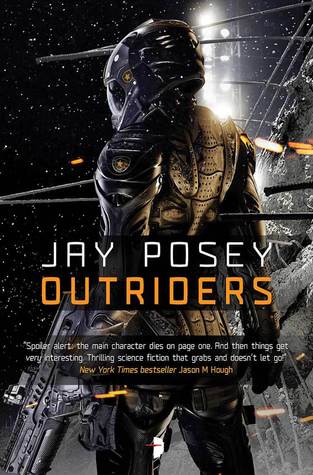
Outriders is the opening salvo in a new military sf series by Jay Posey, whose previous outing (the Legend of the Dustwalker trilogy) decorated its post-apocalyptic action with intriguing remnants of high tech left behind by a fallen culture. Here we get more of that tech, this time in a close-future where humanity has taken its first steps to the planets, if not yet the stars, and things are already getting complicated.
The story gives up its own giant spoiler practically on page one with the reveal that Lincoln Suh, a young captain in Earth’s military, is seconds from death… and minutes from life after death. All this is courtesy of a technology reputedly capable of perfectly mapping a person’s personality onto their own clone in the event of the original being killed. Participation in this ongoing experiment is just one step in an extended, highly competitive selection process for an elite project. However, shortly after his recovery, Suh is fairly devastated to find himself abruptly washed out from contention, only to discover that he’s actually been pulled for something even bigger… or smaller.
 He is offered the chance to head up a semi-off-the-books team whose remit is part intelligence gathering and part crisis prevention — with flexibility regarding how either goal might be achieved and blanket access to the resources needed to get the job done, whatever that job may turn out to be. Chosen for a strain of creative thought considered unique even amongst the cream of the candidates, Suh is inserted into a squad of skilled specialists already bonding as a unit, an outsider in his own team, whose skills he must familiarise himself with if he is to prove himself worthy of the responsibility he’s been given.
However, though they don’t yet know it the clock is already ticking. The assassination of a “diplomatic” figure on Mars — an independent state whose relationship with Earth is precariously balanced — is followed by the destruction of a mining station isolated in space, a chance disaster resulting in the death of thousands and the loss of vast quantities of priceless resources. But there is a survivor, a lone technician from a haulage vessel with no means of calling for rescue, who bore witness to the station’s final moments and suspects that what she saw may not have been all it appeared.
These are only the first moves in a game with unstated rules and unknown players, where the stakes are unimaginable. With political pressures building to explosive levels across the solar system, the Outriders are forced into immediate operation and Suh is pushed to the sidelines, ordered to observe and learn instead of lead. But if he isn’t ready to step up soon, the price they pay could be high…
Outriders offers a high-paced blend of near-future space opera and military sf, and in a nutshell it’s good fun. The new technologies are cool, the social environment is quickly and clearly established, and the plot takes us through a satisfying range of locales both in and out of the Goldilocks Zone. However, in military fiction (sf or otherwise) there are obviously key elements that must be done well if the tale is to have credibility. Speaking as a reader who doesn’t need his fictional combat hardware to display a level of authenticity able to withstand parade ground inspection, there are two elements that stand out above all others: Can the author convincingly convey the personalities and dynamics of military culture? And, Can they deliver me some action?
Fortunately, Outriders boasts varied and entertaining set pieces. Posey’s background in writing for military strategy games serves him in good stead. He sets-up and plays out special forces-style scenarios which include intelligence gathering, covert ops, electronic warfare (if that term isn’t too archaic even today), hostage rescue, hand-to-hand and vehicular combat, and good old-fashioned gunplay. Whether he presents the participants as clinical and cool-under-fire or tosses in a few juicy snafus to up the pressure, these sequences (excuse the military pun) uniformly read well — and, most essentially, the supposedly unkillable nature of the heroes in this storyworld doesn’t lessen the tension when they are in the line of fire.
On the character front Outriders keeps itself afloat, though (in part due to the makeup of special ops units, or at least of their fictional representations) it isn’t what you’d call groundbreaking. We are presented with a tight-knit group, each of whom has their own particular quirks and field specialities: playful, taciturn, self-doubting, etc.; martial artist, sharp-shooter, tech-genius, etc. There are opportunities for all to test their brand skills, as well as for the different personalities to mesh, and clash, and earn each other’s grudging respect… you know, The Way Soldiers Do.
In addition to the standard team of individuals, the Armed Forces Family Unit makes its traditional appearance (gruff father-figure with gold stars and medals, check; non-com-mom who really gets things done, check; officer heir-to-the-throne who has to prove himself to both… check), but Outriders also has its core hook in place: the notion of an army in which those killed in action can be brought back to serve alongside those who saw them die. This gives an interesting stir to a mixture that might otherwise threaten to be, if not stale, fairly conventional, and hints at the possibility of increasing depth to the relationships within the team as the series develops in future titles.
It also hints at a couple of long-game “twists” in the making, both of which may be a little easy for the reader to predict in advance, but which the protagonist of course doesn’t spot, even when one plays out right in front of his eyes. Still, we shouldn’t judge the Captain too harshly — he died recently, after all, and he’s had a lot on his plate since then.
Much as I love science fiction, specifically military sf isn’t usually my first pick off the shelf. I have a soft spot in my heart for violence in fiction, but that can crop up in this subgenre and out of it, and when I’m drawn into any story it’s always because of the characters. Aside from a few particular favourites, my experience of military sf hasn’t been strong in this area, but while Outriders didn’t overturn all my little prejudices on that front it had enough of interest to keep me reading, and the action didn’t disappoint. I look forward to following the ongoing development of Lincoln Suh and company.
Review by Andrew LH – SFFWorld.com © 2016




Hmm. I’m curious about this, despite not being a huge fan of military sf either. For me, Posey’s strength is in his characters (it’s why I loved the first Duskwalker book, and was so disappointed by the second), so I may wait to see who makes the cut for book two.