

Post-apocalyptic alien invasion stories are a staple in the Speculative Fiction genre so when a debut novel comes along telling such a story it either has to hit the highpoints of such a story very well or throw something new into the mix. In Ninth City Burning, J. Patrick Black’s debut, he does just that. As a primer, here’s the jacket copy of the book:
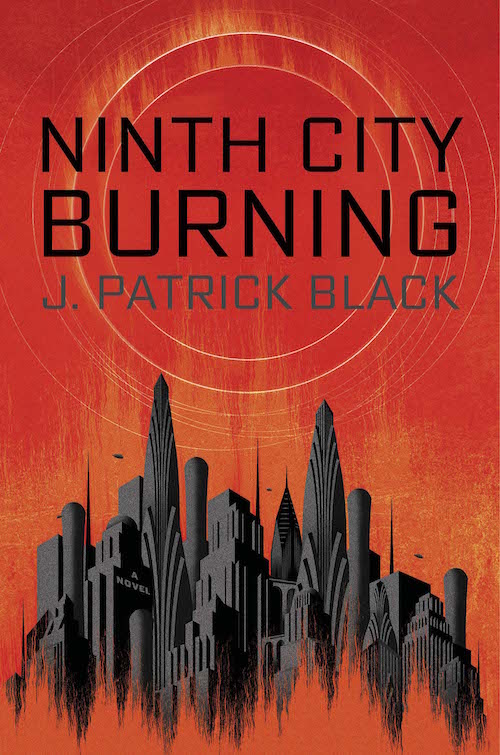
For fans of Red Rising, Starship Troopers, and Ender’s Game comes an explosive, epic science fiction debut…
We never saw them coming.
Entire cities disappeared in the blink of an eye, leaving nothing but dust and rubble. When an alien race came to make Earth theirs, they brought with them a weapon we had no way to fight, a universe-altering force known as thelemity. It seemed nothing could stop it—until we discovered we could wield the power too.
Five hundred years later, the Earth is locked in a grinding war of attrition. The talented few capable of bending thelemity to their will are trained in elite military academies, destined for the front lines. Those who refused to support the war have been exiled to the wilds of a ruined Earth.
But the enemy’s tactics are changing, and Earth’s defenders are about to discover this centuries-old war has only just begun. As a terrible new onslaught looms, heroes will rise from unlikely quarters, and fight back.
The novel takes place about a half millennia after the “Valentines” (so called because their arrival was on Valentine’s Day) came through the Lunar Veil and (to put it lightly) made their presence known. While the world was devastated and only a dozen cities remain with the scattered remnants of humanity have gathered in small settlements. In a sense, a small percentage the survivors were uplifted. These few humans, known as fontani, now have access to thelemity, a force akin to magic which provides them with willpower to affect reality.
The first thing that sets Black’s novel apart is not just the rotating cast of characters, but that each point of view/character chapter is told from in the first person. This establishes an intimacy that a story with such a global scale might otherwise lack. Through each character’s eyes, we see how vastly different portions of the world have reacted to an alien attack and the decimation of technology and infrastructure. Some peoples have reverted to nomadic tribes (Rae and Naomi of the Ochre family), others have helped in the fight against the “Valentines” or “Romeos” through recruitment and honing of special skills (Jax, Kizabel, Imway, and Vinneas), or from the streets and every-day youth through the yes of Torro in the titular Ninth City. This mode of storytelling also illustrates just how broken down technology is, particularly communication as the Ochre family has a vastly different understanding of the state of the world compared to the people who live in Ninth City.
Black does many things well in his debut; he creates a great sense of a fractured world and because he shows it through multiple viewpoints, it feels much more immediate. There is mystery around the aliens themselves as their appearances are minimal at best, and primarily through their weaponry. He also does a very good job with the characters, at least most of them….which leads into some of the issues I had with Ninth City Burning. While I appreciated what Black was trying to do in showing the decimated world defending and rebuilding through the eyes of people from various social strata and background, I felt it was too much of a stretch, a bit crowded. I thought Rae, Naomi, Jax, Kizabel, and Vinneas were the strongest characters of the bunch. However, I felt the story would not have lost much if we didn’t see things through Torro or Imway’s point-of-view and would have made for an all-around stronger and more tightly-woven novel.
I’m of two minds on the aliens themselves. On one hand, I really would have liked to see and know more of the aliens, at least to know them more than simply as the faceless invading force they were for much of the story. On the other hand, I think keeping them somewhat faceless allowed Black to invest more of his creative energies into the characters, allowing readers to build empathy for them. I also would hope Black provides more information about the aliens in future volumes. (Yes, this is the first of a trilogy.) The glimpses he did show of a multiverse, parallel worlds, and grand universe beyond Earth’s atmosphere; however, were enticingly strong (and reminded me a bit of Jason M. Hough’s awesome Zero World reviewed here).
Black is weaving elements from quite a few popular works, like Star Wars (thelemity and the fontani), The Hunger Games (the fractured city states), Red Son Rising (the bleak setting and tone), A Song of Ice and Fire (rotating POVs) and even Ender’s Game (the militaristic feel of the “recruits”). It also blends elements of futuristic SF with the aliens and multiverse with more fantastical elements like the all-but-magic-or-force of thelemity. What Black gets right, he gets right very well. Some of the disconnectedness and wide-spread point of views detract from the novel a bit as I’ve said. One thing is definite, Black’s ambition is quite impressive and even though a reining-in wouldn’t have hurt this novel, that ambition and the delight he seems to have taken in crafting this tale come through quite well.
Overall, Night City Burning is a mixed bag at worst (with more good in that proverbial bag than negative), and an ambitious novel with much promise for future volumes in this trilogy at best. Based on this first book in the series, patient readers would seem to be rewarded.
Recommended.
© 2016 Rob H. Bedford
Review copy courtesy of the publisher, Ace
Hardcover | 496 Pages
Published by Ace | September 2016
http://www.jpatrickblack.com/
Excerpt: http://www.jpatrickblack.com/sample/




I think this review leaves out some fairly crucial details.
1. It tries to be funny at times and its excruciating bad. One characters primary characeristic is dropping Star Wars lines. The engineer character and Rae name a battlemech Snuggles and were supposed to find it funny. It’s not. It’s annoying, and doesn’t make sense for Raer as a character to go along with . Further the engineer figuratively squees overs the shoved in romance of Rae and Vinneas.
2. The magic system that underpins the story is very poorly explained. Some of the basics stick through: fontani are batteries for the revenni. Alright, sticks, makes sense. But then the Fontani stuff gets weird. See the Fontani are really powerful, but there powers aren’t really in there control. They go into a dream world where they can fight, while in reality there basically using their powers to flatten mountain ranges and enemy fleets. But there’s no connection between the two, or why it really works like that. Stranger yet, they all go into anachronistic dreams that are unrelated to the time the story is set.
Expanding on that, when the magic contributes to the finale, it feels completely underwhelming. Suddenly, they can just do a thing because the author needs it to happen. There’s no weight to it. It’s just suddenly
3. Weird but small note: the author justifies a character listening to the Clash by saying that all culture stalled out after the war started, so no new music or other form of art has developed. Which is a weird etail and contributes to another problem.
4. Ninth City isn’t a place. There are people there, and a few places, but its devoid of a meaningful culture. They’ve modeled their unit names and ranks off the Roman legions and government, but it feels like they could have stuck any culture’s ranks on them and it would have the same effect. And Ninth City is the core of the book and its simply not a place you can care about. It’s hollow and empty.
5. The view points aren’t interwoven for the most part. You’ll get long tracts with certain characters, chapter after chapter where the other characters are mostly invisible. Naomi, who actually makes the opening interesting, disappears as a viewpoint for the entire rest of the book. A long section of the book sticks with the engineer, but she’s so ‘quirky’ that it makes the center of the book a slog. Torro, who gives a more grounded eye view of the story, disappears until the final chapters, and has the one gripping scene in the entire last third of the book.
6. Nothing happens for large section of the book. Imway is the only character with a stake in movijng the plot forward, and everyone else does …stuff (mostly choking you under layers of world building that tells you nothing but more impenetrable terms with no relevance ) until the thing he muses about actually happens.
Hi Borborygmos
You bring up some fair points. I think part of it is that we had slightly different reactions, though I do understand your POV.
Personally, I try to balance my reviews with equal parts “recap”/plot points with equal parts opinions/reactions and also leave enough of the plot points for readers to discover on their open. I tend to keep my reviews capped at around 1200-1500 words although, admittedly, this one is a tad shorter.