 When I was a young, starry-eyed lad dreaming of becoming an author someday, an enormous amount of appeal came from the idea of creating my own worlds. I’m guessing it’s probably not unusual for kids to dream about being master of their own fate, where they can make all the rules, and stay up as late as they want and eat ice cream whenever they feel like and ride all the dragons.
As I got older, though, I discovered that if I wanted to create a world that felt plausible and internally consistent, I couldn’t just gloss over all the messy parts of humanity. Even in my futuristic settings, my characters seemed to insist on being people, and apparently people means politics.
Though I wouldn’t classify any of my work as being expressly political in nature, I couldn’t ever seem to escape the fact that whether I was writing in a post-apocalyptic setting or a more optimistic space-faring one, I had to take into account not just the rules and structure of various societies but also everyone’s opinions on those things.
That was a really long sentence.
The bottom line is that I had to do a lot more thinking about things I had previously thought I could just conveniently ignore.
In my military sci-fi Outriders series, for example, I originally thought I was creating a relatively small world. In the series humans have become a space-faring race, but they’ve really only made it as far as Mars, so it’s not like we’re talking about galaxy-spanning empires or anything.
I quickly discovered just how complicated even that tiny expansion could become.
The main characters are part of a special operations unit, and thus far in the series, they’ve primarily been focused on trying to prevent the outbreak of the first interplanetary war, between Earth and Mars. But as I developed the setting, I noticed just how much I had to fight the urge to over-simplify everything with uniformity.
It was tempting to squish everything down to “All Martians believe X and all Terrans believe Y, so they have to fight”. But that’s not how things actually work, and for my particular setting, every step I took that direction felt false.
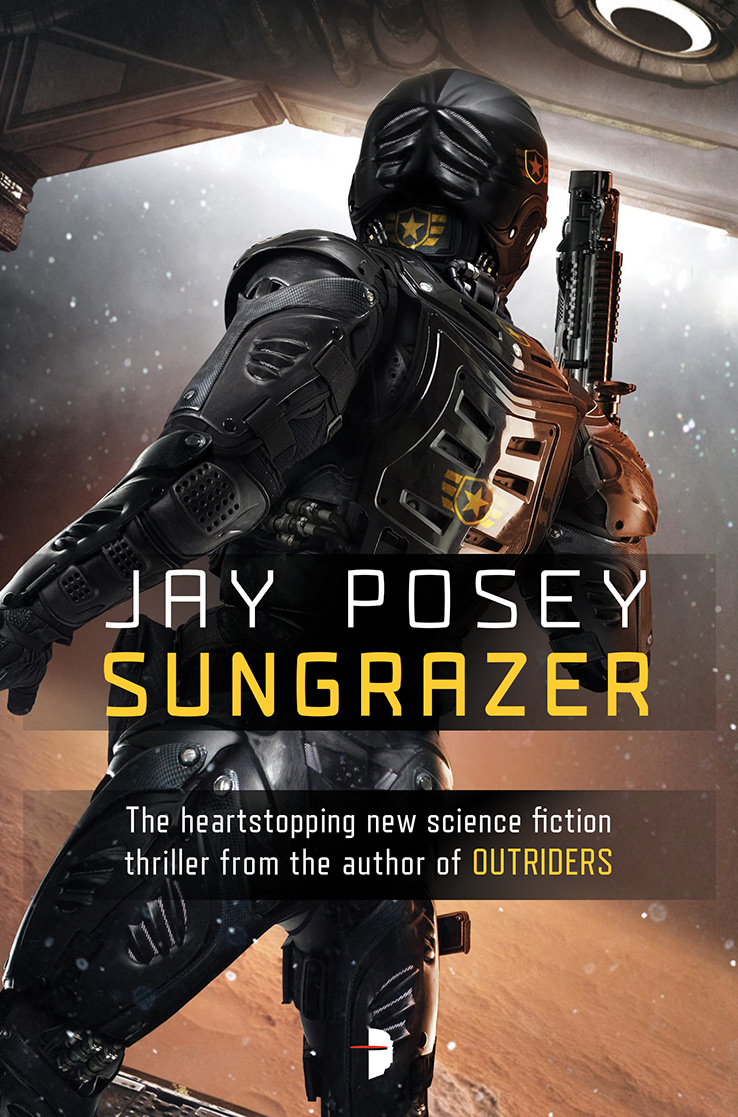 In the Outriders world, Earth isn’t united under a single banner. For example, the US is part of the United American Federation, a unified body from the northern-most reaches of Canada down to the southern-most tip of Chile. But all member nations maintain sovereignty, and of course they don’t agree on everything. Naturally, power dynamics exist within the UAF, and the Outriders (who are a US Army force) might not always be working strictly in the best interest of the UAF as a whole.
Across the ocean, the Eastern Coalition serves as a counter-balance, with countries like Russia, China, and several European nations working with their national interests in mind. Though the landscape has changed, with some nations disappearing and others rising in their place, it’s not like Earth acts as a single entity.
Similar conditions exist on Mars; though there is a Central Martian Authority charged with overseeing the governance of all the various colonies on the planet, there are blurred lines about who has final say in different matters. Some colonies still take their direction from their mother nations back on Earth, while others have broken away and become truly independent. Still others were birthed on Martian soil, with no connection to Earth at all save for their ancestry.
And of course, I couldn’t resist the temptation to create new forms of government. For example, in the small but influential Martian People’s Collective Republic, power is shared between an elected council of humans and a single artificial general intelligence. (Don’t worry, for the sake of this post, I’m going to forcefully ignore the very serious and complex implications of an AGI.)
None of that is even taking into account the various citizens’ opinions of their own governments’ agendas, which, as has been all-too-well demonstrated lately, don’t necessarily align.
When I started working on the first Outriders novel, I hadn’t planned on any of that. I just wanted to tell a story about awesome special ops people in space. But even though a lot of those political dynamics don’t show up explicitly in the books, exploring all those different angles and viewpoints opened up a lot more questions for me than I had anticipated.
For example, just how many nations have to agree to take an entire planet to war? A majority? Or only one? And if some of the people on your planet just happen to take the other guys’ side? What then?
Against this backdrop of impending planetary conflict, the soup of political interests and power dynamics in the Outriders series gave me a wide range of opportunities to explore and evaluate different motivations and ideas. One unexpected side-effect was the stretching and deepening of my own personal political thoughts and theories.
Sci-fi has long been a playground for political theory. Some authors enjoy projecting aspirational, utopian views of certain forms of government, while others explore the dark implications of particular power structures.
Regardless of the approach, science-fiction can serve as a safe place for thought experiments, where current thinking can be challenged and evaluated, where new concepts can be put forth and expanded upon, and where old assumptions can be seen in a new light, removed from the usual context. In the best instances, sci-fi can create worlds from which we can return with improved perspective, wiser for having made the trip.
As a kid, I just thought it was fun to imagine a future with spaceships and lasers. As an adult, I’ve learned just how valuable science-fiction can be as a tool to inform and encourage a debate that is likely to continue for as long as humanity itself remains.
About Sungrazer
In a new Cold War between Earth and the colonies on Mars, when devastating weapons go missing, there’s only one team you can call – the Outriders. A crack force of highly specialised super-soldiers, their clone bodies are near-immortal. When a fully-autonomous vessel with orbital strike capabilities goes missing, it’s up to the Outriders to track the untrackable. But when the trail leads them to the influential Martian People’s Collective Republic, the operation gets a lot more complicated…
Jay is a narrative designer, author, and screenwriter by trade. He started working in the video game industry in 1998, and has been writing professionally for over a decade. Currently employed as Senior Narrative Designer at Red Storm Entertainment, he’s spent around eight years writing and designing for Tom Clancy’s award-winning Ghost Recon and Rainbow Six franchises. A contributing author to the book Professional Techniques for Video Game Writing, Jay has lectured at conferences, colleges, and universities, on topics ranging from basic creative writing skills to advanced material specific to the video game industry.