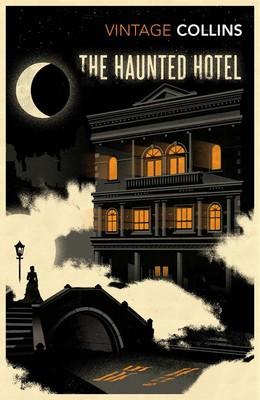
 Randy’s latest review on our Countdown to Halloween is an old classic:
Still looking straight at the light, she said abruptly: ‘I have a painful question to ask.’‘What is it?’
Her eyes travelled slowly from the window to the Doctor’s face. Without the slightest outward appearance of agitation, she put the ‘painful question’ in these extraordinary words:
‘I want to know, if you please, whether I am in danger of going mad?’
The Countess Narona visits a doctor, not the first doctor she has consulted. She feels afflicted, certain of doom hanging over her. The doctor, unable to help, is still intrigued by the Countess’ certainty and soon learns the recent circumstances of her life:
Lord Montbarry broke his engagement to Agnes Lockwood to marry the Countess. Agnes relinquished all claims on him and, aware the Countess only learned of Montbarry’s previous engagement after consenting to marry him, forgave her. His family, not as magnanimous, was scandalized by the breech of the code of conduct and rallied around Agnes, and never more so than after Montbarry’s unexpected illness and death while on honeymoon residing in a palace in Venice.
As the story proceeds, the circumstances surrounding his death come under scrutiny and questions arise: Why did the Countess consent to marry the middle-aged, balding, unlovely Montbarry in the first place? Why did Montbarry’s courier, Ferrari, disappear? And why did the lady’s maid quit the Countess and return to London?
I entered Wilkie Collins’ The Haunted Hotel with moderate to low expectations – I haven’t read anything by Collins except “A Terribly Strange Bed,” a fine old tale of terror, Victorian writers tend to prolixity and sometimes a maudlin sentimentality, and I haven’t really heard much about this novel except it’s one of his later books, when illness and addiction were beginning to affect his writing. Still, I didn’t want to dive into one of his longer works directly.
I was entertained. Aristocracy misbehaving, love, betrayal, romance, a palace, an enigmatic prophesy, a visitation, a secret chamber, Collins deployed many of the fixtures of early Gothic fiction, but updated them in keeping with his time period (the novel is set in 1860), often with fine wit. For example, during the course of the story the palace is bought, renovated and becomes a hotel. Perhaps poking fun at Americans of the time, and maybe at Gothic fiction as well, one of the main characters acquires the room Lord Montbarry died in when the American originally assigned to it complains the hotel was insufficiently modernized and he would rather stay in a less beautiful room supplied with gas; thus Collins excuses the weak, flickering illumination of candle light in a room in an ancient Venetian palace in scenes to come.
Part of the entertainment comes from the setting of much of the story, Venice, part comes from the denouement which includes a summary of a play, part from Collins’ deployment of Gothic trappings, and part from the mystery of just what happened and how, which Collins preserves until near the end. Further, Collins’ main characters, Agnes and the Countess, balance each other: Agnes is of her time but neither as idealized as some heroines of Victorian fiction nor a shrinking violet. Collins depicts Agnes as intelligent as well as sympathetic to those around her. Her antagonist, Countess Narona, is a more extravagant, theatrical creation, but believable within the story, her dramatic personality helping propel the plot.
I wouldn’t put this on par with the best of Victorian or Edwardian ghost stories, like Oliver Onions’ “The Beckoning Fair One” or Robert Hichen’s “How Love Came to Professor Guildea,” but it is well-written and, if you don’t mind fiction told at a leisurely pace, worth seeking out.
More Venice:
“Don’t Look Now” by Daphne du Maurier (Echoes of the Macabre; Foundations of Fear)
The Stress of Her Regard by Tim Powers
THE HAUNTED HOTEL by Wilkie Collins (1879; Dover Publications, 1982)
Online version at Project Gutenberg: https://www.gutenberg.org/ebooks/170