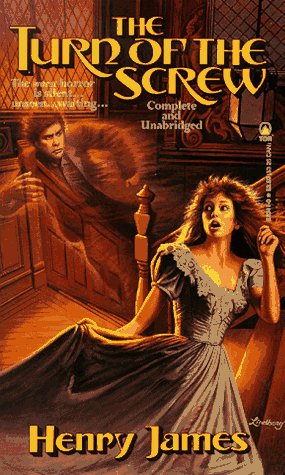
 And now, our last Hallowe’en post from Randy for this year. A solid-gold classic:
“I quite agree—in regard to Griffin’s ghost, or whatever it was—that its appearing first to the little boy, at so tender an age, adds a particular touch. But it’s not the first occurrence of its charming kind that I know to have involved a child. If the child gives the effect another turn of the screw, what do you say to TWO children—?”
“We say, of course,” somebody exclaimed, “that they give two turns! Also that we want to hear about them.”
Deep in the year, around a winter hearth several people sit listening to ghost stories. Among them, Douglas, a man with a story he has wanted to tell but only now feels he can with the passing of the person who told him, a charming woman, his sister’s governess, who first related it to him forty years previous and later sent him a letter recounting the details of her experience at her very first professional position
When their governess dies, Miles and Flora’s guardian hires a new governess, whose name is never told for from this point on Douglas’ correspondent is the narrator. The guardian, their uncle, has sent them to a distant estate, Bly, and when he hires her it is with the stipulation she is to make all decisions regarding her young charges and not to contact him about their care. Though their well-being weighs on him, as a confirmed bachelor and man about town in London, his attitude toward the children is one of duty rather than affection and his approach to their rearing one of benign, good-natured neglect.
On reaching Bly our narrator finds her charges beautiful and endearing, and the housekeeper, Mrs. Grose instantaneously a friend. The only trouble is, she wonders if she has quite won over the children, if they have given her their complete confidence, and then, too, there is the intrusion of a handsome man only she sees who, from her description, Mrs. Grose declares is Quint, the former valet, and like Miss Jessel, the former governess, dead.
It’s unlikely I can say anything about this that someone else hasn’t already said. It is a ghost story, I think, except James doesn’t commit to telling a ghost story. As with “Green Tea” by Joseph Sheridan Le Fanu, a writer James admired, the novel plays in that murky borderland between ghost story and mental delusion. How much of what the governess writes is real and how much the confabulation of a young woman stressed by the responsibilities of her first professional position? How much is this governess concerned for the welfare of these children in spite of their reticence and how much is she desperate for some overt signs of loyalty and a kind of ownership of her charges?
James leaves the answers to these questions to his reader. Told at a leisurely but not sluggish pace, James builds an atmosphere of uncertainty and anxiety throughout so that the novel is unsettling largely because of his restraint, his insistence on suggestion and inference, his building of narrative tension through the play between the story as told and intimations of a different story behind it, between the reader fearing a threat to the children from outside of Bly and anxiety that the threat is already within.
While James’ ghost stories may stem from his reading as a youth, the modern ghost story stems from the work of two James’s: M. R. and Henry. Where Montague Rhodes James influence stems from a body of work, Henry’s stems largely from this short novel though he wrote other very good ghost stories (“The Jolly Corner”; “The Romance of Certain Old Clothes”; “Sir Edmund Orme”; etc.), but The Turn of the Screw was the pinnacle for him and maybe for the ghost story itself.
Other … hauntings?
The Haunting of Hill House by Shirley Jackson
The Little Stranger by Sarah Waters
“Seaton’s Aunt” by Walter de la Mare
THE TURN OF THE SCREW by Henry James (Taplinger, 1980; first published in 1898)
And with that we finish this year’s Countdown. We all hope you have found some of our choices of use this year. As we report to our library, with smoking jacket and brandy and a good book (of course!) we hope you all have a Happy Hallowe’en!