

As with the first two Star Wars trilogies, the Planet of the Apes trilogy seemed to follow the rule of thumb of releasing a movie about every three years with Rise of the Planet of the Apes in 2011, Dawn of the Planet of the Apes in 2014, and War for the Planet of the Apes in 2017. I had the advantage of being introduced to the saga and watching all three films within a period of a few weeks.
Starring in the saga as the intelligent ape Caesar who has exceptional leadership skills is Andy Serkis. Serkis has played important roles in some pretty amazing films such as the Lord of the Rings trilogy, The Hobbit: An Unexpected Journey, Star Wars: The Force Awakens, The Avengers: Age of Ultron, and the Steven Spielberg film The Adventures of Tintin. Almost always portraying a CGI character, he is a stupendous voice actor and is quite accustomed to performing in a CGI suit.
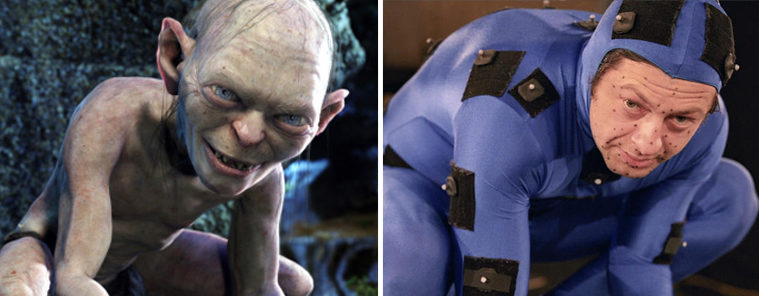
I think many will agree with me when I say the first film, Rise of the Planet of the Apes, was my favorite of the new trilogy. It was simply intriguing. It is the sad, tragic beginning to a pretty sad, tragic tale, yet quite interesting nonetheless. To me, it seems to be similar to Jurassic Park, only the company’s name is Gen-Sys not InGen, and they’re doing lab tests with an experimental drug on chimps instead of genetically modifying and creating dinosaurs.
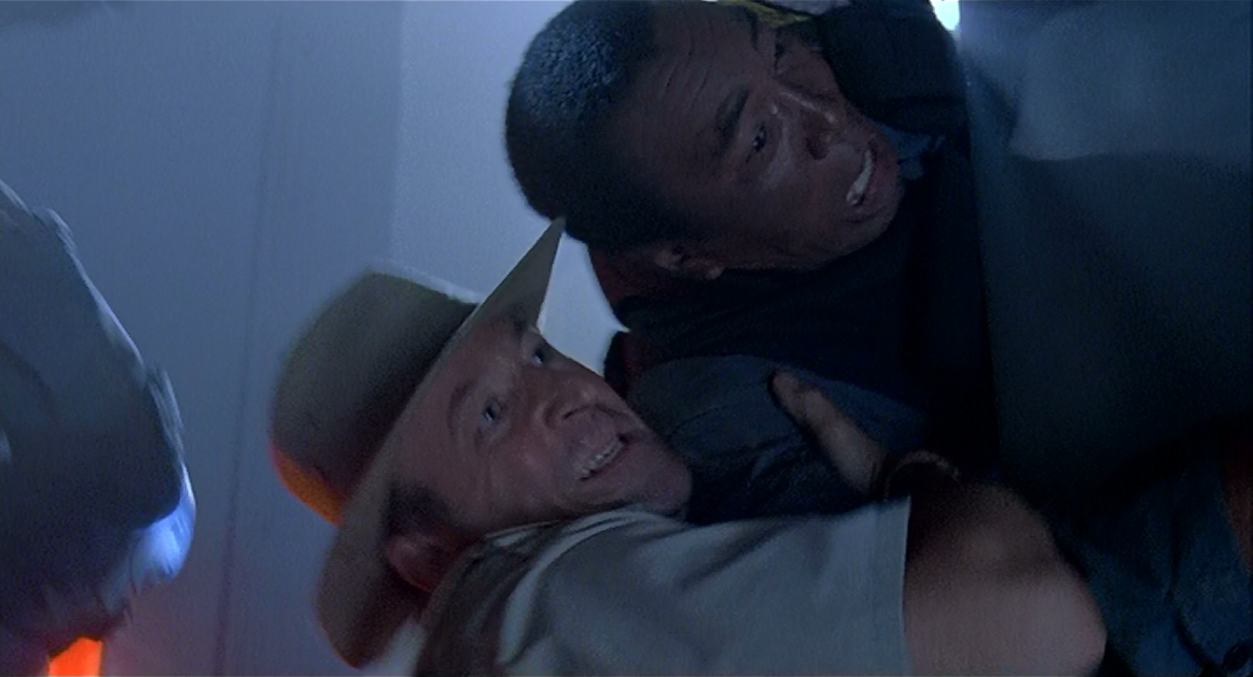
One scientist is even grabbed by the arm and yanked against the side of a glass enclosure by a chimp, personally calling to mind that scene in Jurassic Park in which the gatekeeper is grabbed by the legs by a velociraptor and truly holds on for dear life. However, unlike John Hammond, Steven Jacobs, the head of the Gen-Sys labs experimenting on the chimps, never comes to a realization that what he is funding is dangerous and wrong.

The second installment, Dawn of the Planet of the Apes, was probably the most pointless chapter of the whole trilogy. The movie is mainly the telling of a story in which the remnants of humanity who are immune to the plague brought on by the ALZ-113 chemical developed at Gen-Sys.
The apocalypse concept seems to show a tad of resemblance to the one in The Omega Man with Charlton Heston or The Last Man on Earth with Vincent Price, stories in which a biological or chemical entity created a global plague, in turn wiping out the majority of the Earth’s human population. In The Last Man on Earth, a small group of survivors end up keeping themselves alive and not falling into a zombie-like state via a drug developed by their scientists with which they must be injected frequently.
Anyway, it’s a slight similarity seen in this Planet of the Apes film during which the “Ape-pocalypse” takes its largest, most devastating toll. The most devious enemy of peace in Dawn of the Planet of the Apes is the ape Koba who had been abused and experimented on within the labs of Gen-Sys.

Koba shoots Caesar, kills another ape, and imprisons apes that don’t openly follow his orders after he proclaims himself their leader. I thought this was actually the darkest part of the whole trilogy. Of course, Caesar recovers so he can die in the next movie, and kills Koba, putting an end to his evil. This film was actually more warlike than War for the Planet of the Apes was!
Finally, this year’s War for the Planet of the Apes was the close of the saga. This was a moribund trilogy, and those who watched it probably knew it. But it was a truly necessary chapter in the Planet of the Apes story. The best parts of the film were Caesar’s haunting memories of Koba and the comic relief delivered by “Bad Ape.” The whole trilogy serves as a prequel to the original 1968 film Planet of the Apes, another apocalyptical movie starring Charlton Heston. Heston plays an astronaut named George Taylor who, along with three others, was lost in space while in a cryogenic state.

They land their ship on the planet Earth but do not identify it with anything they remember having seen on Earth; so desolate, scorched, and savage it has become. The “primitive” humans they discover are unable to speak. This has been explained more than 50 years later. The disease generated from the ALZ-113 alters itself, striking down many people who were even previously immune and rendering them not dead but mute, just as the future people Taylor meets are mute.
Also, the young mute girl Nova whom Maurice befriends is the same character who becomes Taylor’s close comrade in Planet of the Apes. One of the biggest things which bothered me about the final film was how Hollywood puts its political/religious slants into its stories. As a Christian, I found the character of the colonel to be utterly repulsive.

He what I detested the most. The colonel’s most common form of punishment for the apes is extremely similar to the ancient torture/ultimate death penalty of crucifixion. The colonel is portrayed as a Christian and yet his whole attitude and mind set is extremely anti-Christian. He obviously is a “sick” man and has a God complex (as he claims to have saved humanity by sacrificing his only son).
While monologuing, the colonel reveals that he shot and killed (murdered) his own son who had a disease as his son was staring straight into his eyes. The colonel is also seen giving his men a sign of the cross with his razor. He has let the power go to his head. Under his leadership, the military has defaced the American flag. He exclaims Jesus Christ’s Name in vain and later commits suicide.
One messed up man if you ask me. (Plus, he’s building a wall. So it would be easy to believe the writers and audience members might relate his character to President Donald Trump.) I just feel that political and religious comments and stereotypes that could be taken offensively be best left out of a movie script.

If you’d like to hear more thoughts on the third installment of the trilogy, including a question I pose as to where all the apes’ horses came from, you can visit this article I wrote for Digital Fox. In the end, the new Planet of the Apes saga begun back in 2011 is unique.
Unlike the Hobbit trilogy or the Star Wars Episodes I-III, the Planet of the Apes trilogy can be watched from start to finish and give the appearance of a complete tale, but it is also a subtle prequel. Earth is the true Planet of the Apes. The apocalypse, the pain, the fear, and the war are all primarily humanity’s own fault. It’s sci-fi stories like these which really interest me because I think that man’s ultimate downfall will really be his own doing.


I disagree that this trilogy is a precursor to the 1968 movie. They occupy different “universes”. It is a homage to & re-visioning of the original, sure. But it was pointed out in Conquest that the plague was brought back from outer space on a space probe, which killed all the cats and dogs and so people took apes as pets. The virus also the other effect of boosting ape intelligence while diminishing human iq. Also in Rise it was brought up twice (I think) the ill-fated Mars mission that was happening at the time. I had expected this to be played out in a later movie but I expect we have to wait for the next trilogy!? “Return To The Planet Of The Apes”?
I hear you there, Matt! The awkwardly-placed scenes in Rise were actually an additional element which I failed to mention in this piece which leads me to take it as a prelude to the original movie. Since Heston’s character and the rest of the astronauts were ‘lost in space’ when they awoke from cryogenic slumber, and a newspaper with the headlines as such was seen in Rise of the Planet of the Apes. There definitely IS controversial material in the saga (as there is in many stories), and I’d really love to see a new trilogy. That would be nice to clear away the mists and mystery.