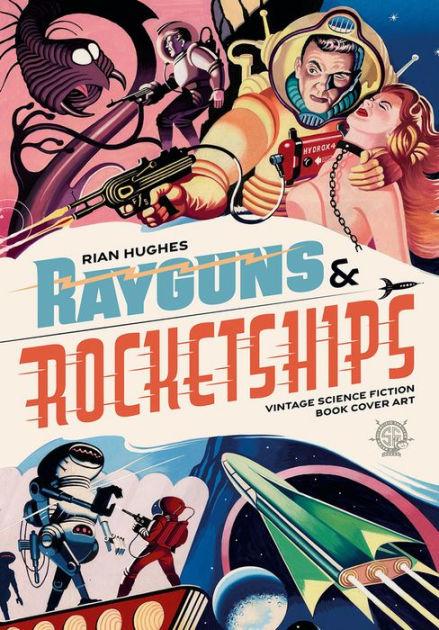
 For many readers today, Science Fiction is of the now – or possibly the future! – using science fictional tropes to examine current themes and issues. It is a fine ideal, and often what makes the genre attractive for many readers.
I think that one consequence of this though is that the past history of the genre is ignored or forgotten. Personally, as much as I enjoy new SF, I also like to see how we have got to where we are – I find fascinating the foundations of SF, with all of its opportunities and challenges it presents to a modern audience. As much as we are about progression forwards, I appreciate from where we have come.
With this in mind, this art book is a fascinating glimpse into this past. Author and graphic designer Rian Hughes (XXX, The Black Locomotive) has compiled a book to show us where SF once was and how it has inspired the writers and artists of today.
There was a time when SF was a much simpler and less complicated genre. The Dawn of the Space Age in the UK in the 1950’s, like that of the US, led to a proliferation of pulp SF, often quickly written and published, designed to be bought by an eager readership but then quickly discarded and forgotten when the next story arrived next month.
The publisher’s motto was clearly quantity over quality, with (rather ironically) stories rarely out-of-the-ordinary. There were heroes, heroines, villains, and yes, rayguns and rocketships, where plots were what was expected and readers keen for more.
The magazines were often a contradiction in style and tone, contrasting the stiff upper lip stoicism of their characters in prose with colour covers and an enthusiasm for (*cough*) out-of-this-world derring-do. Titles such as Robot Mutation, Mushroom Men from Mars, and Dawn of the Mutants were food for the imagination and reflected society’s hopes and fears in this new Space Age, and the magazine’s colour covers were an enticement to buy, to access the entertainment within. Together they created that sense of wonder escapism that made the dreary and mundane real world more bearable.
The importance of these covers to British science fiction cannot be underestimated. You have to remember that most of these covers were produced initially in a time of austerity, when food rationing still existed in Britain, paper had only just become more available and disposable income was still scarce for many. At the same time the end of the Second World War had created a societal fascination with technology but also an optimism that such technology could create a brighter and better future, before the late 1960s and 70s showed an alternative, much more cynical one.
This is a book that revels in the imagery and enthusiasm of those simpler times. There are thousands of covers resurrected here. Some are now understandably instantly identifiable, but there are many here that I suspect have not been seen for decades. There are covers for books by authors that you may recognise – Arthur C Clarke covers for Pan Books, for example, as well as British covers for Alfred Bester, John Wyndham, van Vogt, Kornbluth and Frederik Pohl, Jack Williamson, and many more – and they make a wonderfully nostalgic means of journeying through SF history.
But for me it is the less well-known British magazines and novels from authors forgotten today that intrigue more. For many books and magazines, the authors were less well known than the plots they wrote. Recognized less for their artistic merit than for their ability to produce a potboiler in a matter of days, these authors were not writers such as Asimov, Heinlein and Bester but instead, we had R. L. Fanthorpe, Pel Torro and Vargo Statten, names pretty much forgotten today.
Like in the US, often the authors wrote under pseudonyms (R. L. Fanthorpe and Pel Torro were actually both nom de plumes for the same author, really named Lionel Fanthorpe, for example) in order to hide the fact that three or four publications that month may actually be all written by the same writer. The stories were usually written enthusiastically to ridiculously tight deadlines for mere pennies, often over a weekend. Sometimes the story was written to demand and based on an already produced artwork, rather than the other way around.
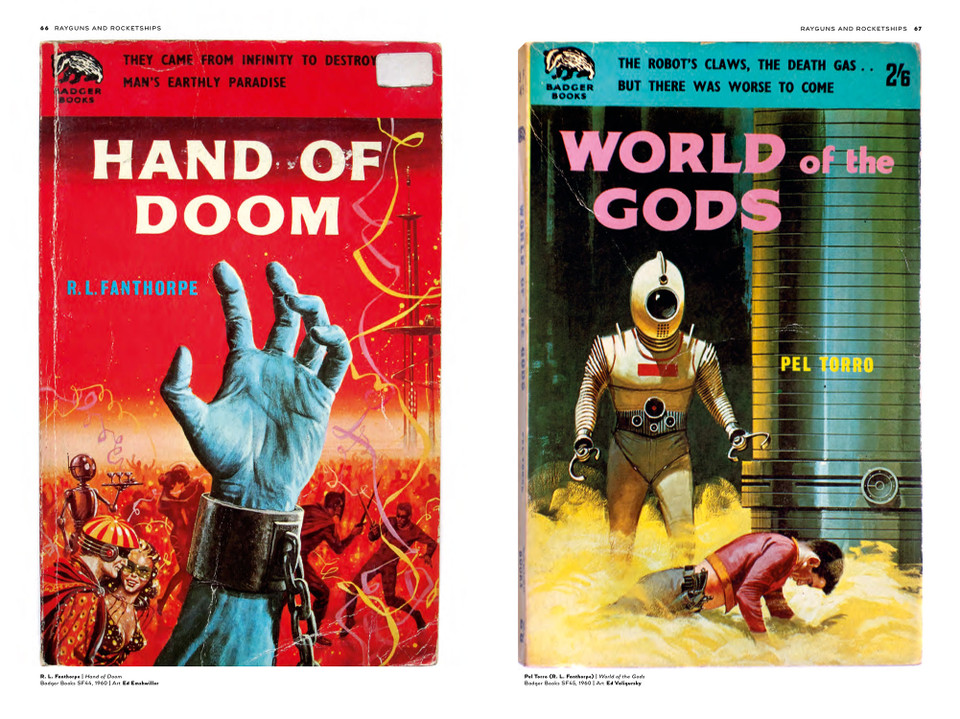
As mysterious as these writers are today, so too the publishers. If you know a little about older SF publishers you may well remember publishers such as Pan Books, Corgi Books, Ace Books and Four Square books, all of which are represented here. But how about Badger Books, Scion and Digit, and magazines such as Worlds of Fantasy, Tales of Tomorrow, and the Vargo Statten Science Fiction Magazine? If my just mentioning such names grabs your interest, or even intrigue you a little, then this book is a treat. Of course, such an overheated market (never mind the artists and writers!) could barely maintain such a pace and so it was that by the late 1960’s most of these publishers had died a sudden, though not entirely unexpected, death. Their job was done, their time was past.

OK – onto this actual book. Science Fiction book aficionado Steve Holland introduces the book explaining how he began reading SF based on the covers he saw in the 1970’s and was introduced to books mainly through the art of artists such as Ron Turner, Norman Light and John Richards. Rian also writes an Introduction, which goes into more detail about the artists and publishers shown in this book. Both narratives are similar and yet together show us how, even though they came from different perspectives, their love of SF was often encouraged by what we see in this book (even if the prose often didn’t match the cover!) Their individual perspectives are very British, and I suspect are very similar to many readers interested in this book.
There are no chapter titles here. Instead, covers are usually grouped together by publisher and then by author or artist, each section divided by a photo of well-worn book spines.
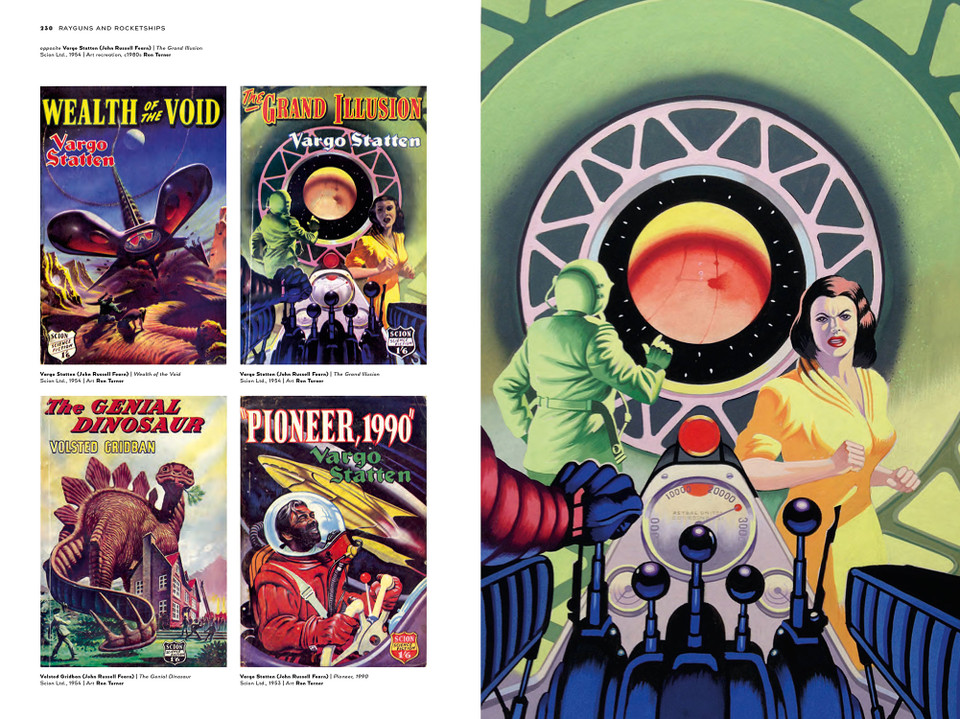
Most of all, the book is about the artwork, in colour with glassy heavy stock and often better imaged than they were originally! There were many covers I was pleased to see again, but most of all there were many covers that I had never seen before and made me want to read the book! Some artist’s names you may recognise – Ed Emshwiller, Chesley Bonestell. Richard Powers and Josh Kirby, amongst others, but I found it most pleasing to see so many of these book covers – over 2000 images – and the work of usually forgotten artists such as the already-mentioned Ron Turner, Henry Fox, Gordon C. Davies, George Woodman and S. R. Boldero, and others. Sadly, there are far too many that are simply labelled as by an unknown artist, but the work still impresses and are deserving of a look.

The main downside of all of this is the size of the book. Some of the pages may have sixteen cover images on them, and unfortunately, the consequence of this is that some of these glorious images are little more than the size of a large postage stamp. The small font type size (size 9 – 10?) also makes the introductions difficult to read.

The need to keep the production costs to a reasonable sellable price is understandable for this small press, but at times I felt that this sadly diminishes what the book is trying to achieve, namely to show off this artwork. This is a book that cries out for a larger format, a “coffee-table-book” sized printing to show these covers off better. When we get covers that take up a full page, slightly bigger even than their original format, they are tremendous.

As you can see from the few illustrations in this review, Rayguns and Rocketships is a lavishly illustrated book that shows us, or reminds us, of those days, bringing back to life those gloriously lurid colour covers, designed to persuade the reader to part with their pocket money. Rian and all those at Korero Press deserve credit for bringing these iconic images back into the light, to show us, or perhaps remind us, that SF has a wonderful past and heritage that should be celebrated almost as much as the present.
At a time when book covers seem to have become near-redundant, looking back to a time when it was often the image that sold the book or magazine is a fascinating experience. Rayguns and Rocketships is a book made with love and respect, bringing to our attention work that should be revered, from a time when science mattered less than the story, and the limitations of the prose were obscured by the gloriousness of the imagery. It is a book to wallow in, to savour, to remember and appreciate.
If only it were a little larger in format… but as a glorious celebration of SF’s past, thoroughly recommended.
Rayguns and Rocketships was first available as a Kickstarter project in 2021. It is now being published to the general public from 24th November 2022.
Rayguns and Rocketships by Rian Hughes
Forward by Steve Holland; Introduction by Rian Hughes;
Published by Korero Press, November 2022
464 pages
ISBN: 978 191 274 0048