 “When the bell rings, Elena mia, I shall free your soul from its earthly shell, on which the hold is already so frail, and let it fly upward into the crystal bell,” murmured Filippo, more tenderly than his wife had ever heard him speak to her before.”
– From “The Remorse of Professor Panebianco” by Greye La Spina
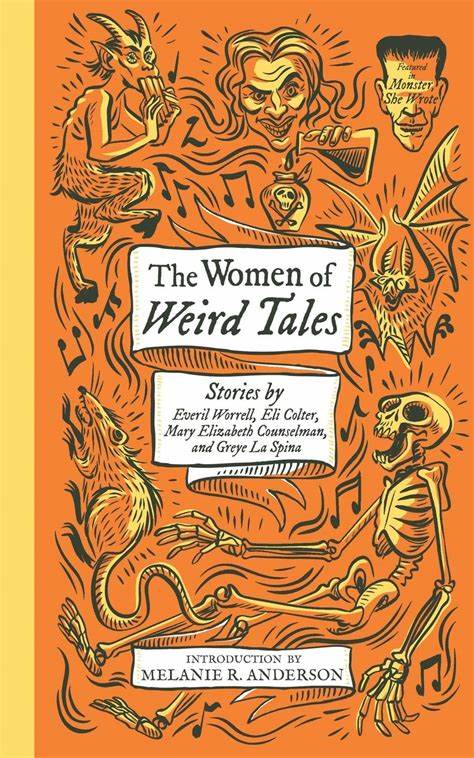
Arguably, the most well-known woman who wrote for the original Weird Tales (1923-1954) was C. L. Moore, who went on to a lengthy and prolific career in the SF. pulp magazines of the 1940s and ‘50s, as well as producing mystery novels and writing for television. But Moore was not the only woman writer to appear in “The Unique Magazine” and this anthology, comprised of thirteen stories by Greye La Spina (5 stories), Everil Worrell (5), Mary Elizabeth Counselman (2) and Eli Colter (1), may not establish the depth of the contributions from women writers, but does suggest the variety of their work in WT. From vampires to mad scientists to ghosts to cursed songs to weird places to things less easily defined and even a touch of humor, The Women of Weird Tales also offers a glimpse of the sorts of stories populating the magazine’s pages from not long after inception (earliest story from 1927) to near its demise (latest story, 1949).
Starting off the anthology is arguably its most feminist statement, “The Remorse of Professor Panebianco” by Greye La Spina in which the Professor’s wife volunteers to test a device which will remove the soul from her body. The gist of the story is less about how the device will work than about how the Professor reacts to the responsibility of his wife’s life. Perhaps overwritten by current standards and reading a little like a variation on Nathaniel Hawthorne’s “Rappaccini’s Daughter,” the story is one of the most intriguing in the book. La Spina also contributes the atmospheric “The Dead-Wagon,” “The Deadly Theory,” “The Antimacassar” and the oddly romantic “Great Pan is Here”.
Everil Worrell contributes “Leonora,” “The Canal,” “Vulture Crag,” “The Rays of the Moon” and “The Gray Killer.” Worrell’s stories more closely resemble what we might think of as typical of Weird Tales fare, building atmosphere maybe at the expense of sense. Still, “The Canal” is one of the more effectively dark stories here and “Leonora” retains its creepiness despite its age. While I was not fond of pseudo-science of “The Rays of the Moon,” the pseudo-science of “The Gray Killer” I found effective; one of the longer stories in the book, it did not outlast its welcome. Marion, suffering from blood-poisoning, is in hospital, afraid of a gray figure stalking the halls but also afraid because she’s on drugs that she will be determined insane since no one else has seen the figure. Worrell presents the story in the form of extracts from documents, mostly from Marion’s diary, which lends the story a kind of verisimilitude.
Eli Colter’s only story, “The Curse of a Song” is a curious story of a ghost that appears to a certain woman whenever she hears a certain song. It’s a neat little conceit and Colter does it justice within the story conventions of the time.
Even more curious is Mary Elizabeth Counselman’s “The Web of Silence”; though saying too much might spoil the story, it is on the lighter side of weird. Meanwhile her “The Black Stone Statue” is the closest to a Lovecraftian story here. Given decades of emphasis on H. P. Lovecraft’s and Robert E. Howard’s appearances in Weird Tales the editors may have purposely avoided both Lovecraftian works and tales of swords and sorcery. Still, Counselman’s is an effective example of a story perhaps lightly influenced by Lovecraft but not blatantly imitative.
To be clear, this is not a collection of neglected masterpieces. But it is a readable collection of the kinds of stories that populated an early 20th century pulp magazine that has become somewhat legendary because it offered publication to writers who later became famous: Lovecraft, Howard, Ray Bradbury, Robert Bloch, and even a young Tennessee Williams. What these stories are not is the kind of obsessive recapitulations of themes and/or displays of literary style that has brought critical and fan attention to Lovecraft and Howard, and to a lesser degree Clark Ashton Smith and C. L. Moore. And that lack of attention is unwarranted. In spite of a melodramatic tinge to much of the prose, the stories remain engaging, not just reminders of what entertained our grandparents or great-grandparents but still entertaining in and of themselves when night sets in and one is in the mood for the comforts of yesterday’s weird.
Contents:
The Remorse of Professor Panebianco by Greye La Spina (January 1925)
Leonora by Everil Worrell (January 1927)
The Dead Wagon by Greye La Spina (September 1927)
The Canal by Everil Worrell (December 1927)
The Curse of a Song by Eli Colter (March 1928)
Vulture Crag by Everil Worrell (August 1928)
The Rays of the Moon by Everil Worrell (September 1928)
The Gray Killer by Everil Worrell (November 1929)
The Black Stone Statue by Mary Elizabeth Counselman (December 1937)
Web of Silence by Mary Elizabeth Counselman (November 1939)
The Deadly Theory by Greye La Spina (May 1942)
Great Pan is Here by Greye La Spina (November 1943)
The Antimacassar by Greye La Spina (May 1949)
THE WOMEN OF WEIRD TALES by Various Authors
Monster, She Wrote #2
Stories by Everil Worrell, Eli Colter, Mary Elizabeth Counselman and Greye La Spina
Introduction by Melanie Anderson
Published by Valencourt Books, November 2020
282 pages
ISBN: 978-1948405751
Review by Randy M Money