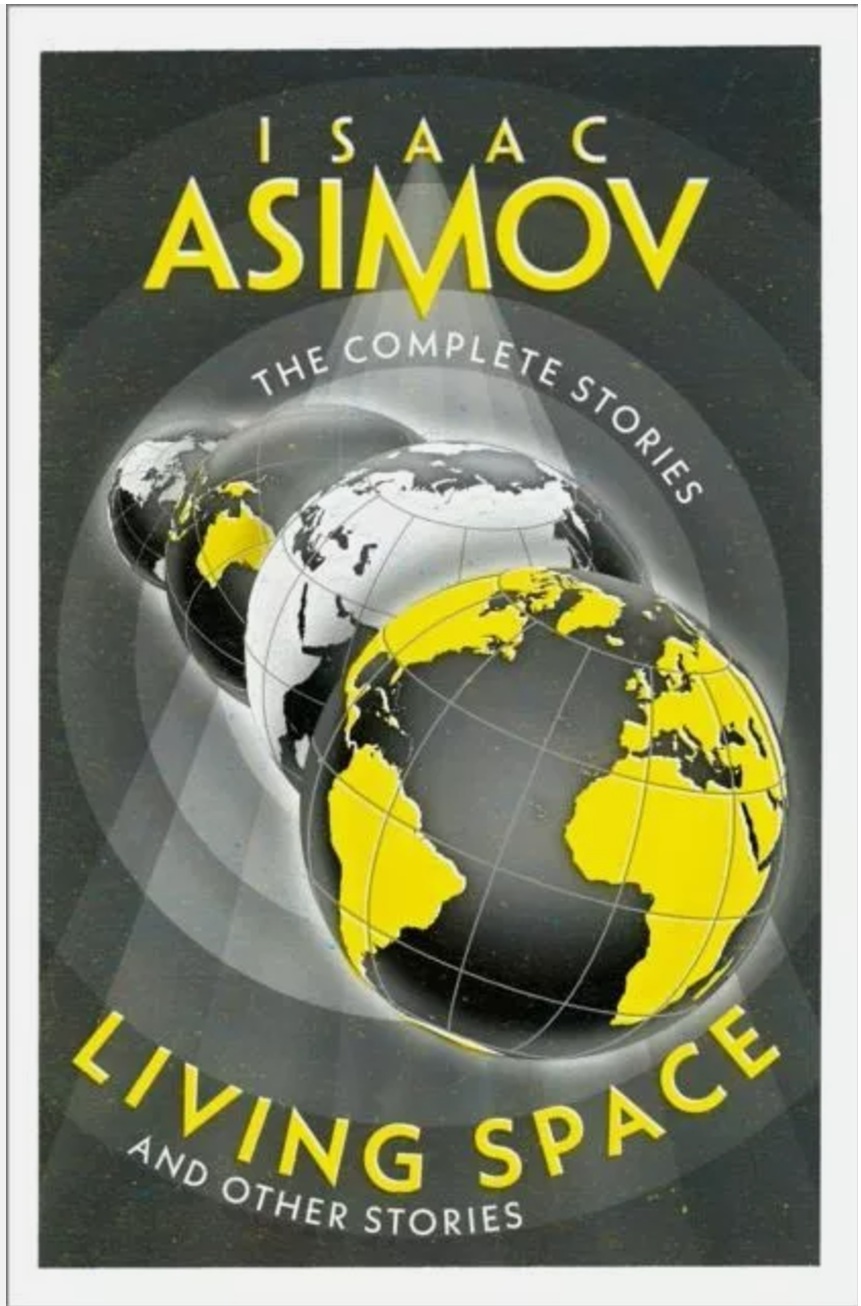
 From the publisher: “Twenty-five of the finest science fiction short stories from one of the genre’s greatest writers, Isaac Asimov.
Isaac Asimov was the Grand Master of the Science Fiction Writers of America, the founder of robot ethics, and one of the world’s most prolific authors of fiction and non-fiction. Asimov’s short fiction has been enjoyed by millions for more than half a century.
Many of the stories in this collection are classics of the genre, including ‘Living Space’, which looks at the consequences of the existence of parallel universes and what would happen if life on Earth never developed.
Always entertaining and thought provoking, these stories display Asimov’s mastery of the short story form. He remains supreme as the thinking person’s science fiction writer.“
The stories included are:
The Dead Past • (1956)
The Foundation of S. F. Success • (1954)
Franchise • (1955)
Gimmicks Three • (1956)
Kid Stuff • (1953)
The Watery Place • (1956)
Living Space • (1956)
The Message • (1956)
Satisfaction Guaranteed • (1951)
Hell-Fire • (1956)
The Last Trump • (1955)
The Fun They Had (1951)
Jokester • (1956)
The Immortal Bard • (1954)
Someday • (1956)
The Author’s Ordeal • (1957)
Dreaming Is a Private Thing • (1955)
Profession • (1957)
The Feeling of Power • (1958)
The Dying Night • [Wendell Urth] • (1956)
I’m in Marsport Without Hilda • (1957)
The Gentle Vultures • (1957)
All the Troubles of the World • (1958)
Spell My Name with an S • (1958)
The Last Question • (1956)
These are also in the story collections Earth is Room Enough and Nine Tomorrows.
Like many of my age, my introduction to SF was through the ‘Big Three’ authors – Arthur C Clarke, Robert Heinlein and Isaac Asimov. (Ray Bradbury appeared soon after.)
I first read Heinlein’s Tunnel in the Sky and then everything from these three authors I could find. With Asimov, it was the Robot stories, but also collections like The Martian Way, Earth is Room Enough and Nine Tomorrows, mostly with iconic Chris Foss covers. Foundation happened later.
Asimov’s stories were short, sharp intelligent and witty; often funny and surprisingly direct, with few embellishments – no literary language, no complex plotting. Just straightforward fun.
So, I am pleased at the re-release of these stories. (There are three other books due as well.) They are all from Asimov’s middle age of writing – for context, Foundation was first published in serial form in the 1940’s and first published as a novel and as a trilogy 1951-53, the first robot story was 1940 before becoming Robbie in 1950. This was when Asimov mainly wrote short stories before novels, anthologies and his science-fact articles for The Magazine of Fantasy & Science Fiction took over his time in the late 1950’s (He began in 1958, and continued until 1991.)
What this means is that at this time Asimov was best known for his short fiction, had continued to refine this craft and develop in style. In total he wrote a mere 383 short stories – impressive, but not when compared to the hundreds of novels, anthologies and collections he got published. Therefore any collection of his stories, in my opinion, is worth noticing.
This collection of 25 stories – well, 23, really, as there are two poems included (The Foundation of S. F. Success and The Author’s Ordeal) – show some range. The Dead Past is an effective story on the effects of watching things through time; Franchise is a MultiVac story about computerised elections that has a whole new meaning in 2024 (as did the title The Last Trump, but that’s another story); Gimmicks Three and Kid Stuff are tales that show that there’s a price for any deal to be made; The Watery Place and The Message are stories that revolve around a pun/ bad joke.
There’s something from what we would include as part of his writing for juvenile readers – The Fun They Had – there’s some longer novelettes (The Dead Past and The Dying Night), a novella (Profession), there’s a Robot story based on Susan Calvin (Satisfaction Guaranteed), there’s a mystery based on his character Wendell Urth (The Dying Night), there’s some of his ‘computer as big as a building’ ‘Multivac’ stories (Franchise, Jokester, All the Troubles of the World, and The Last Question, which was supposedly Asimov’s favourite story that he ever wrote. It may be my own favourite here too.)
It’s a nice selection. I was pleased to find that Asimov’s writing was still good – pleasingly direct, often amusing, even emotional. There’s no overly-florid language, no lengthy sojourns away from the main story, no huge information dumps to fill in background details.
At times the stories are shockingly short (Kid Stuff, The Watery Place, The Message, Hell Fire, for example) and are basically one idea that just seems to get going before they finish, but that is the nature of material published in the 1950’s when magazines ruled and space was at a premium. Whilst there are (understandably) dated technological innovations, talk of flying saucers, and a watery planet Venus seem to place these stories firmly in the past, although I did not personally find these out-of-date elements too jarring.
The only story I felt had really dated badly was “I’m in Marsport Without Hilda”, a story which actually felt a little Heinlein-esque in its jaunty tone, but its attempt at humour was soured by basically being about a secret agent determined to see his mistress. A bad Bond parody, perhaps.
Interestingly, enough time has passed for me not to remember the majority of these stories, and as a result they seem new to me; perhaps the best way to approach this collection. Looking at these stories with a more experienced eye, I did notice more some of the themes that seemed to run throughout the collection.
The idea of ‘Earthers’ and ‘Outsiders’, emphasised in Asimov’s later novels as well as in books like The Naked Sun and Caves of Steel is here.
The importance of computers in the future is really emphasised here. Many of the stories are about Multivac – a computer that stretches for miles and eventually is capable of running countries planets and galaxies – but we also have stories where education is by computer (The Fun They Had) where voting is organised by computer (Franchise), future careers are decided by computer (Profession) wars are fought by computer and even humanity’s future is ultimately in a computer’s control. When I first read these stories, pocket calculators were novel – now a mere forty-odd year’s one I found it interesting to see how some of Asimov’s ideas on future technology have actually held up.
I was also surprised at the religious theme that appeared often here. Stories of angels, devils and Heaven and Hell are peppered thoughout the collection – The Last Trump, Hell Fire and Gimmicks Three, for example – although generally these are not too serious and given with a certain degree of amusement.
Perhaps understandably, the fear of nuclear weapons, atomic power and the possibility of a future Armageddon as a result is on show here – very 1950’s, but perhaps back in vogue in 2024. Although I always considered Asimov to be an advocate of technological development and science, here he does give out a warning. Clearly, it is all about how this information is used that is important, and Asimov is clearly pointing out the opportunities and the pitfalls of this here.
Lastly, the idea of ‘flying saucers’ is mentioned more than once, which do put the stories in their place!
As an aside, I must admit that I missed the author writing introductions and postscripts to his stories, which he did in some of his later collections. This was something I liked when I first read some of Asimov’s stories, but were not part of these collections originally. (It was clearly something Isaac developed in his collections later.)
The only issue for me was the fact that this is not ‘The Complete Stories’, but merely a part.
Nevertheless, Living Space is an ideal way of sampling some of Asimov’s shorter fiction that isn’t Foundation or robot- related (although there is a Susan Calvin story here!) Understandably, for stories around 70 years old, they are a little dated, although they are still a wonderful read. I was surprised how much I enjoyed rereading them, how approachable the stories were, how much they mainly still hold up. If you want to get an idea of how Asimov wrote shorter fiction, of why he was so well-regarded, this collection gives you a hint. Very pleased to see these republished – in the main they deserve to be read.
LIVING SPACE by Isaac Asimov
Part of The Collected Stories series
First published as part of The Complete Stories Volume One (1990)
This edition: November 2024 by Harper Voyager
416 pages
ISBN: 978 000 8672 393
Review by Mark Yon