 Randy continues our countdown to Hallowe’en with a book whose publication history is almost as interesting as the story itself.
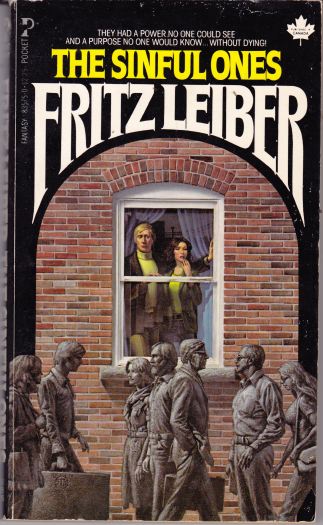
THE SINFUL ONES by Fritz Leiber (Pocket Books, 1980 [revision of novel originally published in 1950])
Mackey is just a cog in the daily-grind, performing his role without imagination or invention, recognizing his rut but not sure how he wants to escape it. Marcia, his girlfriend, pushes him to show some ambition and assertiveness, but he’s not won over by her ideas of success. When Mackey meets Jane he finds he can stand outside the flow of life, watch the parts move and see the machinery act as though he’s still in place, still mouthing his lines, as others respond to things he hasn’t said or done.
But Jane and Mackey aren’t the only people who can extract themselves from the script, and at least some of the others are dangerous, even murderous.
The history of The Sinful Ones is almost as interesting as the novel. In the 1980 edition Leiber added an afterward explaining how he wrote four chapters after the success of Gather Darkness in Astounding Science-Fiction and Conjure Wife in Unknown Worlds magazine (both published in 1943), hoping to place it in Unknown only to find the magazine was being ended due to a WWII paper shortage. After the war book publishing became a possibility and he finished the novel to take advantage of that opportunity. In 1950 the magazine, Fantastic Adventures agreed to publish a 40,000 word version, so he pared it down to novella length, titled “You’re All Alone.” Three years later a small publishing house published The Sinful Ones in combination with another novel. Once published, Leiber was surprised to find his novel, without anyone consulting him, had acquired sex scenes, the publishers tailoring his book to match the other, soft-porn, novel. And that was what he revised for the standards of 1980.
The Sinful Ones is a solid piece of work if you can read it remembering its context of post-World War II. I would recommend it, and especially to readers who enjoy Leiber’s dark fantasy and horror, and those who want to see the beginnings of urban fantasy which Leiber helped to define in works like Conjure Wife. But it is flawed, relying too much on the pulp plot hugger-mugger of chase scenes and presenting three main villains who feel appropriated from Dashiell Hammett’s The Maltese Falcon while lacking the vividness of Hammett’s characters. Further, with the increased sophistication of today’s readers, Mackey may seem purposely dense in his inability to grasp the situation in which he finds himself. Likewise Jane’s hesitation to explain the situation feels as much like plot necessity as concern for Mackey’s well-being.
However, Leiber’s writing retains its power to push you through the improbable, and several passages extend and deepen Leiber’s continuing fascination with the power and personality of cities and the influence they exert over people. In characterizing Chicago, Leiber writes of the business district, “Here the feeling of hostile desolation, that had accompanied him for some time, increased markedly. It wasn’t only that the liquor was dying in him. Back by the stores and theaters there had been at least the ghost of some sort of human excitement, however cheap and stale, the glamor of tawdry lures hung to enmesh human appetites. But these great looming office buildings, with their trappings of iron-work and facings of granite, actually wanted to be ugly. They gloried in their stony efficiency, their indifference to human desires, their gray ability to crush out happiness.”
At the river, “From behind the castellated black wall of warehouses, elevators, bridges, and cranes to the west, the setting sun sent a giant spray of dark red fire streaming through the immensity of the air above the Chicago River. It bloodily edged the giant shoulders of the skyscrapers crowded around the Michigan Avenue bridge like a herd of gray mammoths stopping by the river for the night. It glared from their many faceted window-eyes to the west, but left those to the east in gloom – the small, wickedly intelligent window-eyes expressing the hard, alien thoughts that cities have been thinking since Ur and Alexandria and Rome. It turned the white tiles of the Wrigley Tower a delicate salmon pink and the golden trim of the Carbon and Carbide Building a rosy copper.”
These passages echo passages in early stories like “Smoke Ghost” and foreshadows Our Lady of Darkness wherein cities (Chicago and San Francisco, respectively) seem to shelter or generate entities that are not human in a way similar to that of the Danube River in Algernon Blackwood’s “The Willows”. (More on that story later this month.)
And, along with his thoughts on cities, Leiber contemplates the human condition, as here: “Carr felt a great wave of nausea. Here, he saw in an unwilling flash of thought, was an allegory of the universe’s whole history – those screams crying out death and horror and pain, a murderer loose in the house of life, catlike cruelty at the cosmos’ core, destruction holding a match to the earth’s fuse – and the machine-men going about their patterned business with their minds black, their eyes blind, their ears unhearing.” In the afterword Leiber speculates slightly about what the story might have been if he’d written it all at the time of first inspiration, but this passage seems to me born of considering post-World War II revelations of atrocities. I wonder if the Leiber before war’s end would have thought of the lock-step of civilization leading to such calamity.
Several years ago I read the novella version, “You’re All Alone,” and would even more strongly recommend tracking that down. For me it compresses the flaws right out of the novel, becoming more vivid in the process, and it was reissued in 2011: You’re All Alone. Honestly, I know nothing about the publisher and was surprised to see the line-up of stories they are re-issuing. I see Barnes & Noble and Amazon both list this edition.
Other works of similar interest:
“The Unpleasant Profession of Jonathan Hoag” by Robert A. Heinlein
Our Lady of Darkness by Fritz Leiber (SFFWorld Review),
Neverwhere by Neil Gaiman
The Somnambulist by Jonathan Barnes
Midnight Riot by Ben Aaronovitch
Next: A STIR OF ECHOES by Richard Matheson